Recipes
Chinese Steamed Eggs with Scallions
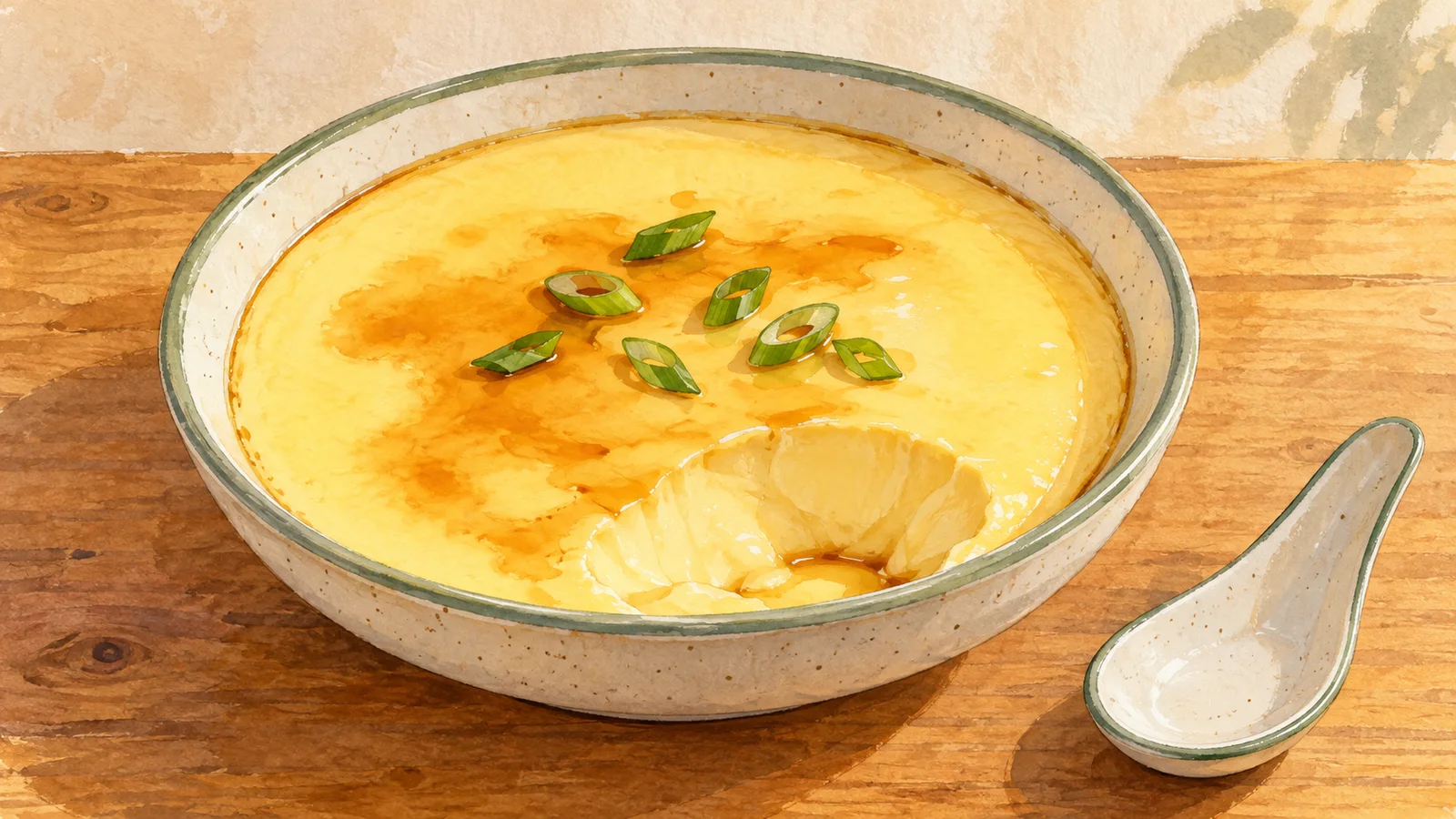
A shallow bowl of savory egg custard, gently steamed and finished with scallion greens and soy sauce.
Jump to recipe ↓Recipe
- Total time
- About 25 minutes
- Method
- Steam
- Difficulty
- Easy
- Allergens
- Egg · Soy · Wheat may be present in soy sauce · Sesame
About 2 side servings
Allow roughly 25 minutes. Bowl depth and the steamer affect cooking time; the 10-minute timer is a first check, not a guaranteed finish. Have any rice ready before starting.
Equipment: Lidded steamer or pot with a stable steaming rack, shallow heatproof ceramic bowl about 16–18 cm (6–7 inches) wide and at least 500 ml capacity, foil, measuring jug, whisk, fine sieve, oven mitts and a food thermometer.
Ingredients
- 2 large eggs, measured after beating
- Warm water at about 45°C (113°F), twice the volume of the beaten eggs (usually about 200 ml), plus water for the steamer
- 1 small pinch fine salt
- 1 scallion, washed; green part thinly sliced for serving
- 2 teaspoons Chinese light soy sauce, for serving
- A few drops toasted sesame oil, optional
Method
Measure the eggs, then the water
Beat the eggs in the measuring jug until evenly mixed and note their volume. Measure twice that volume of warm water: 100 ml beaten egg needs 200 ml water. Stir the water and salt into the eggs gently. Wash hands, utensils and surfaces after contact with raw egg; slice the clean scallion greens with clean equipment and set them aside.
Convert a measurement for this stepStrain into a shallow bowl
Pour the egg mixture through the sieve into the heatproof bowl and skim off surface foam. Keep the mixture shallow, no deeper than about 3 cm. Cover the bowl with foil, leaving space above the mixture, and make two small vent holes. The foil should not touch the eggs.
Convert a measurement for this stepSet the bowl above the water
Fill the steamer according to its instructions, with enough water for the cook but below the rack and bowl. Bring the water to a boil. Using oven mitts, place the covered bowl securely on the rack, close the steamer lid and reduce the heat to a gentle, steady simmer. Keep the steamer from boiling dry.
Convert a measurement for this stepSteam gently and check the center
Once gentle steam is established, start a 10-minute check timer. Stay nearby. At the check, open the lid away from your face and lift the foil carefully. The center should be set rather than liquid and reach 160°F (71°C) on a clean food thermometer, with the tip in the custard rather than against the bowl. If needed, replace the foil and lid and steam for another 2 minutes before checking again.
Convert a measurement for this stepFinish with scallion and soy
Turn off the burner. Lift out the hot bowl with oven mitts, opening the cover away from your face. Add the soy sauce, scallion greens and optional sesame oil. Serve promptly with a spoon; the bowl and custard will be hot.
Convert a measurement for this step
Two eggs, measured once
A measuring jug earns its place here. Egg sizes vary, so measure the beaten eggs and add twice that volume of water. You are making a spoonable savory custard, not scrambled eggs stretched with a random splash.
Adapted from Wei Guo's Chinese steamed eggs.
Choose a wide, shallow bowl rather than a deep mug so the heat can reach the center more evenly. Swapping vessels and keeping the same timer can leave you with a firm edge and a liquid middle. Use a bowl rated for steaming and check that it sits securely before filling it with egg.
Keep the water underneath
The rack must hold the bowl above the steaming water. Leave room around it for steam to circulate and follow your steamer’s filling instructions. Judy Leung’s steamer explanation shows how a lidded pot and rack can do the job without a separate appliance. Her recipe uses a different heat-and-rest sequence; follow the sequence in the card above for this bowl.
Straining catches strands of unmixed egg; skimming removes foam. The foil keeps lid condensation from falling directly onto the surface. These steps help the texture, but a smooth top cannot tell you whether the center is cooked.
A gentle wobble is not a temperature reading
Keep the simmer steady instead of turning up the heat to race the clock. At the first check, move the lid away from your face, then open the foil. If the center is still liquid or below 160°F (71°C), cover it again and continue steaming in short intervals. Put the thermometer tip into the center of the custard without touching the hot bowl.
The 160°F endpoint is the FDA’s guidance for dishes containing eggs. The custard can still be delicate at serving; it does not have to brown or develop a crust.
Serve with a spoon
Soy sauce can run into the small openings left by the spoon, so there is no need to stir the finished custard. Add scallion greens at the end. If you want rice alongside, use the jasmine rice method and have it ready before the steamer goes on.
This dish contains egg and soy, usually wheat in the soy sauce, and sesame if you add the oil. Refrigerate leftovers within two hours, or one hour above 90°F (32°C), in a shallow container at 40°F (4°C) or below. Use within 3–4 days and reheat to 165°F (74°C), as the FDA advises for cooked egg dishes.