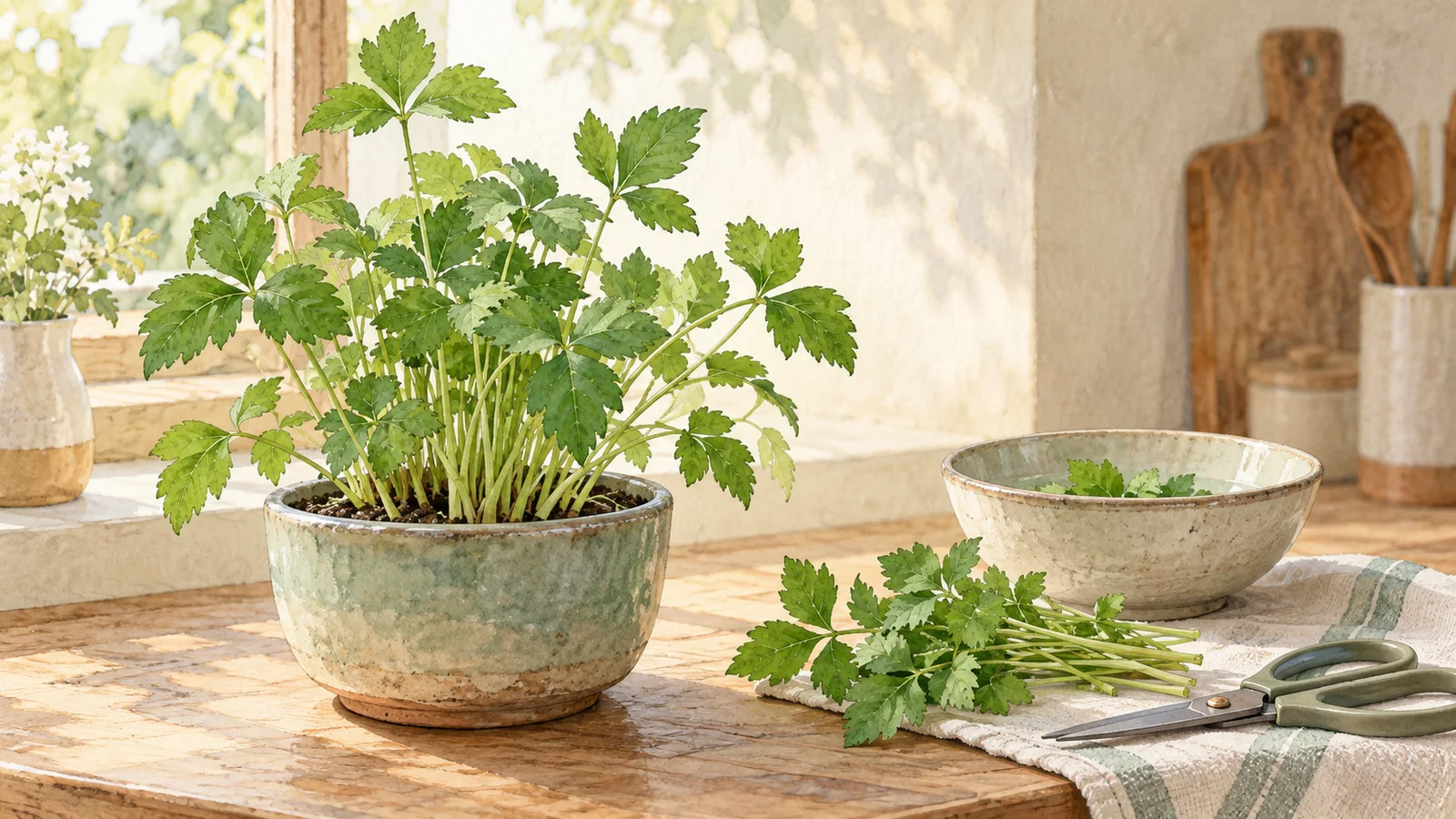
A bowl can be technically finished and still be waiting for one thing. The broth is hot, the rice is ready, and then a few green stems change the aroma before the first spoonful. Mitsuba belongs to that final moment. It is not a bulk crop and does not need to become one. A useful pot only has to keep producing clean, tender stems in amounts the kitchen can actually use.
That modest goal suits Cryptotaenia japonica. The plant forms a leafy rosette at the base, sends each leaf upward on a slender stalk, and divides the top into three toothed leaflets. Its Japanese name refers to that three-leaf form. The resemblance to parsley explains one common name, Japanese parsley, but mitsuba is not ordinary flat-leaf parsley and should not be purchased under a vague label.
The North Carolina Extension Gardener Plant Toolbox describes mitsuba as a short-lived perennial that is often grown as an annual. It can produce additional rosettes from the same root base, yet the original rosette changes after flowering. Thinking in rosettes rather than in a permanent bunch makes its growth easier to read.
Let the label settle the identity
Begin with a sealed seed packet or nursery plant labeled Cryptotaenia japonica. Common names such as Japanese parsley, Japanese wild parsley, Japanese honewort, and mountain celery are shared loosely in catalogs. “Asian parsley” is not an identification.
The botanical name matters for two reasons. First, it keeps mitsuba separate from minari, Oenanthe javanica, another edible Asian plant that may be called Japanese parsley or water parsley. Second, it prevents a cultivated herb project from drifting into wild foraging among parsley-family plants, a group that includes dangerous species. Grow a known crop from known material and leave unidentified roadside or wetland plants alone.
North Carolina Extension also notes possible contact dermatitis and cautions people with sensitivities to celery, parsley, parsnip, and related plants. Gloves are reasonable when handling causes irritation. A known food allergy or a reaction after contact belongs with a medical professional, not a gardening experiment.
Give the pot a cooler assignment
Many kitchen herbs demand the brightest, hottest place available. Mitsuba offers a different arrangement. North Carolina Extension lists dappled light, deep shade, and partial shade among its suitable conditions and notes that strong sun can yellow the leaves and increase bitterness. The Cornell Cooperative Extension variety record likewise describes mitsuba as a cool spring and fall crop that accepts shade.
Shade does not mean a dark room. Outdoors, try bright open shade, gentle morning sun, or light filtered through taller plants. Indoors, a cool bright window may support a small crop, but room light several feet from glass is not equivalent to outdoor shade. Watch the new growth:
- Compact green leaves on firm stalks suggest that the location is usable.
- Long, weak stalks leaning toward one direction suggest inadequate light.
- Yellowed or scorched foliage after a move suggests too much abrupt sun or heat.
- Growth that stalls in a hot window may improve in a cooler, less exposed position.
Change the location gradually. A plant raised under cover can burn even in a site that will eventually suit it.
Build around the crown
Choose a food-safe container with drainage holes and enough width for the rosette to expand. A small starter does not need an oversized reservoir of wet mix. Fresh container mix gives its roots both moisture and air, while dense yard soil can compact inside a pot.
For seed, follow the packet’s depth and temperature directions rather than copying a universal recipe. Keep the upper mix evenly moist during germination, then thin crowded seedlings before their roots become tightly interwoven. The aim is a few identifiable crowns with light and air between them, not a dense mat that looks full for one week and collapses later.
Set a transplant at its previous depth. The point where leaves emerge should remain above the mix. Water across the surface until excess drains, then empty any saucer. Mitsuba prefers moisture, but a permanently submerged root ball is not the same as moist woodland soil.
The pot can be judged by touch and weight. When the upper layer is beginning to lose moisture, water the full root zone again. Hot moving air, a small clay pot, and a mature canopy shorten the interval. Cool weather, a glazed pot, and young roots lengthen it. A weekday reminder should prompt an inspection, not an automatic pour.
Harvest from the outside toward tomorrow
The center of the rosette is the plant’s next meal. Protect it.
Select sound outer leaves whose stalks have reached a useful length. Cut each stalk near the soil line with clean scissors without slicing into the crown. The University of California Marin Master Gardeners recommends low cuts on mitsuba or parsley-type leaf stalks to encourage secondary growth. Spread the harvest among several crowns if possible and leave the newest central leaves intact.
Adjust the harvest to the size and vigor of the clump. A large, actively growing clump can replace more foliage than a recently transplanted seedling. Let the next leaves show whether the previous harvest was sustainable. If replacement growth becomes smaller or slower, harvest less and recheck light, temperature, moisture, and root space before reaching for fertilizer.
Flowering changes the crop’s assignment. Mitsuba can send a flower stalk far above its low foliage. North Carolina Extension explains that a mother rosette may die after flowering and seed maturation while newer segments continue. A gardener can remove the flower stalk to keep attention on leaves for a while, allow seed where local conditions make that appropriate, or start a fresh sowing. None of those choices turns one original rosette into an immortal herb.
Move a small harvest cleanly into dinner
Mitsuba is most useful when treated as a fresh finishing herb rather than a pot of anonymous greens. Cut only what the meal needs. Keep harvested stalks off potting mix, pet-accessible surfaces, and tools that have handled non-food plants or unlabeled garden chemicals.
The U.S. Food and Drug Administration advises washing hands before produce preparation, trimming damaged portions, and rinsing produce under plain running water without soap or commercial produce wash. Dry the delicate stems gently and use or refrigerate them promptly.
A few tender leaves can finish soup, rice, eggs, tofu, or a salad without asking the plant for an entire grocery-store bunch. Add them late when the point is their fresh aroma and texture. If a recipe requires prolonged cooking or a large volume of greens, another crop may be a better match for that job.
Read the pot before correcting it
Tall, pale growth: Move the pot toward stronger usable light in small steps, while avoiding a sudden jump into hot afternoon sun.
Crisp edges in a hot window: Check heat against the glass, severe dry-down, and sun exposure before increasing fertilizer.
Yellowing with wet mix: Confirm that drainage is open and that the root ball is not sitting in runoff. Do not add water because the leaves look weak.
Chewed leaves: Inspect after dark for slugs or snails outdoors. North Carolina Extension identifies both as visitors to mitsuba. Choose any control only after identifying the pest and confirming that the product label permits use on an edible crop.
A tall central stalk: Examine it for flower buds. This may be a normal life-cycle change rather than a nutrient problem.
The best mitsuba pot is not the biggest one. It is the pot whose identity is certain, whose light keeps the foliage tender, and whose center remains intact after dinner. For a sun-loving Asian leaf herb, compare the site’s shiso container guide. For a broader indoor setup, the indoor herb garden guide explains how to match several species to the light they actually receive.
Sources
- Mitsu-ba - Cryptotaenia japonica (North Carolina Extension Gardener Plant Toolbox). Accessed September 11, 2026.
- Parsley Japanese or Mitsuba (Cornell Cooperative Extension Vegetable Varieties for Gardeners). Accessed September 11, 2026.
- Backyard to Belly (University of California Marin Master Gardeners). Accessed September 11, 2026.
- 7 Tips for Cleaning Fruits and Vegetables (U.S. Food and Drug Administration). Accessed September 11, 2026.