Plate 01
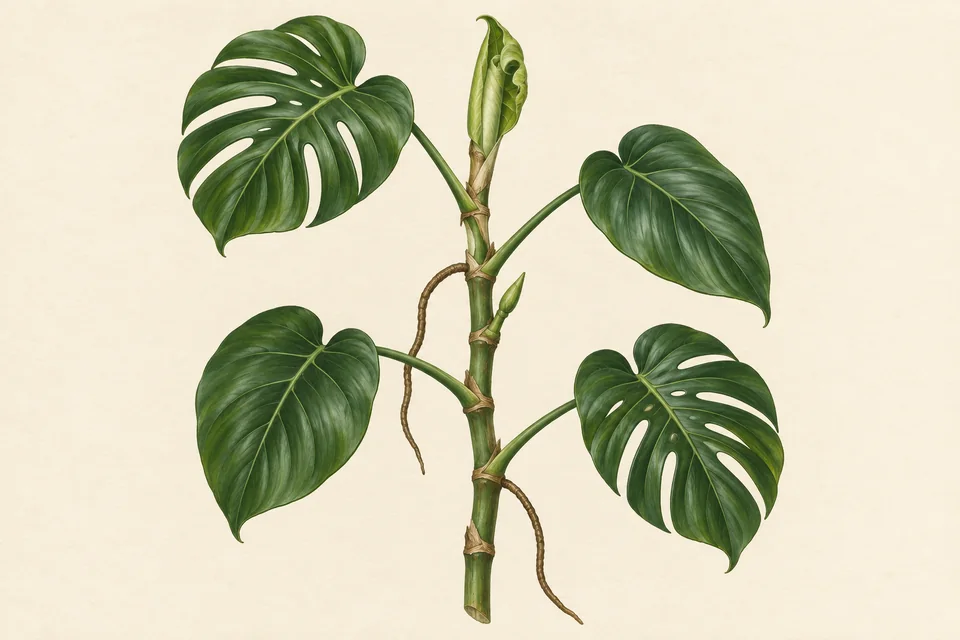
A leafy climbing stem
Use this plate when a guide asks you to find a node, separate a leaf from its petiole, or locate the tissue that can produce another shoot.
Illustrated field reference · 19 terms
Choose a plate, select a label, and learn what the term means on a real plant. The illustrations are teaching landmarks, not species-identification charts.
Choose a specimen
Use this plate when a guide asks you to find a node, separate a leaf from its petiole, or locate the tissue that can produce another shoot.
Use this cutaway to distinguish the crown from the root ball and to see where offsets, lateral roots, root tips, and root hairs belong.

Use this plate before planting, mulching, or pruning a woody plant. The important landmarks sit at branch unions and where the trunk widens into roots.

Plain-language index
Showing all 19 terms.
Leaf + stem
The broad, usually flat portion of a leaf.
Leaf + stem
The prominent central vein running through many leaf blades.
Leaf + stem
The stalk that connects a leaf blade to a stem.
Leaf + stem
The upper angle where a leaf or its petiole meets the stem.
Leaf + stem
A point on a stem where a leaf, bud, branch, or aerial root may attach.
Leaf + stem
The section of stem between one node and the next.
Leaf + stem
A small growth point in or near a leaf axil that may develop into a side shoot.
Leaf + stem
The region of actively dividing tissue that produces new stem and leaf growth.
Leaf + stem
A root that begins on an aboveground stem rather than inside the potting mix.
Crown + roots
The compact region where stems or leaves arise and the root system begins.
Crown + roots
The portion of a leaf nearest its attachment to the stem or crown.
Crown + roots
A new plantlet produced beside or from the parent plant, often from a short stem, runner, or rhizome.
Crown + roots
The root system together with the mass of growing medium it currently holds.
Crown + roots
A root that branches from another root and extends the plant’s root system.
Crown + roots
The actively growing end of a root, protected at its leading edge by a root cap.
Crown + roots
Microscopic extensions of young root surface cells that greatly increase contact with water and dissolved nutrients.
Woody base
The widening transition where a tree trunk meets its upper structural roots.
Woody base
The often swollen tissue around the base of a smaller branch where it joins a larger stem or trunk.
Woody base
A raised strip of bark formed at the upper side of many branch unions.
How to use the plates
Plant forms vary. A node on a pothos, crown on an African violet, and root flare on a young tree will not look identical to these simplified specimens.
Look before cutting. Confirm the plant, propagation method, and required tissue in the linked guide. A leaf, petiole, root, or stem segment is not viable for every species.
Describe location precisely. Naming the affected structure makes photographs, notes, searches, and conversations with a horticultural professional more useful.
Reference desk
Written and maintained by Nicklaus. Substantively updated .