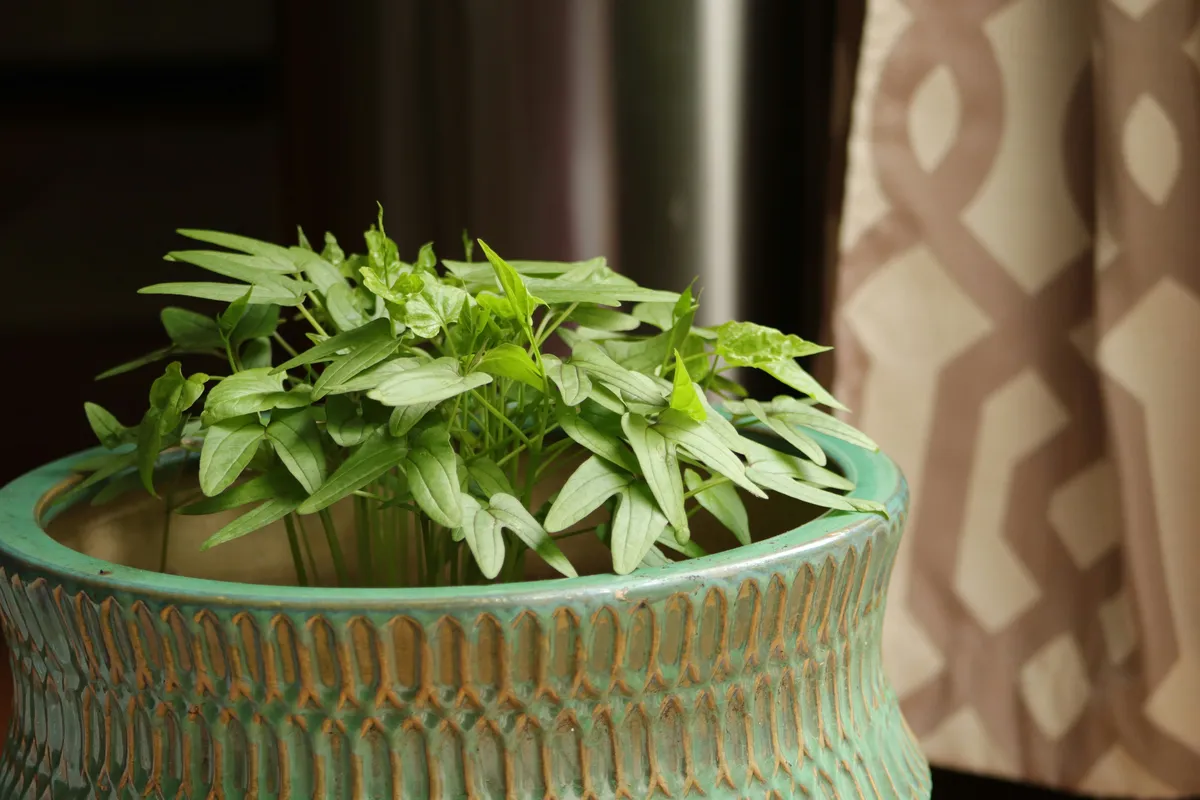
Cilantro (Coriandrum sativum) is a cool-season annual, not a permanent indoor foliage plant. It grows leaves, elongates a flowering stem, forms seed, and completes its life cycle. An indoor setup can support useful leaf harvests, but it cannot keep one plant vegetative indefinitely.
Oregon State University Extension explains that both temperature and day length influence flowering and seed production, with warmth accelerating the life cycle. Keep the plant well lit and sow replacement pots for continued leaf harvests. Temperature management alone cannot keep cilantro from eventually flowering.
Choose the harvest before sowing
The same plant supplies two different crops. “Cilantro” usually means the fresh leaves and tender stems. “Coriander” means the mature, dried seed. A leaf crop is harvested while the plant is compact and vegetative; a seed crop must flower and remain in place until seeds develop and dry.
This choice affects variety, spacing, and timing. Utah State University Extension recommends a slow-bolting cultivar when leaves are the goal and notes that standard cultivars can be grown for seed. “Slow bolting” is relative. It does not mean bolt-proof, and a cultivar description cannot override a hot root zone, inadequate light, or the plant’s annual life cycle.
For steady leaves, plan several small sowings. For coriander, dedicate at least one pot to flowering and seed maturation rather than repeatedly cutting it for foliage. Indoor seed set is not guaranteed: light, plant vigor, flowering conditions, and pollination can all affect the result.
Use a final container with drainage
Cilantro develops a taproot and generally responds poorly to unnecessary transplanting. University of Illinois Extension describes it as an annual with a short useful leaf-crop life and recommends direct sowing because of that taproot. Starting in the final container avoids moving a fragile seedling from a cell or crowded nursery pot.
NC State Extension’s container guidance specifies a container at least eight inches deep for cilantro, drainage holes, and container planting medium rather than garden soil. Indoors, place a detachable saucer under the pot, but empty drainage water instead of letting the root zone stand in it.
A practical leaf-crop pot should have:
- at least eight inches of usable depth;
- one or more unobstructed drainage holes;
- fresh, well-drained container or seed-starting mix; and
- enough surface area to space seedlings according to the seed packet.
Avoid an oversized pot that stays wet for long periods, a decorative vessel with no drainage route, and dense garden soil. If a cachepot hides the nursery pot, remove the inner pot for watering and empty the outer vessel afterward.
Give foliage strong usable light
Low indoor light does not prevent bolting in a useful way. It more often produces stretched stems, small pale leaves, and weak growth. A cool room cannot compensate for an unlit corner.
Iowa State University Extension and Outreach identifies light as the common limiting factor for indoor herbs. Its general indoor-herb guidance calls for about eight hours of direct natural light or 12 to 16 hours under supplemental lights. Those figures are lighting guidance, not a universal cilantro bolting threshold.
Use the brightest suitable window available, or place a full-spectrum lamp at the distance specified by its manufacturer and operate it with a timer. Check the plant rather than relying only on the label “sunny window.” Winter glass, nearby buildings, screens, and distance from the window can substantially reduce usable light. Rotate a windowsill pot if growth leans strongly in one direction.
Separate light from heat. A leaf touching hot glass or a pot above a radiator may experience heat stress even when room air feels comfortable. LEDs also vary in intensity and heat output. Raise or dim a lamp if leaves bleach or develop dry patches, and lower it within the manufacturer’s safe range if seedlings stretch. Keep cords, plugs, and timers dry and follow the fixture’s electrical and clearance instructions.
Direct-sow in small batches
Read the seed packet first because cultivar instructions and tested germination rates vary. A defensible indoor sequence is:
- Fill the final container with lightly moistened mix, leaving room below the rim for watering.
- Sow seed about one-quarter to one-half inch deep, the range used in Extension cilantro guidance, or use the packet’s specific depth.
- Space seed across the surface rather than placing the entire packet in one clump. Label the cultivar and sowing date.
- Water gently so seed remains covered. Allow the container to drain.
- Keep the medium consistently moist during germination but not saturated. Do not seal a waterlogged pot under a humidity cover.
- After emergence, provide strong light immediately. Thin crowded seedlings according to the packet; clean thinnings can be harvested rather than leaving roots to compete.
Soaking or crushing seed is not required for every cultivar. Use a packet instruction if one is provided rather than assuming an overnight soak always improves germination. Emergence time also varies with seed age, temperature, depth, and moisture, so a seven-day or ten-day promise is not reliable.
Water for even growth, not constant wetness
Check the medium with a finger rather than watering on fixed weekdays. Young seedlings need steady access to moisture, but cilantro also requires drainage and does poorly in persistently wet medium. Water the mix thoroughly when its surface begins to dry, let excess leave the pot, and empty the saucer.
A small pot in strong light may dry quickly. A large glazed container in a cool room may stay wet much longer. Wilting alone does not distinguish drought from injured roots, so feel the medium before adding water. If it is wet and the plant droops, inspect drainage, temperature, crown firmness, and root health instead of automatically watering again.
Use fertilizer conservatively. Follow the potting-mix and fertilizer labels, account for any fertilizer already included in the mix, and do not add extra nitrogen as a supposed cure for bolting. Utah State warns that overfertilization can reduce flavor. Pale growth may reflect low light, wet roots, crowding, or nutrient shortage, and the cause should be checked before feeding.
Make succession the main strategy
Succession sowing accepts cilantro’s short life instead of treating flowering as a care failure. Sow a new small pot before the current one bolts. University of Maryland Extension recommends intervals of roughly two to three weeks for an extended supply. Actual overlap will differ with cultivar and conditions, so adjust after observing how quickly one indoor batch emerges and reaches harvest size.
A simple rotation uses three stages:
- a newly sown pot kept evenly moist;
- a vegetative pot supplying leaves; and
- an older pot approaching flowering, either replaced or reserved for coriander.
Labeling prevents an older batch from being mistaken for a slow new one. It also makes temperature, light, and variety comparisons more useful. Sow only what the available light can support; many crowded pots under one weak lamp will not create a better harvest.
Harvest leaves as the plant matures
Begin a modest harvest when plants have enough foliage to keep growing. Utah State gives about four to six inches as a leaf-harvest stage. Use clean scissors, take selected outer stems near their base, and leave the center and enough leaf area to continue photosynthesis. Wash leaves under clean running water before eating and refrigerate or use them promptly.
Frequent cutting does not “trick” cilantro out of its life cycle. It can supply tender leaves while a plant is vegetative, but severe harvesting weakens a small plant. Once the central stem lengthens and the foliage becomes finer and more divided, flowering is underway. Flavor and texture may change; personal preference should determine whether the remaining leaves are useful.
Removing an early flower stem may extend leaf harvest somewhat, as Maryland Extension notes, but it does not reset the plant. If leaf production is the goal, shift attention to the next succession pot. If seed is the goal, stop removing flower stems and allow the plant room to develop.
Let a separate plant mature for coriander
A coriander crop needs more time, height, and uninterrupted flowering than a leaf crop. Keep the chosen plant in strong light, water according to the medium, and support the stem if it becomes unstable. Do not assume every flower will set seed indoors.
Wait until seed heads and seeds mature from green toward tan or brown. Cut dry or nearly dry heads into a paper bag, keep them in a dry, ventilated place, and separate the seed after it finishes drying. Discard seed with mold, off odors, or moisture damage. Store fully dry culinary coriander in a labeled, sealed food container.
Planting seed and culinary seed are not always interchangeable. The National Pesticide Information Center explains that pesticide-treated seed is often visibly dyed and must never be eaten or used as feed. Check the seed label. Wear and use the protective measures it requires, keep treated seed away from food preparation, and do not turn leftover treated sowing seed into coriander spice.
Read common outcomes accurately
| Observation | What it can mean | Useful response |
|---|---|---|
| Seedlings are pale and stretched | Light is too weak or too distant | Increase usable light gradually and check lamp distance |
| Leaves wilt beside hot glass | Heat and rapid drying may be stressing the crop | Move the pot away from hot glass and check medium moisture |
| Lower leaves yellow in wet mix | Poor drainage, excess watering, or root injury | Empty standing water and let the root zone regain air |
| Seedlings collapse at the soil line | Damping-off organisms may be active in wet, crowded conditions | Remove affected seedlings, improve sanitation and airflow, and avoid saturated mix |
| A small plant bolts | Warmth, day length, cultivar, crowding, or normal maturity can contribute | Harvest usable leaves and start another sowing for the next leaf crop |
| Germination is sparse | Old seed, uneven moisture, excessive depth, or unsuitable temperature are possibilities | Check the packet and sowing record before reseeding |
| Fine upper leaves and a tall center appear | The plant is transitioning to flowering | Choose replacement for leaves or continued growth for coriander |
Cilantro indoors works best as a planned sequence, not a single everlasting plant. Direct-sow into a draining final pot, supply enough light without overheating the root zone, keep moisture even, and start the next batch before the current one flowers. When coriander is the goal, allow a separate plant to complete the stage that a leaf grower is trying to postpone.
Sources
- How to grow cilantro for leaves or coriander seeds (Oregon State University Extension Service). Accessed August 25, 2026.
- Cilantro/Coriander in the Garden (Utah State University Extension). Accessed August 25, 2026.
- Cilantro (University of Illinois Extension). Accessed August 25, 2026.
- Growing Herbs Indoors (Iowa State University Extension and Outreach). Accessed August 25, 2026.
- How to Create a Container Garden for Edibles in the North Carolina Piedmont (NC State Extension). Accessed August 25, 2026.
- Cilantro/Coriander (University of Maryland Extension). Accessed August 25, 2026.
- Treated Seeds (National Pesticide Information Center). Accessed August 25, 2026.