Recipes
Oyakodon Chicken and Egg Rice Bowls
Chicken thigh and onion simmered in a dashi-soy broth, finished with fully cooked egg and spooned over two bowls of rice.
Jump to recipe ↓Recipe
- Total time
- About 30 minutes with cooked rice
- Method
- Skillet
- Difficulty
- Moderate
- Allergens
- Egg · Soy · Wheat may be present in soy sauce · Fish may be present in dashi
2 rice bowls
Allow roughly 30 minutes once the rice is cooked. This food-safety-forward version cooks the egg fully rather than leaving it runny. Standard dashi may contain fish; soy sauce may contain wheat.
Equipment: Cutting board, chef's knife, two bowls, liquid measuring cup, fork or chopsticks, 10-inch skillet with lid, spoon, spatula, and clean instant-read food thermometer.
Ingredients
- 3 cups hot cooked Japanese short-grain rice, divided
- 280 g (10 oz) boneless skinless chicken thighs, cut into 3/4-inch (2 cm) pieces
- 1/2 medium yellow onion, thinly sliced
- 1/2 cup prepared dashi
- 2 tablespoons regular soy sauce
- 2 tablespoons mirin
- 2 teaspoons sugar
- 3 large eggs
- 4 sprigs mitsuba, cut into short lengths; or 1 sliced scallion
Method
Prepare separate raw and ready-to-eat work
Put the cooked rice into two serving bowls and keep it away from the raw chicken area. Slice the onion and mitsuba first on the clean board. Cut the chicken last, then wash the board, knife, hands and any touched surfaces before continuing.
Convert a measurement for this stepBuild the simmering broth
Stir the dashi, soy sauce, mirin and sugar together in the skillet. Add the onion and bring the liquid to a gentle simmer over medium heat. Cook until the onion begins to soften.
Convert a measurement for this stepCook the chicken safely
Spread the chicken pieces through the simmering broth. Turn them as they lose their raw color and keep the liquid gently bubbling. Check several of the largest pieces with a clean thermometer; continue until every checked piece reaches 165°F (74°C). Wash the probe after it touches the chicken.
Convert a measurement for this stepSet the egg
Beat the eggs just enough to combine. Pour them evenly over the chicken and onion, lower the heat, and cover. Cook until no liquid egg remains and the center of the egg-and-chicken mixture reaches 160°F (71°C).
Convert a measurement for this stepMove the topping onto rice
Turn off the burner. Divide the chicken, onion, egg and as much pan broth as you like between the rice bowls. Finish with the mitsuba or scallion and serve immediately.
Convert a measurement for this step
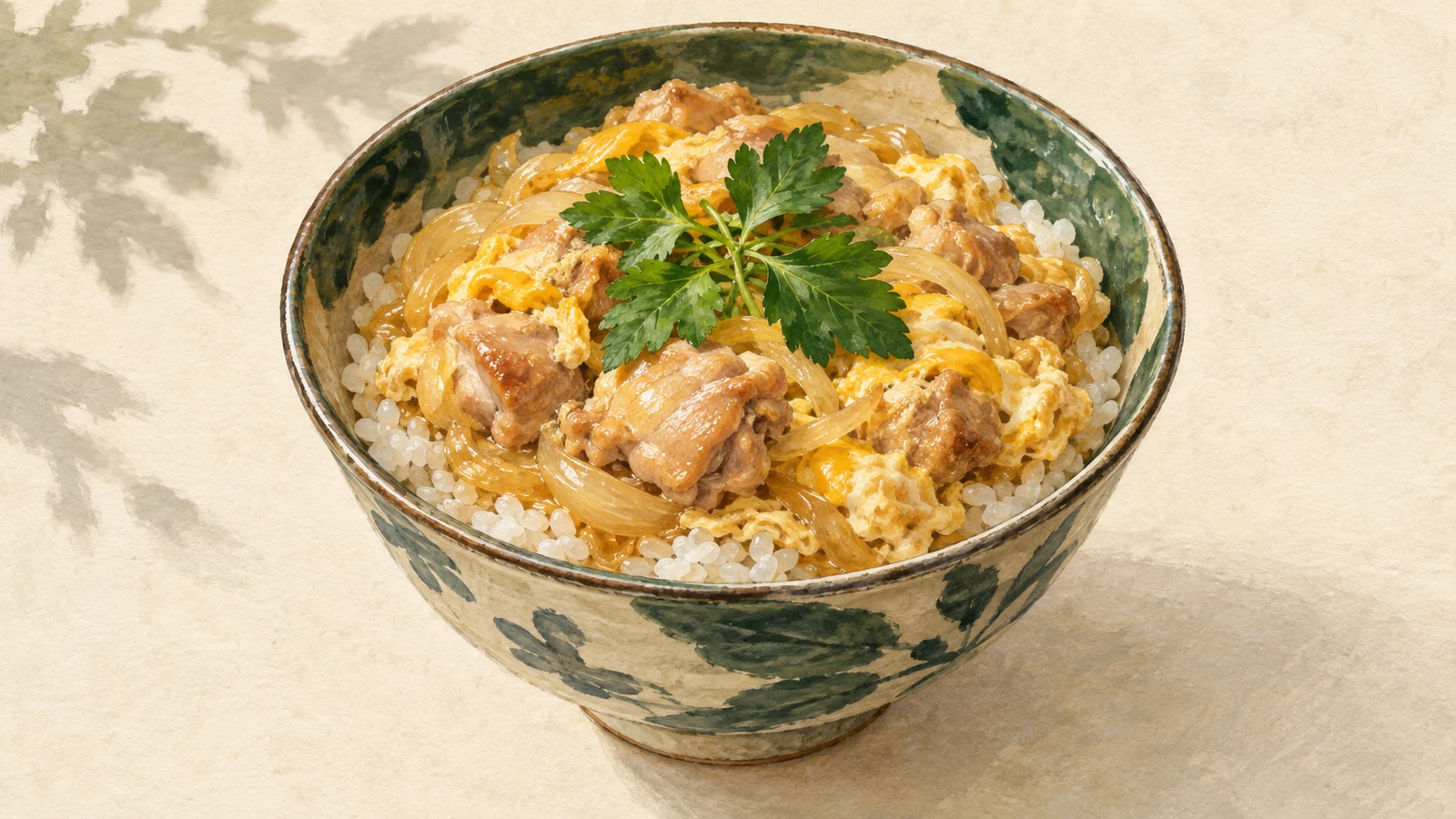
Oyakodon brings chicken and egg together over rice, which explains its Japanese name: “parent and child” rice bowl. Onion softens in a sweet-salty dashi broth, small pieces of chicken cook in that liquid, and egg turns the contents of the pan into one spoonable topping.
This source-based version adapts Namiko Hirasawa Chen’s oyakodon for a 10-inch skillet and two servings. Her recipe describes the common soft, nearly set egg finish and advises longer cooking outside Japan. This version makes the departure explicit: it cooks the combined egg dish to 160°F (71°C). No physical kitchen test is claimed.
Use the small pan as a shallow simmering dish
A 10-inch skillet spreads the broth far enough to cook the onion and chicken without requiring a specialty oyakodon pan. Cut the chicken into pieces of similar thickness so the largest pieces can reach their safe endpoint without the smallest becoming needlessly firm.
Keep raw chicken work separate from the cooked rice, mitsuba and serving bowls. After cutting the chicken, wash the board, knife, hands and touched surfaces with hot soapy water. A picture or a lack of pink is not the safety check. The thickest pieces need to reach 165°F (74°C) on a clean food thermometer, as specified for poultry by FoodSafety.gov.
The egg finish is a deliberate choice
Japanese oyakodon is often served with softly set or runny egg. That texture is not the endpoint used here. Cover the skillet after pouring in the egg and continue gently until no liquid egg remains and the center reaches 160°F (71°C), the FoodSafety.gov endpoint for egg dishes.
Mitsuba brings a fresh, lightly herbal finish. Scallion is a practical substitute, but it changes the aroma. If you grow mitsuba, cut sound outer stalks without removing the central crown; the connected growing guide below carries the full harvest cautions.
Put away rice and topping without delay
Refrigerate leftovers within two hours in shallow covered containers. Use them within three to four days. Reheat the chicken-and-egg topping and rice to 165°F (74°C) throughout, adding a spoonful of water if the broth has tightened in storage.