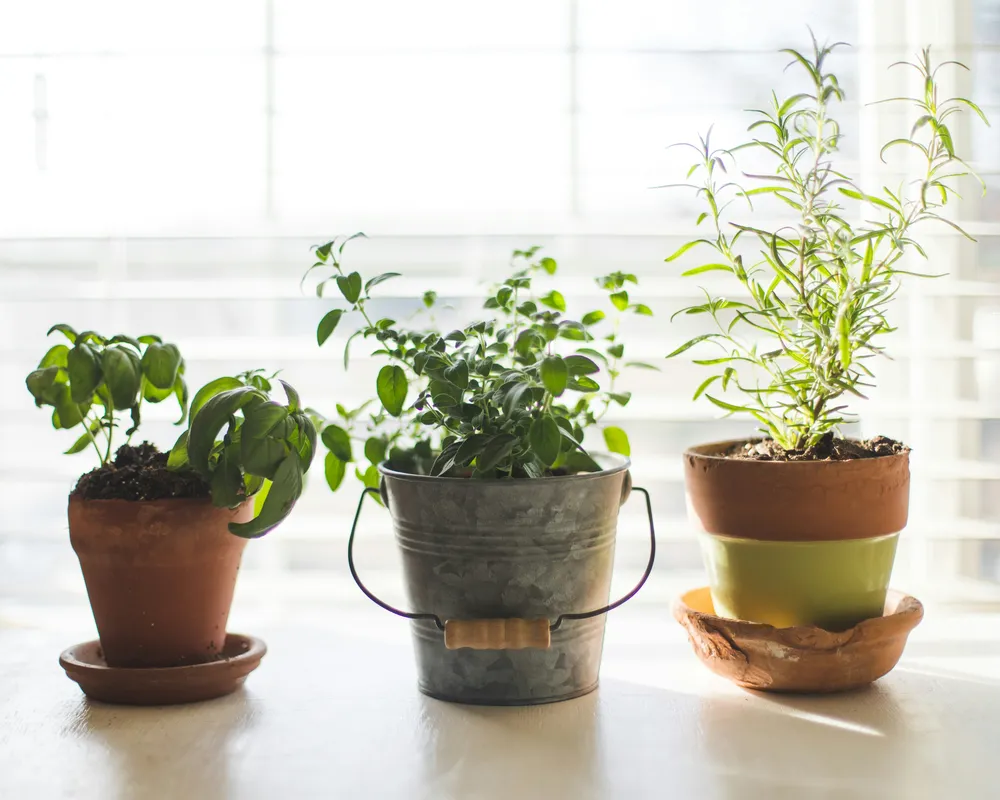
An indoor herb garden succeeds or fails primarily on light. A kitchen may look bright to human eyes while providing too little energy for compact, harvestable growth. Watering and fertilizer cannot compensate for that deficit; extra water in weak light often makes root problems more likely.
Start with a few compatible herbs and harvest small amounts without stripping the plants. A windowsill can be enough in a favorable season. A grow light makes the result more predictable when daylight is short, the window is obstructed, or the herbs stretch toward the glass.
Define the harvest before choosing plants
The phrase “year-round herb garden” can mean very different things. One basil plant may provide occasional leaves, but it will not replace large weekly grocery-store bunches indefinitely. Cilantro is naturally short-lived once it flowers. Woody rosemary and thyme persist longer but grow slowly indoors. Mint can outgrow neighbors and prefers different moisture than Mediterranean herbs.
Choose one of these realistic goals:
- Occasional garnish: two or three small pots in the brightest window.
- Regular small harvests: multiple plants, supplemental light, and staggered sowing of short-lived herbs.
- Overwintering mature plants: reduced harvest and careful pest inspection during low-light months.
- Seed-to-harvest production: dedicated light and replacement sowings rather than expecting one annual plant to live forever.
Penn State Extension identifies chives, basil, and cilantro as useful indoor choices. Iowa State University Extension recommends growing species in separate containers because their preferred conditions differ. Separate pots also make it easier to remove a pest, replace a short-lived crop, or water basil without soaking rosemary.
Choose herbs by growth pattern
| Herb | Indoor behavior | Planning note |
|---|---|---|
| Basil | Warm-season annual; productive with strong light and warmth | Replace after flowering or decline; protect from cold window glass |
| Chives | Clumping perennial with relatively manageable size | Cut leaves above the crown and allow regrowth |
| Cilantro | Cool-tolerant annual that naturally flowers | Sow small replacement pots rather than trying to stop its life cycle |
| Parsley | Biennial, often slow to germinate | Begin with a transplant for faster harvest; use a reasonably deep pot |
| Thyme or oregano | Sun-loving, drought-tolerant once established | Use a draining mix and avoid pairing with moisture-demanding basil |
| Mint | Vigorous perennial that accepts more moisture | Keep in its own pot so it does not dominate a mixed container |
| Rosemary | Woody perennial needing strong light and careful watering | Indoor winter survival is a more realistic goal than rapid production |
Start with two species whose leaves are actually used in the household. A decorative collection of eight struggling herbs is harder to learn from than two clearly labeled pots.
Before adding any plant to a home with animals, confirm the exact botanical identity. Common names can refer to different plants, and culinary use by people does not establish pet safety. The ASPCA plant database is a starting reference; a veterinarian or animal poison-control service should handle a suspected exposure.
Audit the available light
Most culinary herbs need substantial direct light. Iowa State describes light as the usual limiting factor indoors and advises providing roughly eight hours of direct light when possible. University of Minnesota Extension states that most herbs grow well with at least six hours of direct sun and may need artificial light during dark winter periods.
Observe the proposed location over a full clear day:
- Record when direct sun first reaches the leaves.
- Record when it ends.
- Note exterior shade from buildings, trees, balconies, or screens.
- Recheck as the season changes.
A south- or west-facing window may provide strong light, while an east-facing window can work for some herbs. Direction alone is not proof. A deep roof overhang or neighboring building can remove most direct sun.
Signs of inadequate light include long spaces between leaves, thin pale stems, small foliage, leaning, slow regrowth after harvest, and weak aroma. Move the plant closer to suitable light or add a horticultural fixture rather than fertilizing more.
For supplemental light, follow the fixture manufacturer’s coverage and distance guidance. A timer can provide a consistent photoperiod; Extension recommendations commonly fall around 12 to 16 hours depending on the setup. Plants still need a dark period. Secure the fixture, protect electrical connections from irrigation water, and adjust if leaves bleach, curl, or feel unusually hot.
Assemble a functional setup
Each herb needs:
- A container sized for its current root system
- At least one unobstructed drainage hole
- A saucer or waterproof outer surface
- Fresh, well-drained potting mix rather than garden soil
- A label with species and sowing or purchase date
- Enough spacing for inspection and air movement
An oversized pot stays wet longer than a correctly sized one. Unglazed clay dries faster than plastic or glazed ceramic. Those material differences are neither good nor bad; they change how often the root zone needs checking.
Do not rely on a layer of stones inside a pot with no drainage hole. Use a draining nursery pot inside a decorative cachepot and empty collected water after irrigation.
Mixed herb planters look attractive but create compromises. Iowa State’s container-herb guide advises grouping only herbs with compatible water requirements. Individual pots are the clearer default indoors.
Start from seed or a transplant
Seed
Use fresh seed from a reliable supplier and follow the packet’s depth, temperature, and germination directions. Fill a clean container with pre-moistened seed-starting medium, sow at the stated depth, and give emerging seedlings strong light promptly. Thin crowded seedlings rather than leaving a dense, weak cluster.
Basil germinates and grows relatively quickly. Parsley can be slow. Cilantro develops a taproot and is usually simplest when sown in its final pot. Staggering annual herbs in separate pots creates replacement harvests without disturbing an established container.
Transplant
Choose a compact plant with healthy color, no sticky residue, no webbing, and no visible insects on leaf undersides or stem joints. Check the pot for drainage and roots. A grocery-store herb may contain many seedlings crowded together; division can damage an already stressed root mass, so separate only when the plants and roots can be handled without severe tearing.
Quarantine a new transplant from other houseplants while inspecting for aphids, whiteflies, spider mites, fungus gnats, or scale. The observation period is more useful than a preventive pesticide applied without identifying a pest.
Water the root zone, not the calendar
Check moisture with a finger or wooden skewer below the surface. Water when that species has reached its appropriate threshold, then apply enough water to wet the root ball and allow excess to drain. Empty the saucer.
Many Mediterranean herbs prefer some drying between waterings. Basil should not be allowed to become severely dry. University of Minnesota recommends checking indoor herbs around one-half inch below the surface, while Iowa State emphasizes that most herbs do not tolerate persistently wet soil.
The watering interval will change with light, temperature, plant size, pot material, and season. A plant under winter light may use water much more slowly than the same plant in summer. Symptoms must be interpreted in context:
- Wilt in dry mix suggests water shortage.
- Wilt in wet mix can indicate root injury, not thirst.
- Lower yellow leaves can result from excess moisture, insufficient light, root crowding, or normal aging.
- Crispy edges can accompany severe drying, salt buildup, hot glass, or low humidity.
Fertilize lightly and deliberately
Herbs need nutrients, but more fertilizer does not create more light. Determine whether the potting mix contains a starter charge. Once active growth is established, use a fertilizer labeled for edible container plants and follow its directions at a restrained rate.
Both Penn State and Iowa State caution against heavy feeding. Excess fertilizer can produce weak growth, injure roots, or reduce desirable aroma and flavor. Reduce or stop feeding when growth slows in winter unless a well-lit, actively growing plant and the product label support continued use.
Never improvise a fertilizer concentration, and keep products in their original labeled containers away from children and pets.
Harvest without exhausting the plant
Use clean scissors and take small amounts from established growth. For branching herbs such as basil or mint, cut just above a leaf node to encourage side shoots. For chives, cut leaves while leaving the crown intact. Do not remove most of a slow-growing rosemary or thyme plant at once.
Flowering is part of an annual herb’s life cycle. Pinching basil flower buds can extend leafy production, but it does not make the plant perennial. Cilantro often progresses quickly to flowering under warm, long-day conditions; replacement sowing is more reliable than repeated rescue attempts.
Keep edible foliage separate from potting mix, pets, dirty tools, and household chemicals. Rinse harvested herbs under potable running water before use and dry them. A pesticide should be applied only when its current label permits that edible herb and indoor site, and all preharvest intervals must be observed.
Diagnose before replacing everything
| Symptom | Check first | Common response |
|---|---|---|
| Long, pale stems | Actual direct-light hours and fixture distance | Increase usable light; do not add fertilizer as a substitute |
| Soil stays wet for many days | Drainage hole, pot size, light, and root health | Correct the container system and allow an appropriate dry-down |
| Plant wilts repeatedly in dry mix | Root crowding, undersized pot, and watering coverage | Rehydrate evenly and repot one size larger if roots are congested |
| Sticky leaves or distorted tips | Aphids, scale, or whiteflies | Isolate and identify the pest before selecting treatment |
| Tiny flies around mix | Fungus gnats and chronic surface moisture | Let the surface dry appropriately and use an evidence-based control plan |
| Brown rosemary tips | Both drought and waterlogged-root possibilities | Inspect moisture and roots rather than watering automatically |
| Cilantro or basil flowers | Normal maturity plus temperature and day length | Harvest and begin a replacement sowing |
A practical first garden
Begin with one pot of chives and one pot of basil, cilantro, or another frequently used herb. Place them in the strongest suitable light, use separate draining containers, and record watering and harvest dates for a month. Add a grow light if the plants stretch or cannot replace harvested growth.
The goal is not permanent abundance from a crowded windowsill. It is a small system in which light is adequate, each root zone can be managed independently, and harvest never outruns growth. That approach produces more usable herbs and clearer lessons than buying a large collection before the growing conditions are known.
Sources
- Growing Herbs Indoors (Penn State Extension). Accessed August 5, 2026.
- What Growing Conditions Are Best for Indoor Herbs? (Iowa State University Extension and Outreach). Accessed August 5, 2026.
- Growing Herbs in Home Gardens (University of Minnesota Extension). Accessed August 5, 2026.
- Growing Herbs in Containers (Iowa State University Extension and Outreach). Accessed August 5, 2026.
- Toxic and Non-Toxic Plants List (ASPCA Animal Poison Control Center). Accessed August 5, 2026.