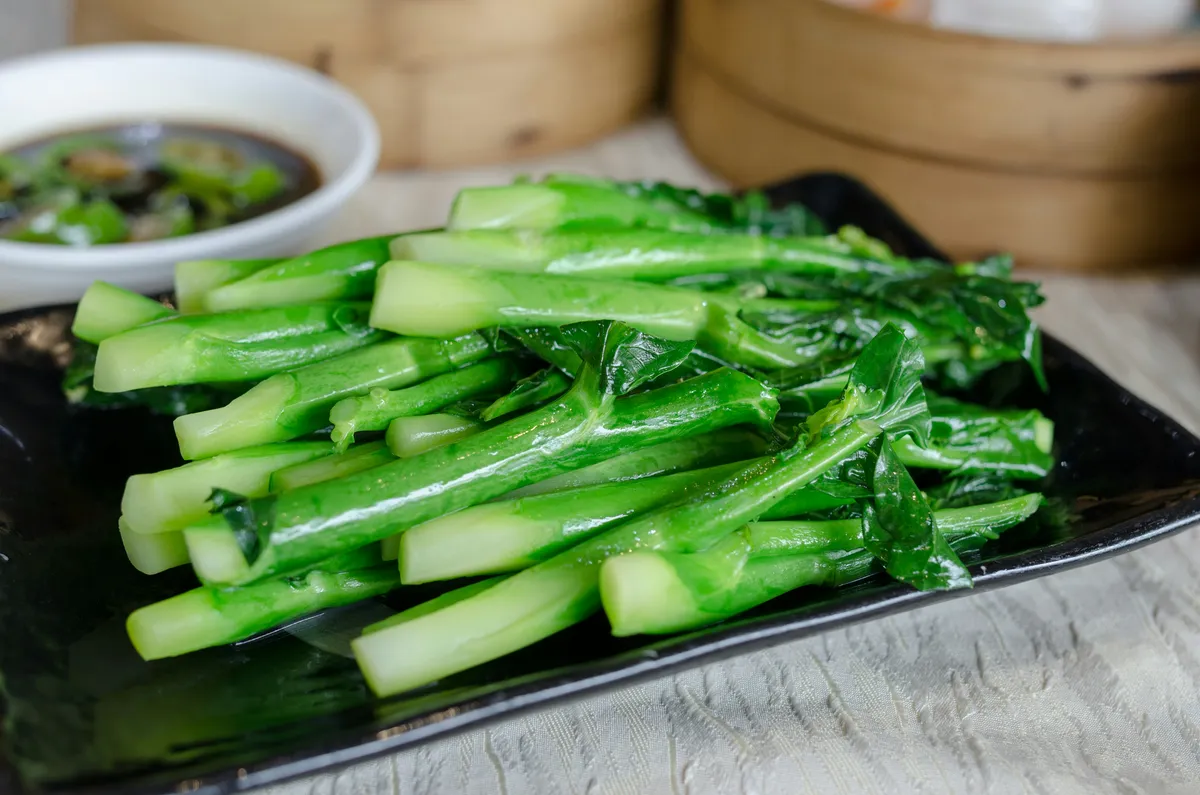
Gai lan is grown for thick, tender stems, broad blue-green leaves, and compact flower buds. Harvested before the flowers open, the central stalk is the main crop; lower nodes may later produce smaller side shoots.
It is often sold as Chinese broccoli or Chinese kale. Those common names can create confusion at the seed rack, so check the botanical identity and the packet description. University of Florida IFAS Extension lists gai lan as Chinese broccoli within Brassica oleracea, while separating it from bok choy and other Brassica rapa vegetables and from Brassica juncea mustard.
That distinction affects expectations. Gai lan does not form the large central head of standard heading broccoli, the pale spoon-shaped stalk cluster of bok choy, or the spicy leafy growth associated with gai choy mustard. It makes upright edible stems with smaller bud clusters.
Match the crop to a cool growing window
Gai lan is a cool-season brassica. The best sowing window depends on local frost dates, summer heat, cultivar, and whether the crop begins as seed or transplants. Rather than copying a national month, count backward from the period when the local garden usually has mild conditions.
In a cold-winter climate, that may mean a spring crop planted before sustained heat and a second crop started for fall. In a mild-winter climate, fall through winter can be the main season. UF/IFAS planting guidance illustrates the difference within one state: its North, Central, and South Florida windows are not identical. Use the local Extension calendar as the final timing reference.
UC Master Gardeners notes that spring plantings are more likely to flower quickly as weather warms, while fall plantings can produce over a longer period. Flowering is not a crop failure. The buds are edible, but open flowers and lengthening stems mark a later harvest stage than many growers want.
Choose a cultivar described for the intended season. Days-to-harvest values are comparison tools, not guarantees. Heat, cold, transplant stress, crowding, water, and soil fertility can move the date.
Decide between direct sowing and transplants
Both methods can work.
Direct sowing reduces root disturbance and makes succession planting simple. Sow to the packet depth in a prepared bed or container, keep the seed zone evenly moist, and thin seedlings before they compete severely.
Transplants protect the earliest growth from difficult outdoor conditions and can save bed space. Start them in clean seed-starting mix under strong light. Harden them off gradually before planting so the change in sun, wind, and temperature is not abrupt.
Kansas State University Research and Extension treats transplants as a reliable way to establish cool-season broccoli crops and notes that cultivar choice differs between spring and fall. Its standard-broccoli spacing is wider than many gai lan systems, which is why the packet and a gai-lan-specific regional source should control final spacing.
UF/IFAS commercial guidance lists relatively close in-row spacing for Chinese broccoli, while NC State Extension points gardeners to local schedules and describes both direct sowing and seedlings. A home grower can start near the cultivar recommendation, then give plants more room when the goal is thicker individual stalks and easier airflow.
Prepare a bed or container that drains
Choose a site with strong light and soil that drains after irrigation. Work from a soil test when growing in the ground; it is more reliable than adding fertilizer from habit. Mix recommendations should focus on the actual soil, not on the crop’s common name.
For a container, use fresh potting mix and unobstructed drainage holes. A broad box or tub is easier to space than several tiny pots. The container must hold enough mix that it does not swing from saturated to severely dry every day, yet it should not remain waterlogged.
Practical setup checks:
- leave enough room between plants to see lower leaves and inspect for pests;
- keep soil below the crown rather than burying the stem deeply;
- place the container where drainage will not create a slip hazard or damage a structure;
- provide afternoon protection only when local heat makes it necessary;
- avoid a site previously used repeatedly for brassicas when rotation is possible.
Crop rotation cannot eliminate every problem in a small garden, but it can reduce repeated exposure to soilborne brassica pests and diseases. Clean up badly diseased crop debris instead of composting it in an uncertain home system.
Keep moisture steady without saturating roots
Young seedlings have shallow roots and need consistent access to moisture. Check the soil rather than watering only by date. Irrigate deeply enough to wet the active root zone, then allow drainage and air to return. Containers, raised beds, and windy sites usually dry faster than in-ground soil.
Mulch can moderate moisture and limit soil splash after seedlings are established. Keep it from pressing against the stems. If plants wilt in wet soil, do not assume they need more water; check drainage and roots. If growth is pale or slow, review temperature, light, crowding, roots, and soil-test guidance before adding fertilizer.
Fast growth does not justify an unmeasured feeding schedule. Excess nitrogen can produce soft growth and does not solve heat stress or a damaged root zone. Follow soil-test or container-fertilizer label directions, and keep fertilizer granules off leaves and stems.
Build prevention into pest management
Gai lan can attract the same caterpillars, flea beetles, aphids, and other pests that visit related brassicas. Inspect leaf undersides and growing points at least weekly, and more often when damage is increasing. Small holes, pale stippling, distorted new leaves, frass, and visible eggs each point toward different causes.
Exclusion is useful when installed early. University of Maryland Extension explains that row cover can reduce insect access and offer some weather protection, but it must be secured and monitored. A cover can also trap pests already present, accumulate heat, reduce airflow, or rub foliage.
Use lightweight row cover or insect mesh that suits the season, inspect beneath it, and remove or ventilate it if temperatures rise beyond the crop’s comfort. Because gai lan is harvested before it needs insect pollination, a well-managed barrier can remain through much of the crop cycle.
If a treatment becomes necessary, identify the pest first. Use only a product labeled for that pest, the exact edible brassica crop, and the intended site. Follow rates, protective equipment, reentry directions, and the preharvest interval. A homemade spray does not bypass plant injury or food-safety risk.
Harvest stems before the buds open
Begin checking the central stalk when the bud cluster is compact and the stem has reached a useful size for the cultivar. Clemson Cooperative Extension recommends harvesting Chinese broccoli before the flowers open and leaving a stub that can support side shoots. UC Master Gardeners likewise recommends cutting below the top while retaining one or two lower leaf nodes.
Use a clean, sharp knife or pruners. Cut the main stem without damaging the lower crown. Then continue watering and inspecting the plant while side shoots develop. Regrowth varies with cultivar, weather, root health, and how much healthy leaf area remains, so treat additional harvests as possible rather than guaranteed.
| Harvest stage | What it looks like | Decision |
|---|---|---|
| Too early for the main cut | Small plant with little stem length | Let it build more leaf area unless thinning |
| Primary target | Thickened stem, tender leaves, compact unopened buds | Cut the central stalk above lower nodes |
| Later stage | Lengthening stalk with flowers beginning to open | Harvest promptly; texture may be firmer |
| Side-shoot stage | New stems emerging from retained lower nodes | Cut individually when they reach the preferred size |
Harvest during a cool part of the day and shade the cut stems promptly. Rinse under clean running water before preparation. Do not use soap or household cleaners on produce.
Keep the crop distinct and the notes useful
Label seed trays and containers with the crop, cultivar, and sowing date. This is especially useful when gai lan grows near bok choy, gai choy, standard broccoli, or other brassicas with similar seedlings.
Record four observations: sowing or transplant date, first weather stress, first pest sign, and first harvest stage. Use those notes to plan the next sowing around the conditions in your garden.
Gai lan rewards timely observation. Plant it for a genuinely cool part of the local season, give each plant a draining and evenly moist root zone, exclude pests early when practical, and check the bud clusters often as harvest approaches.
Sources
- Chapter 6. Cole Crop Production (University of Florida IFAS Extension). Accessed August 25, 2026.
- Chinese Kale (Brassica oleracea Kai Lan & Chinese Kale Group) (NC State Extension Gardener Plant Toolbox). Accessed August 25, 2026.
- Gailon (UC Master Gardeners of Santa Clara County). Accessed August 25, 2026.
- Broccoli (Kansas State University Research and Extension). Accessed August 25, 2026.
- Vegetable Garden Weather and Pest Protection (University of Maryland Extension). Accessed August 25, 2026.
- Chinese Vegetables (Clemson Cooperative Extension). Accessed August 25, 2026.