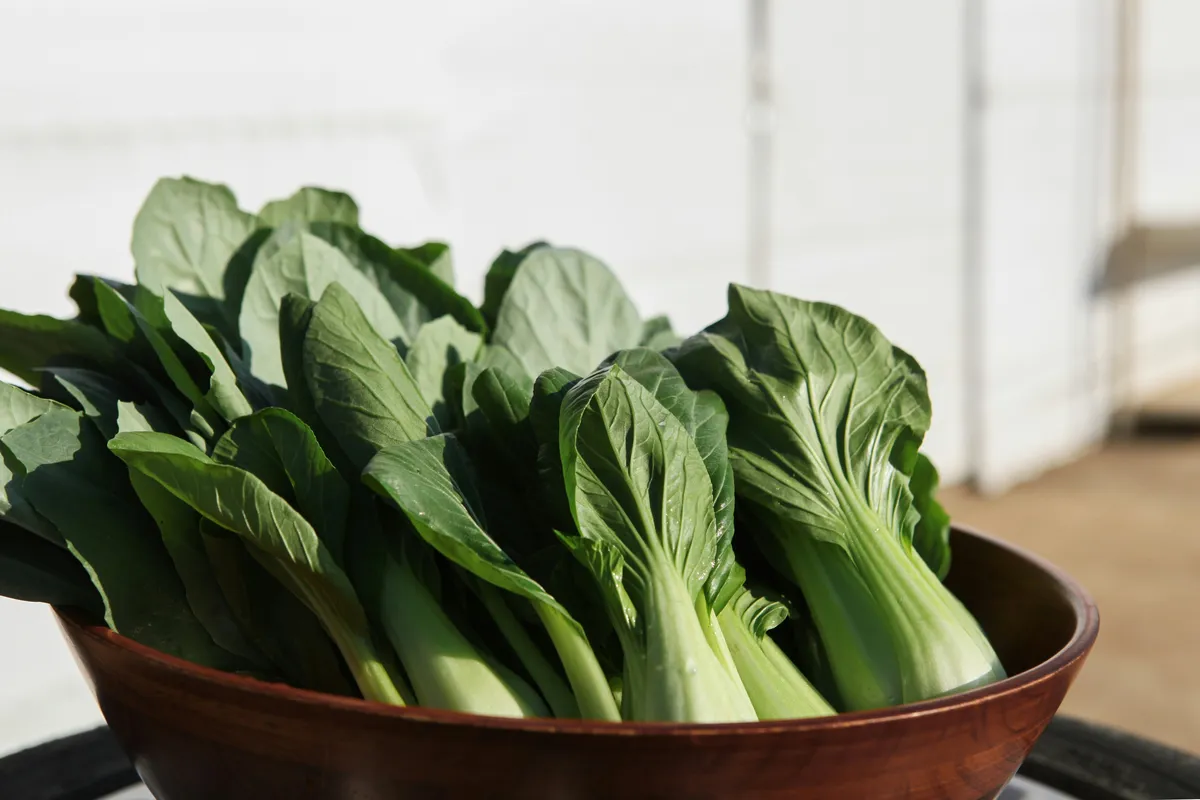
Bok choy can produce new leaves from the cut base left after cooking, but that experiment is not the same as growing a new, full-sized head. The stored energy in a grocery-store base may support a modest flush of leaves; its condition, age, and remaining growing point determine whether it roots at all. For a repeatable harvest, start with seed.
Choose the scrap method for a low-cost observation project and the seed method when the harvest matters.
Choose the method that matches your goal
| Goal | Start with | Likely outcome | Main limitation |
|---|---|---|---|
| Watch leaves regrow from a kitchen scrap | A fresh base with the center intact | A small second flush, sometimes with roots | Results vary; decay can outrun rooting |
| Harvest baby leaves | Seed in a shallow, wide container | Several small harvests if light is adequate | Dense sowing requires close moisture and airflow control |
| Grow a compact head | A dwarf or baby bok choy seed variety | The most predictable indoor crop | Needs strong light, steady moisture, and enough spacing |
| Grow a full-sized head | Seed and a large container | Possible, but space- and light-intensive indoors | Full-size plants normally need 12 to 18 inches of spacing |
The University of Illinois Extension includes bok choy among vegetables that can be regrown using the same basic method as a celery base, while warning that home-regrown produce may not resemble commercial produce. The University of Minnesota’s crop guide treats seed as the normal production method and emphasizes steady water and nutrients. Together, those sources support a useful boundary: scraps are an experiment; seed is a crop plan.
Method 1: Regrow a bok choy base
Start with a sound base
Save about two inches of the base after cutting off the usable leaves. The central growing point must remain attached. Do not use a base that is slimy, sour-smelling, deeply bruised, or already moldy; water will not reverse decay.
Rinse away food debris, then place the base upright in a clean, shallow dish. Add enough water to cover the bottom portion without submerging the cut crown. The Illinois Extension method calls for about one inch of water and a daily water change.
Keep the water stage short and clean
Place the dish where it receives bright light but is not heated against a hot window. Change the water every day, rinse the dish, and inspect the base. New pale-green leaves may appear before roots; leaf movement alone does not prove that the scrap has established a new root system.
Move to potting mix when roots are visible and the center is actively growing. Illinois Extension suggests two to three weeks for the comparable celery-base process, but bok choy timing is variable. Stop sooner if the base softens, smells unpleasant, develops fuzzy growth, or collapses. Compost or discard it rather than trying to rescue rotting edible tissue.
Transfer without burying the crown
Use a clean container with drainage holes and fresh soilless potting mix. Garden soil is too dense for a small indoor container; the University of Maryland Extension’s seed-starting guidance explains that a porous soilless mix holds water while preserving air space around roots.
Set the roots and lower base into pre-moistened mix, leaving the new center leaves above the surface. Water gently until excess drains. Keep the mix evenly moist, not saturated, while the new roots adjust.
Harvest individual outer leaves once they are large enough to use. Do not assume the base will form another dense head. If growth stalls after the first flush, the experiment has probably reached its practical limit.
Method 2: Grow bok choy from seed
Select for the space you have
Look for a dwarf, baby, or container-suitable cultivar and follow its packet for mature size and days to harvest. Cultivar descriptions matter because bok choy ranges from compact plants around six inches tall to full-sized plants about a foot tall. The University of Minnesota bok choy guide recommends 12-inch spacing for dwarf types and 18 inches for full-sized heads in the garden. Indoors, a single compact plant is much easier to light evenly than a crowded group.
For baby-leaf production, plants can be closer because they will be harvested young. For heads, thin decisively to the packet’s final spacing. Crowded leaves compete for light, while crowded roots compete for water and nutrients; the University of Maryland container guide identifies overcrowding as a cause of lower productivity and disease-favoring airflow.
Sow into a real growing medium
Use a food-safe container with drainage and fresh soilless mix. Sow seed one-quarter to one-half inch deep, the depth range given by Minnesota Extension, then keep the surface evenly moist during germination. A general vegetable-seed media temperature of 65 to 75°F is appropriate according to Maryland Extension. Once seedlings emerge, remove any humidity cover and provide air movement.
Do not add gravel to the bottom to “improve drainage.” Maryland Extension notes that rocks can raise the saturated zone in a pot. Drainage comes from holes, a porous mix, and not leaving the container standing in runoff.
Supply enough usable light
A bright window may work during a sunny season, but visual brightness to a person does not guarantee enough light for a compact food crop. Stretching stems, leaves leaning sharply toward the glass, and slow growth indicate that the plant needs more light.
For consistent results, use an LED grow light on a timer and follow the fixture maker’s distance guidance. The University of Minnesota indoor-lighting guide recommends blue or mixed light for seedlings and leafy greens, with 16 to 18 hours for seedlings and 12 to 14 hours for hydroponic lettuce and herbs. A practical bok choy plan is 16 hours while seedlings establish, then about 12 to 14 hours after thinning, adjusting the lamp distance if leaves bleach or seedlings stretch. Plants still need a dark period; do not run the light continuously.
Manage water by observation, not a calendar
Bok choy quality depends on steady access to moisture and nutrients. Check the mix below the surface daily, especially in small pots. Water when it is beginning to lose moisture, applying enough to wet the root zone and drain from the bottom. Empty the saucer. Wilting is not a reliable instruction to water because both dry and waterlogged roots can cause it.
If the mix contains starter fertilizer, it may supply seedlings for several weeks. Otherwise, use a fertilizer labeled for edible container vegetables at the label rate after true leaves form. Do not improvise stronger mixtures, and never use a lawn “weed and feed”; Minnesota Extension warns that fertilizer containing herbicide can kill vegetable plants.
Troubleshoot by pattern
| What you see | Check first | Best next action |
|---|---|---|
| Seedlings are tall and leaning | Lamp distance and duration | Move the approved grow light closer within its instructions; increase duration if below the source ranges |
| Mix stays wet and growth stalls | Drain holes, standing runoff, dense media | Clear drainage, empty the saucer, and replace persistently dense media |
| Leaf edges dry or the crop tastes unusually bitter | Moisture swings and heat | Restore even moisture and move away from a heater or hot glass |
| A flower stalk forms | Temperature stress, plant age, cultivar | Harvest promptly; leaf growth and quality usually decline after bolting |
| Small holes or visible insects appear | Leaf undersides and new growth | Isolate the container; remove insects physically and identify them before considering treatment |
| Scrap base becomes soft or foul-smelling | Crown and waterline | Discard it; do not eat tissue from a decaying base |
Bok choy is a cool-season brassica. Heat, water stress, and certain cold-then-warm sequences can trigger bolting. Indoors, the useful response is not a rigid thermostat setting but avoiding extremes: keep the crop away from radiators, hot window glass, air-conditioner blasts, and prolonged cold. Once a flower stalk elongates, harvest rather than expecting the plant to return to head production.
Harvest and food-safety boundaries
Harvest clean outer leaves with washed scissors, leaving the center if you want more growth. A whole head is ready when it reaches the cultivar’s useful size and the oldest leaves are still tender. Minnesota Extension advises harvesting promptly because bok choy does not hold quality for long once mature.
Rinse harvested leaves under clean running water before eating. If pests require more than hand removal or a water rinse, use only a product whose label explicitly permits indoor use on edible brassica greens, and obey its pre-harvest interval. “Natural” or homemade does not automatically mean safe on food.
Indoor growing does not eliminate uncertainty. Cultivar, seed age, lamp output, room temperature, container volume, and the condition of a grocery scrap all change the result. Record sowing date, lamp hours, watering observations, and harvest weight if you want to improve the next crop.
Sources
- Kitchen Scrap Gardening: Regrow Your Fruits and Vegetables! (University of Illinois Extension). Accessed August 5, 2026.
- Growing Chinese cabbage and bok choy in home gardens (University of Minnesota Extension). Accessed August 5, 2026.
- Lighting for indoor plants and starting seeds (University of Minnesota Extension). Accessed August 5, 2026.
- Starting Vegetable Seeds Indoors (University of Maryland Extension). Accessed August 5, 2026.
- Growing Vegetables in Containers and Salad Tables (University of Maryland Extension). Accessed August 5, 2026.