Ingredients
Gai Lan, Bok Choy and Choy Sum at the Grocery Store
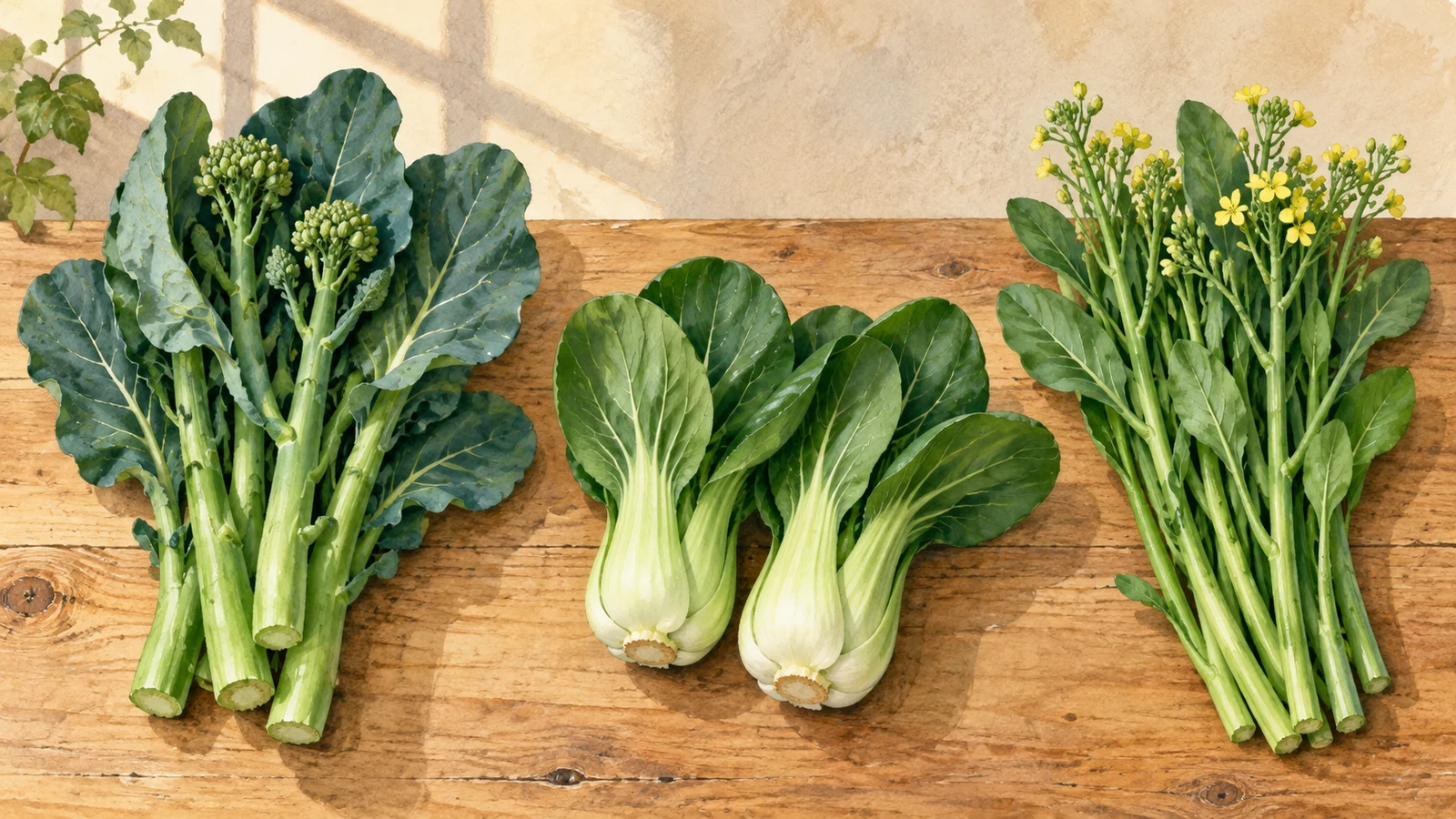
Start at the base of the bunch. Bok choy gathers thick, spoon-shaped stalks into one compact base. Gai lan and choy sum rise as individual stems with leaves along them. Once that first fork is clear, the rest of the vegetable becomes much easier to read.
The market-bag test
A compact base with fleshy stalks: this is bok choy, also sold as pak choi. White-stem types have bright white stalks; Shanghai types are pale green. The leaves may be small or large, but they still gather at the base.
Round, sturdy stems with broad dark leaves: this points to gai lan, Chinese broccoli, Chinese kale or kai lan. Small flower buds may sit near the top. It does not form the large central head associated with broccoli.
Slender stems with oval leaves and yellow flowers or buds: this is choy sum, choi sum or cai xin, and it is often labeled yu choy or yu choy sum. It looks like a leafy flowering stalk rather than a tight bok choy head.
Names shift between markets. The UC Cooperative Extension Asian Vegetable Primer distinguishes choy sum from yu choy, while many Chinese cooking sources group them together. The Woks of Life leafy-greens guide provides photographs of common forms. Use the sign and the shape together.
Pick up the bunch
Turn it over before deciding. The leaves should look fresh, the stems should feel firm and the cut ends should be free of decay. Extensive yellowing, wilting or bruising is a reason to choose another bunch.
With gai lan, slim young stalks need less trimming. Large stalks remain useful when their fibrous lower skin is peeled away; the Woks of Life gai lan guide shows that preparation. Tight buds suggest a fresher bunch than many fully open flowers.
Choy sum is different: tender yellow flowers are an ordinary edible part of this flowering vegetable. Judge the leaf and stem condition instead of rejecting every blossom. Yellow flowers and yellowing leaves are not the same signal.
Unpack it for tonight
All three vegetables contain edible stems and leaves, but the cut should respect how quickly each part cooks.
| Green | Keep | Prepare | Cook first |
|---|---|---|---|
| Gai lan | Leaves, buds and tender stems | Trim dry ends; peel fibrous lower stalks; slice thick stems diagonally | Thick stem pieces |
| Bok choy | Leafy tops and fleshy stalks | Separate large stalks, or halve small heads; rinse inside the layers | Large stalk pieces |
| Choy sum | Tender stems, leaves, buds and flowers | Trim the cut end; divide long stalks into serving lengths | Only noticeably thick lower stems |
UMass Extension’s bok choy guide explains why its stalks take longer than the leaves. Bill Leung’s yu choy preparation similarly adjusts for stem thickness rather than treating every bunch alike.
Bok choy often hides grit between the stalk layers. Separate the stalks or open halved small heads enough to rinse inside. Sandy greens can be swished in a clean bowl of water and lifted out, leaving grit behind, then rinsed under running water. Drain well before stir-frying.
The FDA’s produce guidance recommends clean hands and utensils, rinsing produce under running water and keeping it away from raw meat. Soap and household detergent do not belong on vegetables.
If one green stands in for another
Gai lan has the most substantial stems and a broccoli-like flavor. Bok choy brings a juicy, mild stalk. Choy sum is generally tender and a little sweeter than gai lan.
Replacing gai lan with choy sum means checking tenderness sooner. Replacing it with bok choy means accounting for the thick gathered base. When gai lan replaces a tender green, peel and cut the lower stems and give them a head start. Carry over the purpose of the dish, not its exact cooking time; taste an actual stem.
Refrigerate the greens unwashed in a loose produce bag and cook them soon. Purdue Extension’s bok choy guidance recommends the crisper. Put gai lan to work in gai lan with oyster sauce, or grow the next bunch with the guides to gai lan outdoors and bok choy indoors.