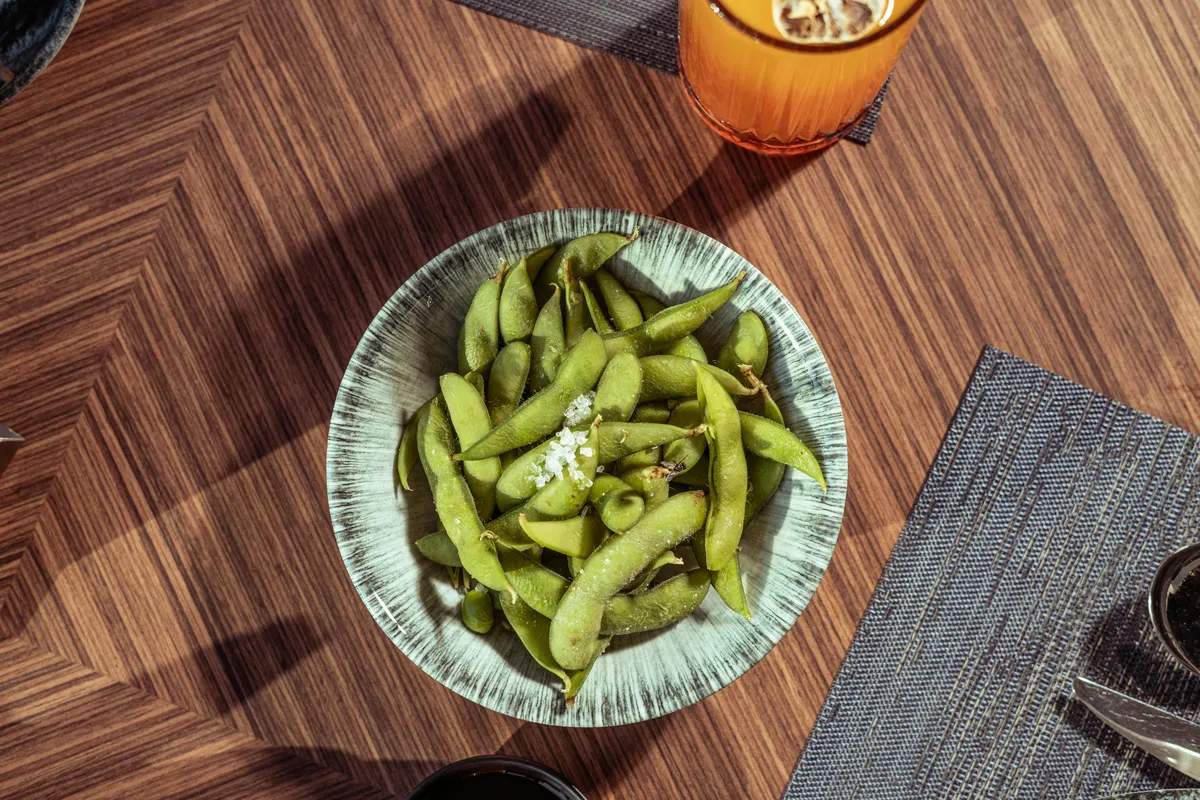
Edamame is a vegetable-stage harvest of soybean, Glycine max. The pods are picked green while the seeds are full but still tender, rather than left to dry as a grain crop. Plants of the World Online accepts Glycine max as the botanical name.
That harvest stage is the main difference between an edamame plan and a generic bean guide. Cultivar maturity, warm-soil establishment, steady moisture during flowering and pod fill, and timely picking all matter. Most vegetable soybean cultivars grow as compact bushes, but the seed packet, rather than the common name, sets the reliable spacing and maturity expectations.
Buy seed labeled for edamame
Select a vegetable soybean cultivar offered for fresh green harvest. Grain soybean or an unlabeled food bean is not a useful substitute. A named cultivar gives you a maturity estimate, growth habit, disease information, and regional guidance from the seller.
Rutgers’ edamame guide explains that vegetable types are selected for large green pods containing two or three large seeds. Its trial list ranged from roughly 75 to 100 days, and the publication notes that broader cultivar maturity can extend to about 125 days. These figures show why a gardener should match seed to the local frost-free season rather than assume every edamame matures in 85 days.
Compare packet maturity with the time between reliably warm soil and the first likely fall frost. In a short season, choose an early cultivar. In a long season, two cultivars or staggered sowings can spread harvest, although day length and temperature can alter a catalog estimate.
Do not plant roasted, cooked, frozen, or salted edamame. Use seed intended for planting. If seed is treated, follow every handling and planting instruction on the label and keep it away from food, children, and pets.
Wait for warm soil, then direct-sow
Edamame is a warm-season crop. Cold, wet soil slows emergence and increases the risk of seed decay. Rutgers recommends planting around a 65°F soil temperature at a two-inch depth, using a planting depth of about one inch. Treat that as regional guidance and confirm local timing through a nearby Extension planting calendar and the seed packet.
Direct-sow into the final bed or container. A simple sequence is:
- Choose a sunny, well-drained site after frost danger has passed and the soil has warmed.
- Prepare the bed from a soil test, or fill a container with fresh, well-drained potting mix.
- Sow at the packet depth, which is often near one inch, and use the cultivar’s final spacing.
- Water gently so seed stays covered and the root zone is moist but not saturated.
- Label the cultivar and sowing date.
- Protect the row from digging animals and watch for emergence before assuming the stand failed.
Soaking is not a universal requirement. Soybean seed can be damaged by rough handling once it absorbs water, and a packet may carry treatment or inoculation directions that soaking would disrupt. Follow the seed supplier rather than an inherited soak schedule.
Give a garden row enough room
Rutgers uses six inches between plants in a single row, with closer staggered rows or wider cultivation rows depending on the system. Use that as one tested layout, not a rule for every cultivar. Crowding can reduce airflow, make inspection difficult, and increase competition for water during pod fill.
Most edamame cultivars are bush types and do not need a tall trellis. The Rutgers guide describes many at roughly one to two feet tall, while noting that a few vining types require support. Check the packet before deciding. A short stake may steady a bush cultivar in a windy site; a genuinely vining cultivar needs support suited to its mature habit.
Rotate the crop rather than planting soybeans in the same bed every season. Legume diseases and nematodes can persist in soil, and rotation is more useful when crops from the same plant family are kept together in the plan.
Adapt the spacing to a container
Container edamame needs the same full-season light and cultivar spacing as a garden planting. A small pot may hold too little medium to buffer water and temperature for several plants. Choose a wide, stable container that can preserve the packet’s final spacing, support the expected mature height, and drain freely.
University of Illinois Extension recommends drainage holes, potting mix rather than dense garden soil, planting at packet depth, and a location matched to the crop’s sunlight requirement. It also notes that container moisture needs attention throughout the season.
The number of edamame plants a pot can support depends on its diameter and the cultivar, not just its gallon capacity. Surface area sets spacing; volume affects water reserve and stability. Thin crowded seedlings rather than leaving a dense clump because they all emerged.
A container on a balcony also needs a safe load-bearing location, a saucer that is emptied after drainage, and protection from wind. Do not place a pot where runoff can fall on people or where vines, stakes, or foliage block an exit.
Use a soil test and the correct inoculant
Soybean can form nitrogen-fixing nodules with compatible Bradyrhizobium bacteria, but that partnership is not proof that any soil supplies every nutrient the crop needs. Virginia Cooperative Extension recommends a soil test and correction of actual deficiencies. It notes that nitrogen fertilizer is usually unnecessary when fertility is adequate and the crop nodulates successfully.
Where soybeans have not recently grown, a soybean-specific inoculant can help establish the correct bacteria. Use a product labeled for soybean and follow its storage, expiration, and seed-application directions. Bean or pea inoculant is not automatically interchangeable. Keep inoculated seed out of direct sun and plant it within the label’s specified window.
In a container, bagged mix does not come with a field history. The seed or inoculant supplier can advise whether inoculation is appropriate. Do not compensate for uncertainty by adding large amounts of nitrogen: excess nitrogen can favor leafy growth, and fertilizer salts can injure container roots.
Protect flowering and pod fill from water stress
Water to establish even moisture through the root zone, then use the soil or potting mix instead of a weekday schedule to decide when to irrigate again. Seedlings should not sit in saturated soil. Established plants need consistent moisture, especially as flowers form and seeds fill the pods.
In a bed, water slowly enough to enter the soil instead of running off. In a container, water until excess exits, then empty the saucer. Hot weather, wind, plant size, and container material can change water demand quickly. Mulch can moderate a garden bed, but keep it from burying young stems.
If plants wilt in wet soil, do not add water automatically. Inspect drainage, roots, stem bases, heat, and disease symptoms. Flat pods can result from stress, cultivar timing, or an early harvest; they are not evidence that a self-fertile soybean “failed to pollinate.”
Inspect pests before choosing a treatment
Deer and rabbits can remove young plants, while beetles, aphids, stink bugs, and other insects may feed on foliage or pods. Diseases that affect grain soybean can also affect edamame. The crop, pest, location, and harvest timing determine which management choices are lawful and appropriate.
Inspect leaves, stems, flowers, and pods regularly. Identify the organism and estimate damage before acting. Physical exclusion, hand removal, irrigation correction, sanitation, and crop rotation may be useful depending on the problem. If a pesticide is considered, the label must list the crop and target pest, and every application, reentry, and preharvest interval must be followed. A product allowed on ornamental houseplants is not automatically allowed on edamame.
Oregon State University Extension’s edamame publication is a useful regional reference for production decisions. Combine it with current local pest alerts because pressure and legal product options vary by location and year.
Harvest at full green seed, before yellowing
Edamame has a narrower quality window than a dry bean. Look for green pods whose seeds have expanded enough to fill the pod cavities. Pods should be plump and tender, not flat and not beginning to yellow.
Virginia Tech identifies early full-seed stage, called R6, as the target: a green seed fills the pod cavity at an upper node while the leaf at that node remains fully developed. The same source warns that yellowing indicates the best quality window has passed. A home gardener can hand-pick ready pods over several visits or cut a plant when most pods reach the target stage.
Harvest in the cool part of the day and refrigerate promptly. The Virginia Tech guide describes rapid postharvest quality changes in warm pods, so do not leave a basket in sun while finishing other garden work.
If pods mature unevenly, pick the plump ones and leave flat pods briefly. If most are ready at once, cutting the plant can make stripping pods easier. Do not confuse an immature flat pod with a fully mature dry soybean; each represents a different endpoint.
Cook the beans and discard the pods
North Dakota State University Extension directs home cooks to boil, steam, or microwave edamame pods until tender. It gives about five minutes after returning salted water to a boil as one method. Cooking time varies with pod size and equipment, so verify tenderness rather than relying on the clock alone.
The fibrous pods are discarded after the beans are shelled. Refrigerate fresh pods and use them promptly; NDSU recommends two to three days for best quality. Follow a tested Extension process if freezing. Clean hands, surfaces, containers, and harvested pods before preparation, and refrigerate prepared dishes promptly.
A practical first sowing
- Choose an early vegetable soybean cultivar whose maturity fits the local warm season.
- Wait for warm, workable soil and sow at the packet depth in full sun.
- Preserve final spacing in a bed or a wide draining container.
- Use a soil test and soybean-specific inoculant guidance instead of routine heavy nitrogen.
- Keep moisture even through flowering and pod fill without saturating the roots.
- Inspect wildlife, insects, and disease signs before choosing controls.
- Pick when green seeds fill the pods and before pods yellow.
- Cool promptly, cook until tender, and discard the pods.
Edamame is not difficult because it climbs or needs elaborate pruning. It is exacting about cultivar-season fit and harvest stage. Match those two decisions first, and the remaining work resembles care for a compact warm-season bush crop rather than a generic bean vine.
Sources
- Glycine max (L.) Merr. (Plants of the World Online, Royal Botanic Gardens, Kew). Accessed August 25, 2026.
- Edamame: The Vegetable Soybean (Rutgers New Jersey Agricultural Experiment Station). Accessed August 25, 2026.
- Edamame (Oregon State University Extension Service). Accessed August 25, 2026.
- Edamame in Virginia II: Producing a High-Quality Product (Virginia Cooperative Extension). Accessed August 25, 2026.
- Field to Fork Edamame! (North Dakota State University Extension). Accessed August 25, 2026.
- Growing Vegetables in Containers (University of Illinois Extension). Accessed August 25, 2026.