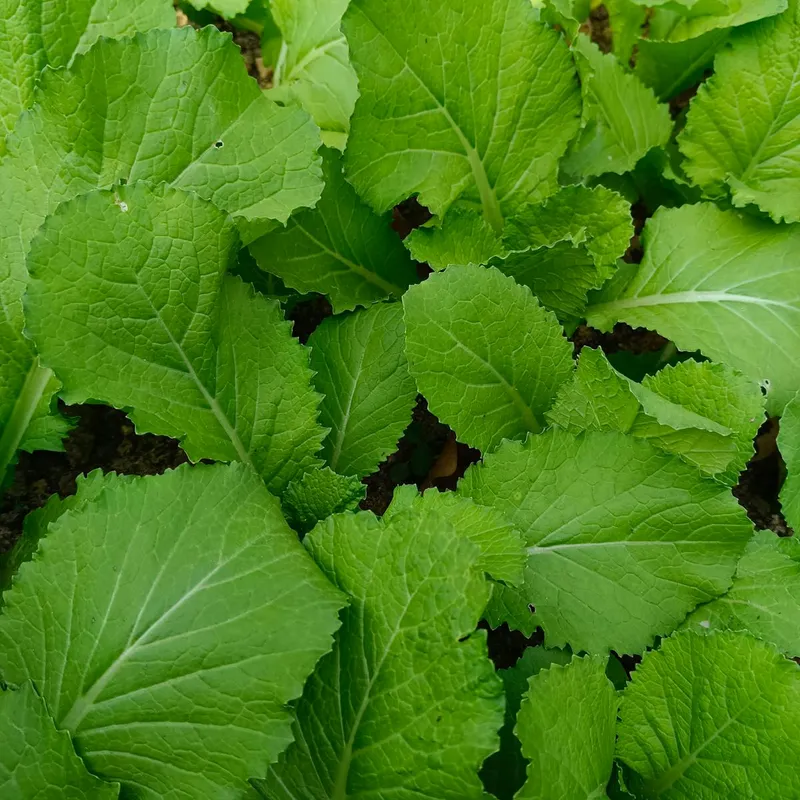
Mustard greens reward good timing more than elaborate equipment. They germinate quickly, tolerate cool weather, and can be harvested as baby leaves or allowed to form a larger plant. Heat, inconsistent water, and early insect damage are the usual obstacles.
“Gai choy” is commonly used for Chinese mustard greens, often forms of Brassica juncea, but seed sellers use overlapping English and regional names. Broad-leaf, curled, red-leaf, stem, and heading types can differ greatly in size and time to maturity. Let the cultivar name and seed packet, rather than a generic photo, control final spacing and harvest expectations.
The crop at a glance
| Decision | Practical starting point |
|---|---|
| Season | Cool spring or fall conditions |
| Planting method | Direct sowing is usually simplest |
| Light | A sunny outdoor site; leafy greens can tolerate somewhat less light than fruiting crops |
| Soil | Fertile, well-drained soil or fresh container mix |
| Water | Even moisture without standing water |
| Harvest | Baby leaves early, outer leaves over time, or a whole mature plant |
| Main early pest | Flea beetles, which make many small “shot holes” |
Utah State University Extension identifies mustard as a cool-season vegetable and emphasizes rapid, uninterrupted growth before summer heat. University of Minnesota Extension lists mustard greens as a fast fall crop that survives light frost, while noting that young leaves can be harvested before full size.
Choose seed by intended use
The word “mustard” covers more variation than a single growing guide can capture. Before buying seed, decide what should reach the kitchen.
- Baby-leaf types are useful for repeated small sowings and early harvest.
- Broad-leaf or curled greens produce larger leaves for stir-fries, soups, braises, or pickling.
- Heading and thick-stem types need more space and a longer season than baby greens.
- Red or purple cultivars add color but still need cultivar-specific timing and spacing.
Choose seed intended for food production and check the packet for days to maturity, mature spread, sowing depth, and whether the listed harvest is for baby or full-size leaves. “Asian greens mix” can contain crops with different growth rates; a single named cultivar is easier for a first trial.
Plan backward from heat or frost
Mustard is generally grown in spring and fall. The best local dates depend on climate, elevation, and the cultivar. A local Extension planting calendar is more useful than a national month-by-month rule.
For spring, sow when soil can be worked and the packet’s temperature guidance is satisfied. Utah State suggests planting several weeks before the local last frost for its production conditions. For fall, count backward from the expected first hard freeze using the packet’s days to maturity, then add time for slower growth as days shorten.
Minnesota’s fall-crop guidance places many mustard greens in roughly the 30- to 40-day range, but that is not a guarantee for gai choy types that form large stems or heads. Baby leaves arrive earlier; mature plants may need considerably longer.
Warm conditions can accelerate flowering and make leaves tougher or more pungent. If a spring crop sends up a flower stalk, harvest usable leaves promptly. Cutting the stalk does not return a physiologically mature plant to its earlier leafy stage.
Prepare a bed or container
In-ground or raised-bed planting
Choose a site with direct sun and soil that drains after rain. Mustard grows best without strong moisture or nutrient stress. A soil test is the sound basis for lime and fertilizer decisions; avoid applying a large nitrogen dose without knowing the soil or product analysis.
Remove weeds before sowing because small mustard seedlings compete poorly. Avoid planting repeatedly where mustard-family crops recently grew, including cabbage, broccoli, kale, bok choy, radish, or turnip. Rotation cannot eliminate every pest, but it reduces the repeated buildup of some crop-family problems.
Container planting
Mustard greens work in containers when roots have adequate depth and the pot drains freely. NC State Extension’s small-space guidance includes mustards among leafy vegetables suitable for compact gardens and notes that leafy crops can produce with less direct sun than fruiting vegetables.
Use fresh potting mix rather than dense garden soil. Pick a broad container for multiple plants and follow the cultivar’s mature spacing; a tiny grocery-store pot cannot support several full-size gai choy plants. More mix volume buffers rapid swings in water and temperature. Every primary pot needs drainage holes, and standing water should be emptied from saucers or cachepots.
Sow and thin deliberately
- Moisten the seedbed or container mix. It should be evenly damp, not muddy.
- Make a shallow furrow. Several Extension guides use about one-half inch as a mustard sowing depth, but the seed packet remains the final instruction.
- Sow more closely than final spacing. Small seed is difficult to place perfectly.
- Cover lightly and water gently. A forceful stream can move seed into clumps.
- Keep the surface from crusting during germination. Do not keep the whole root zone saturated.
- Thin after emergence. Remove or snip crowded seedlings so remaining plants match the intended harvest size.
NC State’s cool-season vegetable guide gives one-half inch depth, close initial sowing, and later thinning for mustard greens. A dense stand can be appropriate for very young leaves; full-size broad-leaf or stem mustard needs much more room. Crowded mature plants stay damp, compete for light and water, and are harder to inspect for insects.
For a steady baby-leaf harvest, sow a short row or small container every couple of weeks during suitable weather rather than planting every seed at once. Stop when upcoming heat or cold will arrive before the crop can mature.
Manage water and fertility by observation
Keep the root zone evenly moist while seedlings establish. After establishment, water deeply enough to wet the active root area, then allow excess water to drain. A fixed daily schedule is unreliable: wind, sun, temperature, container material, and plant size all change water use.
Irregular moisture can slow growth and reduce leaf quality. Mulch around established outdoor plants can moderate soil moisture and suppress weeds, but keep heavy mulch away from tiny stems and inspect beneath it for slugs.
Mustard is a leafy crop, so nitrogen supports growth; excess fertilizer can still injure roots or wash into waterways. Use soil-test recommendations in beds. In containers, determine whether the potting mix already contains fertilizer, then use a product labeled for edible container vegetables at its stated rate. Observe all application directions and preharvest restrictions.
Protect seedlings before pests arrive
Flea beetles are especially attracted to spicy brassicas such as mustard. Adults make numerous small round holes, and seedlings tolerate the damage poorly. University of Minnesota Extension identifies this early feeding as a key risk.
A lightweight insect row cover installed immediately after sowing can physically exclude many flying pests. Seal the edges and support the fabric so growing leaves are not abraded. Do not place a cover over soil that already harbors the target pest, and inspect underneath regularly. Mustard grown only for leaves does not need insect pollination before harvest.
Other likely problems include:
- Cabbageworms and loopers: green caterpillars and irregular chewing holes; inspect leaf undersides and centers.
- Aphids: clusters of soft-bodied insects, often on tender growth or leaf undersides.
- Slugs: ragged holes plus slime trails, especially in damp sheltered areas.
- Leaf spots or yellowing: possible disease, nutrient, root, or weather problems that require diagnosis rather than automatic spraying.
Remove badly damaged leaves, hand-pick caterpillars when practical, control weeds, and avoid leaving diseased brassica debris in the bed. If a pesticide is needed, identify the pest first and use only a product whose current label explicitly permits the edible crop and site. Follow the label’s rate, protective equipment, re-entry interval, and preharvest interval. “Natural” does not mean exempt from label directions.
Harvest for the texture wanted
There are three useful harvest patterns:
Baby leaves
Cut clean young leaves when they reach the desired size. Leave enough plants or growing points for continued production if the cultivar supports repeat harvest.
Outer-leaf harvest
Take the largest healthy outer leaves and leave the smaller center leaves growing. NC State reports that individual mustard leaves may be ready within several weeks under suitable conditions. Harvest time still varies with cultivar and weather.
Whole-plant harvest
Cut or pull the plant when it reaches the packet’s listed maturity or before heat causes unacceptable bolting and toughness. Thick-stem and heading gai choy types are usually handled this way.
Use clean hands and tools. Keep harvested greens off soil and away from raw meat, poultry, seafood, pets, and dirty containers. Remove damaged tissue, rinse under potable running water before preparation, dry, and refrigerate promptly. Washing reduces surface dirt but cannot rescue produce contaminated by manure, unsafe water, or misused pesticides.
Diagnose the common failures
| Problem | Most useful checks |
|---|---|
| Seedlings emerge in clumps | Sowing distribution, watering force, and surface crusting |
| Leaves have many tiny round holes | Flea beetles; check for small jumping adults and improve early exclusion |
| Plants are tall, weak, or leaning | Light level and crowding |
| Leaves are tough and very pungent | Heat, flowering, drought stress, or an inherently strong cultivar |
| Growth stalls in a container | Root crowding, depleted mix, insufficient light, or chronic overwatering |
| Lower leaves yellow | Normal aging, waterlogged roots, nitrogen shortage, or disease; inspect the whole plant before treating |
| Flower stalk appears early | Warm conditions, long days, crop maturity, or other stress; harvest rather than expecting reversal |
A reliable first crop
Begin with one named broad-leaf or baby-leaf cultivar, a short row or wide draining container, and a spring or fall window supported by a local planting calendar. Sow shallowly, thin according to the intended harvest, maintain even moisture, and exclude flea beetles from the beginning.
Those controls matter more than chasing an exact universal date. When the cultivar and local season are matched, mustard greens can provide a quick baby-leaf harvest and, with more space, the substantial leaves and stems associated with gai choy.
Sources
- How to Grow Mustard in Your Garden (Utah State University Extension). Accessed August 5, 2026.
- Planting Vegetables in Midsummer for Fall Harvest (University of Minnesota Extension). Accessed August 5, 2026.
- Growing Cool-Season Vegetables in Childcare Production Gardens (NC State Extension). Accessed August 5, 2026.
- Vegetable Gardening in Small Spaces (NC State Extension). Accessed August 5, 2026.
- Common Insects in Vegetable Crops (University of Minnesota Extension). Accessed August 5, 2026.