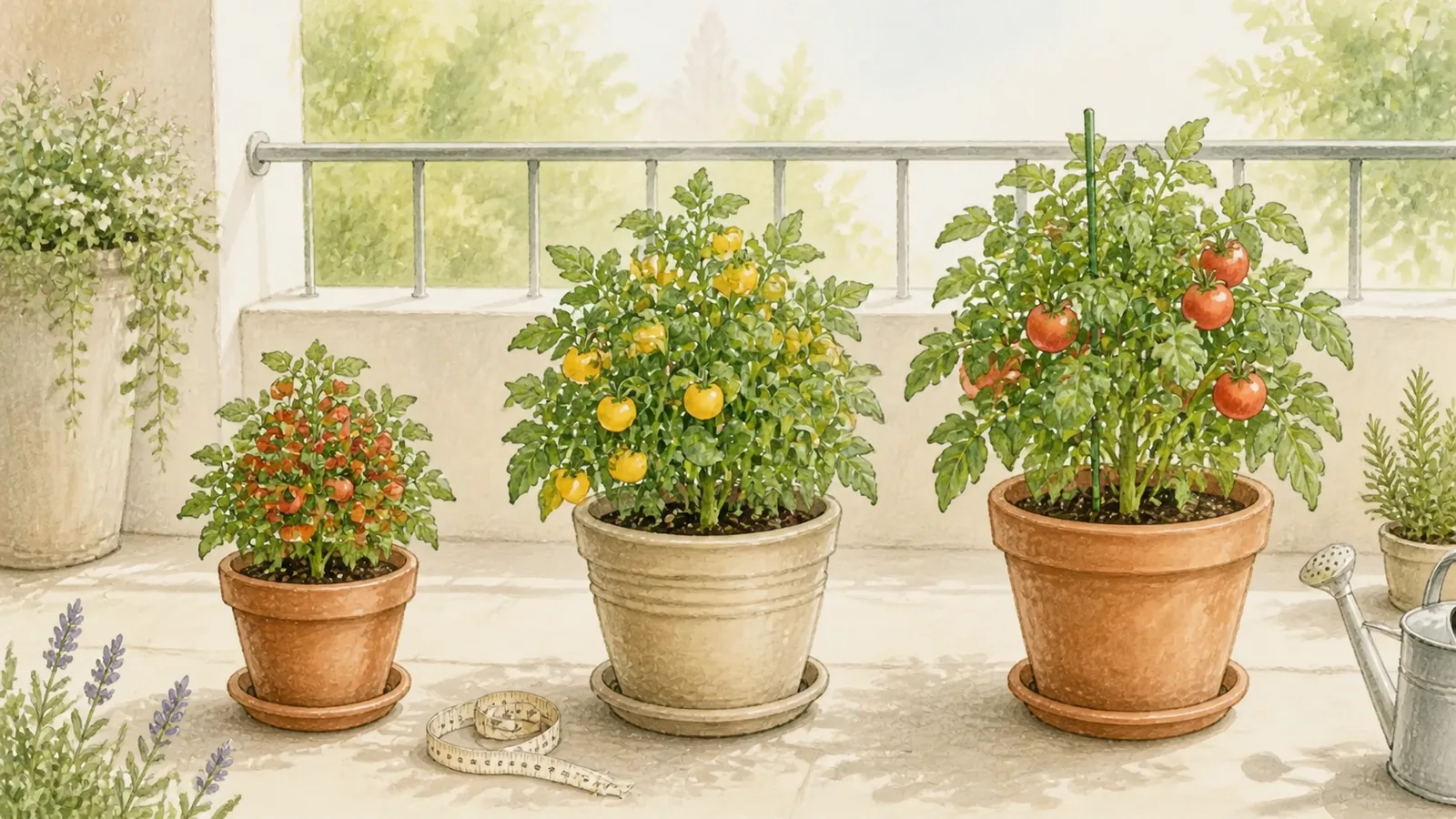
A tomato described as “dwarf” can still be the wrong plant for a windowsill. One compact cultivar may stay short but spread broadly. Another may fit a narrow shelf yet produce fewer tomatoes. A third may give a larger harvest but need a bigger pot, stronger light, and support.
A new Utah State University cultivar guide turns that vague label into a more useful comparison. It profiles 18 dwarf tomatoes by growth habit, plant size, yield, fruit size, and soluble solids, usually reported as degrees Brix. The related research poster identifies the central tradeoff: larger cultivars generally produced more fruit per plant, while smaller cultivars used space more efficiently and tended to have higher soluble-solids readings.
That does not produce one universal winner. It produces a better way to choose.
What the Utah State project compared
The researchers grew 18 dwarf tomato cultivars in controlled-environment rooms under LED lights. Their guide gives each cultivar a photograph and a compact set of measurements so growers can compare physical size with production and fruit characteristics.
Those categories answer different questions:
- Plant height and footprint: Will the mature plant fit beneath a light, beside a railing, or within a shelf?
- Growth habit: Does it remain compact, or will stems still need room and support?
- Yield per plant: How much fruit did one plant produce in that particular setup?
- Yield per volume: How efficiently did the plant use the three-dimensional space it occupied?
- Fruit size: Is the harvest made of snack-size tomatoes or larger fruit?
- Soluble solids: How much dissolved material, much of it sugars, was measured in the juice?
The distinction between per-plant yield and yield per volume is especially useful. A bigger plant can produce more total fruit while being less efficient in a cramped growing area. A tiny plant can produce less fruit by itself while allowing more plants beneath the same bank of lights.
For a household, the practical metric depends on the constraint. A sunny patio with room for one container may favor total production from one plant. A narrow indoor rack may favor the amount harvested from each cubic foot of growing space. A family that values snack tomatoes may accept a smaller crop in exchange for fruit size or flavor.
Why “dwarf” is not a complete size description
Dwarf tomatoes are bred for compact growth, but the category is not one standardized final dimension. Seed listings may also use terms such as micro-dwarf, patio, bush, compact, or determinate. Those words overlap, but they do not always describe the same architecture.
Height alone can also mislead. A short tomato with side branches may occupy a wide circle. A taller, narrower plant may fit better against a wall. Leaves can extend beyond the pot, fruit clusters can pull branches outward, and a cage or stake adds to the working footprint.
Measure the actual growing space before shopping:
- Record the maximum plant height from the soil surface to the light or shelf above it.
- Record the usable width and depth, including space for airflow.
- Leave access for watering, pruning, inspection, and harvest.
- Include the saucer, support, and light fixture in the plan.
- Check whether doors, windows, railings, or walkways reduce the usable area.
A cultivar guide is most helpful when its dimensions are compared with those real limits rather than with the word “small.”
Choose the goal before the cultivar
The Utah State results suggest four practical selection paths.
Maximum harvest from one pot
If there is room for one substantial container, prioritize per-plant yield and a mature footprint that still fits the location. Do not automatically choose the shortest entry. A somewhat larger dwarf may turn the available light and root volume into more total fruit.
Maximum production beneath a grow light
For a shelf or compact indoor garden, compare yield with the volume occupied. A smaller plant can be a better use of a fixed lit area even when its individual harvest is lower. Keep enough space between plants for light to reach the lower leaves and for air to move through the canopy.
Larger fruit
Fruit size is a separate trait from plant size. A compact plant does not guarantee tiny fruit, and a small-fruited cultivar is not automatically the smallest plant. Choose the harvest style first: quick snacks, salads, cooking, or slices. Then confirm that the plant fits.
Flavor and sweetness
Degrees Brix can help compare soluble solids under the same experiment, but it is not a complete flavor score. Acidity, aroma, texture, ripeness, variety, watering, temperature, and light all affect how a tomato tastes. A higher reading in a controlled room is useful evidence, not a promise that every balcony harvest will taste sweeter.
Translate a controlled-room guide to home conditions
The project offers a strong shortlist, but it is not a nationwide outdoor trial. The plants were grown under controlled conditions and LED lights at one institution. A cultivar can behave differently with summer heat, cool nights, wind, uneven sunlight, local disease pressure, or a different container and fertilizer program.
The report is also a student research guide rather than a replicated multi-location cultivar trial. Its measurements describe the project setup; they should not be treated as guaranteed household yields.
Use the guide in two stages. First, screen out cultivars that plainly exceed the available space or fail the preferred fruit goal. Then check a regional Extension source or local grower trial for climate, planting dates, and disease considerations.
Build the container around the mature plant
Compact tops still need functional roots. A pot that repeatedly dries out can stress growth and raise blossom-end-rot risk; sharp dry-to-wet swings can also contribute to fruit cracking.
University of Maryland Extension lists five gallons as a general container size for standard tomatoes and two gallons for cherry tomatoes while noting that bush, dwarf, and compact vegetables can suit smaller spaces. Penn State Extension recommends choosing dwarf, bush, or determinate tomatoes for containers and emphasizes ample sun, drainage, moisture, and support.
Those are starting points, not permission to force every dwarf into the smallest possible pot. Use the breeder’s recommendation when available, and move upward in container volume when the site is hot, windy, or difficult to water consistently.
Set up the container with:
- drainage holes that remain open;
- fresh container mix rather than dense garden soil;
- a saucer or surface plan that handles runoff safely;
- a cage, stake, or tie system installed before branches carry heavy fruit;
- enough headroom for the plant and support;
- a watering routine that keeps the root zone evenly moist, not waterlogged.
The site’s potting-soil guide explains why air space and drainage matter in containers, and the grow-light guide covers intensity, duration, and distance for indoor setups.
Light remains the limiting input
A compact tomato is still a fruiting crop. It cannot turn a dim decorative corner into a productive garden. Outdoors, choose the sunniest practical location and track how many hours are unobstructed during the growing season. Indoors, use a horticultural light sized for the full canopy rather than a small lamp aimed at one leaf.
Light placement should account for growth. A seedling that fits neatly beneath a lamp may crowd it after branching. Watch for stretched stems, large gaps between leaves, weak growth, poor flowering, or blossoms that fail to set fruit. These signs can also have other causes, but they are reasons to reassess the growing environment rather than simply add fertilizer.
Run a one-season household trial
The best cultivar for a specific apartment or patio may not be the highest-ranked plant in any report. Treat the first season as a small comparison.
Record:
- cultivar and seed source;
- container size;
- mature height and widest canopy span;
- hours of direct sun or grow-light schedule;
- whether support was needed;
- first flowering and first ripe fruit dates;
- approximate harvest count or weight;
- watering frequency during the hottest week;
- flavor, texture, and how the fruit was actually used.
Two cultivars are enough to reveal useful differences without turning a balcony into a research facility. Keep the pot, mix, planting date, and care as similar as practical. At the end of the season, choose based on the constraint that mattered most: space, maintenance, harvest, or taste.
The useful takeaway
The new 18-cultivar guide makes one point clear: “dwarf” is the beginning of a tomato decision, not the end. Plant size, space efficiency, total yield, fruit size, and soluble solids can move in different directions.
Choose the metric that matches the home. A patio gardener with one large pot may prefer the stronger per-plant producer. An indoor grower may favor a smaller plant that uses lit volume efficiently. A family looking for snack fruit may prioritize fruit size and taste over maximum weight.
The best compact tomato is not the smallest plant or the biggest harvest in isolation. It is the cultivar whose mature shape, care needs, and fruit fit the space that will actually grow it.
Sources
- Dwarf Tomato Cultivar Selection Guide (Utah State University). Accessed August 24, 2026.
- Selecting Dwarf Tomato Cultivars for Space-Limited Systems: Tradeoffs in Size, Yield, And Fruit Quality (Utah State University). Accessed August 24, 2026.
- Growing Vegetables in Containers and Salad Tables (University of Maryland Extension). Accessed August 24, 2026.
- Container Vegetable Gardening - Four Keys to Success (Penn State Extension). Accessed August 24, 2026.