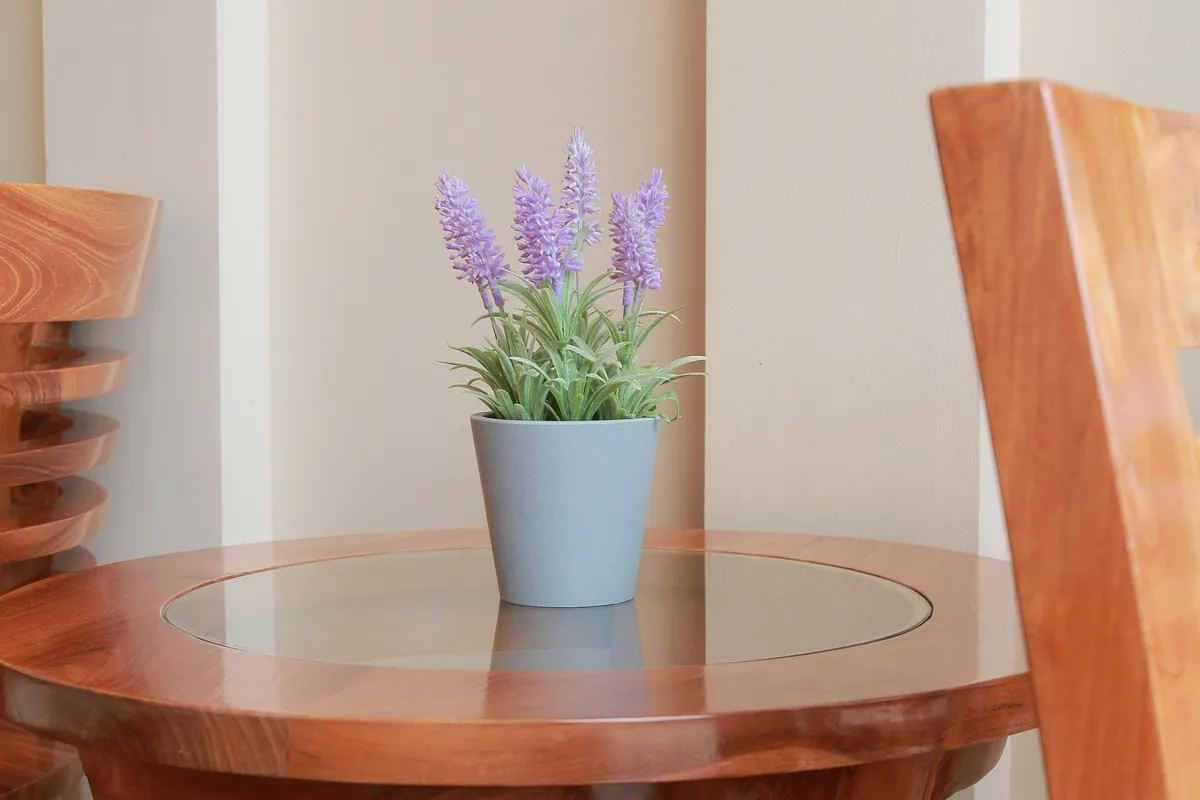
Lavender can grow in a pot, but the container does not cancel the plant’s basic needs. It still requires strong outdoor sun, a root zone that drains quickly, and a cultivar suited to the local summer and winter. The pot also creates a new constraint: its small volume can swing from wet to dry and from hot to frozen faster than garden soil.
For a reliable starting setup, plant one lavender in a container about 12 to 16 inches (30 to 40 cm) wide, use a coarse container mix, and make sure water can leave through unobstructed holes. Put it where it receives at least six hours of direct sun. Water thoroughly only when the mix has begun to dry, then empty any saucer. Those decisions matter more than a fixed watering calendar.
Choose lavender for the climate, not just the flower
“Lavender” covers species and hybrids with different mature sizes and cold tolerance. Check the botanical name, cultivar, expected width, and hardiness information on the plant label before choosing the pot.
- English lavender (Lavandula angustifolia) is usually the practical starting point where winters are cold. The NC State Extension profile lists full sun, excellent drainage, and hardiness across USDA Zones 5a through 9b, while local performance still depends on winter moisture, humidity, and microclimate. Utah State University Extension names cultivars including ‘Munstead’ and ‘Hidcote’ in its English lavender guide.
- Lavandin (Lavandula × intermedia) can be vigorous and broad. It may need a larger pot than a smaller English cultivar, so use the labeled mature width rather than assuming every lavender stays compact.
- Spanish lavender (Lavandula stoechas) handles heat but is less cold-hardy. NC State Extension lists it for Zones 8 through 9 and emphasizes full sun, gritty well-drained soil, and air circulation. It may be treated as a seasonal plant or moved to suitable frost-free shelter where winters exceed its tolerance.
Hardiness-zone numbers describe regional minimum temperatures, not the temperature of an exposed root ball. Container roots have less insulation than roots in the ground. A plant rated for the local zone can therefore still be injured in a pot.
Use a wide pot with working drainage
The Royal Horticultural Society’s lavender guide recommends a large container about 12 to 16 inches in diameter. That range gives a young plant room without surrounding a small root ball with an unnecessarily large mass of slow-drying mix. Match the final container to the cultivar’s mature spread and repot when roots crowd the pot or water runs through an exhausted root ball without moistening it evenly.
The pot must have drainage holes. One attractive sealed planter is not a substitute. Either drill suitable holes or keep the lavender in a draining nursery pot that lifts completely out of the decorative container for watering. Never leave the inner pot standing in collected water.
Do not add a gravel layer inside the bottom of the growing pot. The University of Illinois Extension drainage guidance explains that gravel can leave a saturated zone perched in the mix above it; holes that let water escape are the important feature. Cover a very large hole with mesh if needed to retain mix, but do not plug it.
Terracotta can help a mix dry faster, but it is not mandatory. Unglazed clay also dries faster during heat and can be damaged by freeze-thaw cycles. Plastic and glazed pots retain moisture longer. Container material changes how often the substrate needs attention; it does not create one universally correct choice.
Build an airy potting mix
Use container mix rather than soil dug from the yard. The target is a stable blend with enough large pores to admit air after watering and enough moisture retention to keep new roots from drying immediately. The RHS suggests a loam-based or multipurpose container compost amended with coarse grit as one workable model, using up to roughly one-quarter grit by volume. Product ingredients and local weather vary, so judge the result by drainage rather than copying a recipe blindly.
After planting, water once until the whole root ball is moist and water exits the holes. If drainage is slow, correct the hole, compacted mix, or blocked saucer instead of trying to compensate with smaller sips. Set the crown at the same depth it occupied in the nursery pot; burying the woody base keeps it wetter.
Lavender has modest nutrient needs. Rich compost and frequent high-nitrogen feeding can push soft leafy growth at the expense of flowers and resilience. Start with the fertilizer already listed on the potting-mix label. Add more only when a soil or substrate assessment and the product directions justify it.
Give potted lavender full outdoor sun
English lavender needs full sun, which NC State Extension defines as at least six hours of direct light. Eight hours is a useful target where the cultivar and climate tolerate it. A bright room is not equivalent to an open patio: glass, window direction, buildings, and screens all reduce available light. A plant kept indoors may survive for a time yet stretch, flower poorly, or remain too wet because it uses water slowly.
Place the pot where air can move around the foliage and rainwater can drain away. Do not crowd it between dense plants. If a nursery plant was grown under cover, introduce stronger sun over several days so the existing leaves can adjust. In extreme heat, watch the substrate and leaf condition rather than assuming a drought-tolerant plant in a small pot cannot dry too far.
Water by substrate condition, not weekday
Potted lavender needs a wet-to-drier cycle, not permanent drought and not constant moisture. Check below the surface with a finger or wooden skewer and learn the pot’s weight after watering and as it dries. When the upper mix is dry and the pot is noticeably lighter, water slowly until the entire root ball is moistened and excess drains. Empty the saucer.
The correct interval changes with heat, wind, rain, container material, root density, and mix. The University of Illinois Extension watering guide specifically cautions that container watering has no hard-and-fast schedule. A young transplant may need more frequent checks while roots establish. An established plant in glazed plastic may stay wet longer than the same cultivar in terracotta. Winter dormancy and cool weather reduce demand.
If water races down a gap between a shrunken root ball and the pot, one quick pour has not watered the roots. Apply water gradually in several passes so the mix can rehydrate. Conversely, yellowing, collapse, or darkening at the crown while the mix stays wet calls for a drainage and root-zone inspection, not another drink.
Prune without cutting into bare wood
Annual trimming helps lavender remain compact, but timing depends on climate. The RHS recommends removing spent flower stalks and about an inch of leafy growth after flowering in late summer. In a colder climate, frost-damaged growth may be easier to assess after winter; Oregon State University Extension advises pruning after the chance of frost has passed in its regional guidance.
In either case, keep green leaves below the cut. Lavender may not send new shoots readily from old, leafless wood, so a severe cut into the woody framework can leave permanent bare sections. Deadhead individual flower stalks as desired, disinfect cutting tools, and replace an old plant when the woody structure can no longer be corrected safely with light pruning.
Overwinter the cultivar you actually bought
Winter care is not simply “bring every pot inside.” First identify the lavender and compare its hardiness with local lows. Hardy English lavender may do best dormant outdoors in a sheltered position, protected from repeated saturation and severe wind. The RHS notes that containers are more cold-sensitive and recommends shelter plus protection from excessive winter rain. Insulating the outside of the pot or placing it in a protected cold frame can reduce root-temperature swings without turning the plant into an actively growing indoor specimen.
Tender Spanish or French types may require a bright, ventilated, frost-free location. Warm, dim storage encourages weak growth and keeps the mix wet longer. Whatever the location, check the root ball occasionally: keep it on the dry side, but do not let it remain completely desiccated for months.
The practical rule is to plan winter care before buying. A cultivar that fits the climate, a pot that drains, and a place with genuine full sun make growing potted lavender much more predictable than trying to rescue a mismatched plant after cold, shade, or chronic wetness has already caused decline.
Sources
- How to grow lavender (Royal Horticultural Society). Accessed August 24, 2026.
- Lavandula angustifolia (NC State Extension). Accessed August 24, 2026.
- Lavandula stoechas (NC State Extension). Accessed August 24, 2026.
- How to Grow English Lavender in Your Garden (Utah State University Extension). Accessed August 24, 2026.
- Container Drainage Options (University of Illinois Extension). Accessed August 24, 2026.
- Watering (University of Illinois Extension). Accessed August 24, 2026.
- When is the best time to prune lavender? (Oregon State University Extension Service). Accessed August 24, 2026.