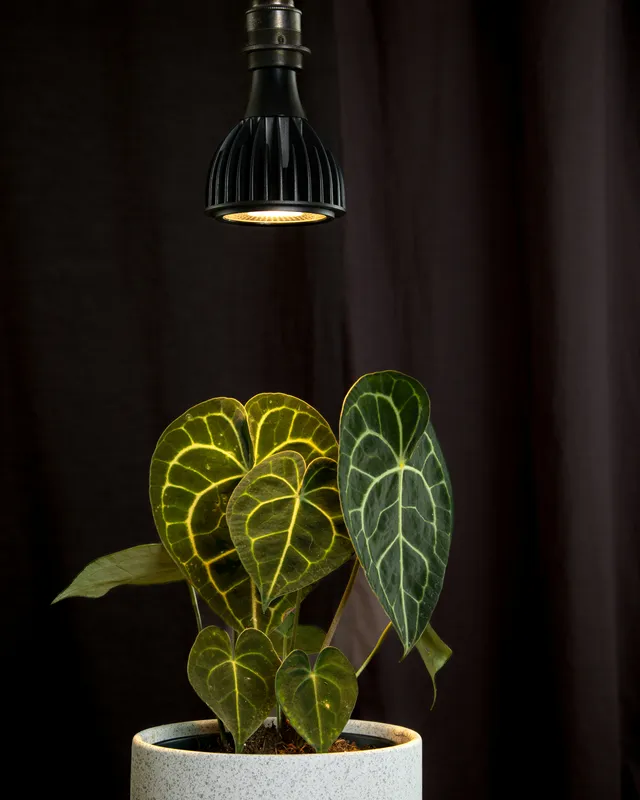
Start with the plant, not the lamp
A grow light can supplement a dim window or provide the main light for a plant shelf, but a fixture does not create one universal growing environment. The useful question is not whether a lamp is marketed for plants. It is whether enough plant-usable light reaches the entire canopy for an appropriate number of hours without overheating or bleaching the plant.
First identify the plant and its normal light response. A shade-tolerant foliage plant, a sun-adapted succulent, and a flowering crop can require very different light totals. Also define the goal: maintaining existing foliage through winter requires less light than producing compact new growth, flowers, or edible yield.
University of Minnesota Extension lists pale foliage, long spaces between leaves, leaning, and failed flower-bud formation among possible signs of insufficient light. None is diagnostic by itself. Root stress, excess fertilizer, temperature, and normal growth habit can overlap, so examine the whole plant and its care history before buying hardware.
Understand the measurements on a grow-light listing
Lighting terms describe different things. Treating them as interchangeable leads to poor comparisons.
- Watts describe electrical power draw, not how much light reaches a leaf. An advertised “equivalent wattage” is not a plant-light measurement.
- Lumens weight light according to human visual sensitivity. They help describe how bright a room appears, but University of Minnesota Extension notes that they do not fully measure the wavelengths important to plants.
- PAR refers to photosynthetically active radiation, conventionally the 400-to-700-nanometer waveband used in common horticultural measurements.
- PPF is the plant-usable photon output from a source each second.
- PPFD is the photon flux arriving at a surface, such as the top of a plant canopy, each second. It is commonly reported in micromoles per square meter per second.
- DLI, or daily light integral, combines PPFD with hours of exposure to describe the day’s total plant-usable light at that location.
The distinction matters because a fixture can have a high total output but spread it over a large area, leaving low PPFD at the leaves. PPFD also falls as distance from the fixture increases. A useful product document provides a PPFD map with the measured hanging height and coverage area, not only a maximum value at the center.
The relationship between a constant PPFD and DLI is:
DLI = PPFD x light hours x 3,600 / 1,000,000For example, a measured 100 micromoles per square meter per second for 12 hours equals about 4.32 moles per square meter per day. This calculation does not prove that 4.32 is correct for a particular species; it simply makes intensity and duration comparable. Michigan State University Extension discusses PPFD, photoperiod, spectrum, and DLI as separate controls in indoor lighting.
Use target ranges as starting points, not guarantees
University of New Hampshire Extension gives roughly 4 to 6 moles per square meter per day as a general houseplant reference in its indoor-lighting Q&A. That is a coarse planning range, not a species database. Plants sold as houseplants span understory foliage species, succulents, orchids, herbs, and flowering plants; acclimation history and the desired growth rate also matter.
For duration, University of Minnesota Extension suggests 12 to 14 total light hours for foliage houseplants and 14 to 16 for flowering houseplants. The same source explains that some flowering plants respond to day length. Chrysanthemums, poinsettias, and holiday cacti, for example, can require long uninterrupted nights to initiate flowers. Extending their day without checking species-specific guidance may maintain foliage while preventing the desired bloom cycle.
Use published ranges to select a cautious initial schedule, then observe and measure. Do not compensate for a very weak lamp by running it continuously. Plants have species-specific photoperiod responses, and a predictable dark interval also makes the setup easier to evaluate.
Choose a fixture from usable information
Modern LED and fluorescent fixtures can both support plants. University of Missouri Extension describes LEDs as efficient, long-lived, low-heat sources whose spectra can be tailored, while fluorescent fixtures remain workable for indoor plant culture. Technology labels alone do not establish performance: a weak LED can deliver less useful light than a well-positioned fluorescent fixture.
Prioritize these specifications:
- Measured PPFD and coverage. Look for a map at several realistic mounting heights. Confirm whether values were measured in open space or inside a reflective tent, which can change results.
- Spectrum. University of Minnesota Extension states that white or mixed/balanced light is suitable for most plants at any growth stage. Blue-heavy or mixed light can support leafy growth; red or mixed light can influence flowering. An exact red-to-blue ratio is rarely necessary for a home foliage shelf.
- Physical format. A bulb can serve one compact plant. Bars fit shelves. A panel spreads light over a group. Select a shape that illuminates the canopy rather than the floor or a wall.
- Controls. A simple external timer is often more dependable than an unverified built-in timer. Dimming makes gradual adjustment easier.
- Installation information. The manual should state mounting method, input rating, operating environment, clearances, and any restrictions. Select a product and socket appropriate for the location.
Marketing claims such as “full spectrum,” “sunlike,” or a large replacement-watt number do not answer how much PPFD reaches a plant at home. If the manufacturer supplies no output or placement data, setup becomes trial and error.
Place the light by coverage and measurement
There is no universal 12-inch or 18-inch hanging distance. Beam angle, lens, power, reflector, and canopy shape all change the result. Start at the manufacturer’s documented height for the intended footprint. Measure at plant height if a quantum sensor is available, checking the center and edges rather than only the brightest point.
A phone illuminance app can reveal relative changes and dark corners, but it is not a calibrated PPFD meter. Its estimate depends on the phone sensor and the lamp spectrum. Use it to compare positions, not to claim a precise plant-light dose.
Arrange pots so taller foliage does not shade smaller plants. Keep leaves within the mapped coverage area and rotate a pot only if the species tolerates handling and the fixture is strongly one-sided. A tall plant may need side lighting because a top light can leave lower foliage below the useful zone.
Natural and artificial light add together. A plant beside a bright window may need only a morning or late-afternoon supplement, while an interior shelf needs the fixture to supply almost the entire DLI. Seasonal changes in sun angle, tree cover, and day length can justify a new measurement rather than a permanent schedule.
Increase exposure gradually
Leaves formed in low light can be injured by an abrupt jump to high intensity. Begin below the final estimated intensity or with a shorter duration, then increase one variable at a time over several days or weeks. The pace depends on the species and the size of the change; there is no single acclimation interval supported for all houseplants.
After each adjustment, inspect new and exposed foliage:
- Possible insufficient light: elongated new growth, leaning, smaller pale leaves, widely spaced nodes, or loss of lower leaves.
- Possible excess light or heat: bleaching, tan or brown patches on the fixture-facing surface, upward curling, or unusually rapid drying.
- A better response: compact species-appropriate growth, stable color, and leaves oriented without severe leaning or bleaching.
Old damage will not reverse. Judge a change mainly by new growth and whether the problem stops progressing. If symptoms worsen, change only one factor and document fixture height, timer hours, and dimmer setting.
Use a timer and respect flowering responses
Set a repeatable schedule that includes natural window light. For a foliage plant receiving little daylight, 12 to 14 hours from University of Minnesota Extension is a reasonable starting duration. A plant already receiving six useful hours near a window may need fewer supplemental hours to reach a similar daily total.
Do not assume that longer is always better. A fixture running 18 hours at low PPFD and one running 10 hours at higher PPFD can deliver similar DLI, but the plants may not respond identically because photoperiod and intensity have independent effects. Flowering species require their own guidance, particularly when uninterrupted darkness triggers buds.
Timers should control the full on-and-off cycle consistently. Recheck programmable devices after a power outage and confirm that a built-in timer truly follows a 24-hour schedule rather than restarting whenever power is interrupted.
Follow fixture directions and basic electrical limits
Generic horticultural advice cannot override an electrical product’s instructions. Use the fixture only in environments, orientations, sockets, and mounting arrangements allowed by its manual and markings. Do not exceed a lamp holder’s rated wattage. Keep plugs, power strips, drivers, and non-rated fixtures away from irrigation and humidifier mist. Secure hanging equipment independently from plant supports, and keep ventilation openings clear.
LEDs often feel cool at the leaf surface, but drivers and heat sinks still release heat. Check canopy temperature after installation and again after moving the fixture closer. Follow manufacturer clearance and daisy-chain limits exactly. Replace damaged cords or loose mounting hardware rather than improvising a repair above plants and water.
Troubleshoot the system, not only the plant
| Problem | Evidence to collect | Cautious adjustment |
|---|---|---|
| Growth stretches toward one side | PPFD or relative readings across the canopy | Recenter the fixture or improve side coverage |
| Center plants thrive while edge plants decline | Manufacturer map and edge measurements | Reduce footprint, add a bar, or rearrange pots |
| Bleaching appears only on top leaves | Distance, dimmer setting, leaf temperature | Reduce intensity or increase distance within manual limits |
| No response after several weeks | Actual power state, timer history, PPFD at leaves | Confirm operation and measure before replacing the light |
| Flowering stops but foliage looks healthy | Species photoperiod requirement and timer schedule | Restore the required uninterrupted dark period |
| Mix remains wet much longer after a seasonal change | Natural-light contribution and plant growth rate | Reassess watering rather than increasing light blindly |
An effective grow-light setup is documented and adjustable. Choose a fixture with credible output data, measure at the canopy, use a species-appropriate timer, preserve any required dark period, and make gradual changes. Product directions govern installation; plant response and repeated measurements guide horticultural adjustment.
Sources
- Lighting for Indoor Plants and Starting Seeds (University of Minnesota Extension). Accessed August 5, 2026.
- Optimizing Plant Growth with Indoor Lighting Q&A (University of New Hampshire Extension). Accessed August 5, 2026.
- Lighting Plants Indoors (Michigan State University Extension). Accessed August 5, 2026.
- Lighting Indoor Houseplants (University of Missouri Extension). Accessed August 5, 2026.