A fruit-tree label can make a five-year commitment look like an impulse purchase. The photo shows ripe peaches or crisp apples. The small pot makes the tree look easy to place. The word “dwarf” seems to settle the size question.
None of those details confirms that the tree will flower reliably, find compatible pollen, fit the yard at maturity, or remain manageable in a container.
Before buying, check six things in order: usable light and space, winter hardiness, chill and growing-season conditions, the exact cultivar and rootstock, pollination, and the yearly care budget. A tree that passes all six is a much better candidate than a nationally popular variety chosen from a list.
Check 1: Measure the real growing space
Fruit trees need more than a circle of bare soil. Their canopy must receive useful light, roots need suitable drainage, and the household needs room to prune, harvest, inspect, and clean up fallen fruit.
Measure the available width and height rather than estimating by eye. Include setbacks from buildings, fences, overhead wires, sidewalks, driveways, property lines, and neighboring plants. Track direct sun during the growing season; winter observations can be misleading because the sun angle and surrounding foliage change.
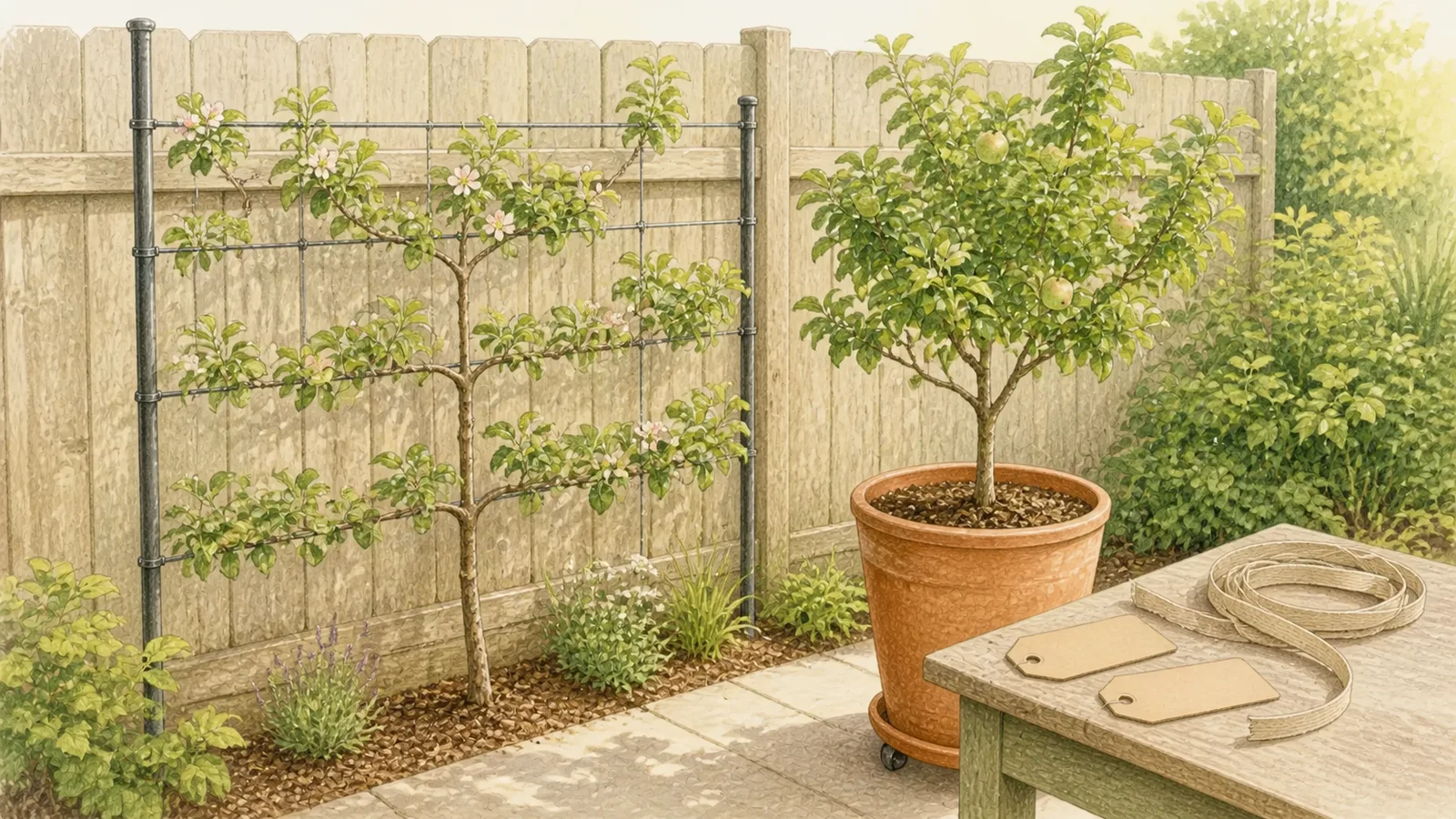
Also decide how the space will be used. A tree centered in a small lawn needs a different shape from an espalier trained along a fence. A narrow side yard may fit a flat trained canopy but not a broad freestanding crown. A patio container needs stable footing, drainage management, and a route wide enough to move the tree when necessary.
Do not plan to keep a standard-size tree permanently tiny through improvised pruning. Start with a rootstock and training system designed for the available space.
Check 2: Separate hardiness zone from fruiting climate
The USDA Plant Hardiness Zone Map groups locations by average annual extreme minimum winter temperature. It helps estimate whether a perennial can survive regional cold. It does not promise a harvest.
A tree can survive winter yet flower at the wrong time, lose buds to a late freeze, struggle in summer heat, or fail to complete fruit before autumn. Utah State University Extension notes that hardiness zones do not account for growing-season length. Local spring and fall frost timing, summer heat, humidity, disease pressure, and microclimate all matter.
Use the zone as one climate filter, then ask a county Extension office or reputable regional nursery whether the exact cultivar and rootstock perform locally. A south-facing wall can warm and advance bloom. A low pocket can collect cold air. Two yards in the same ZIP code can expose flower buds to different risks.
Check 3: Verify chill needs and bloom timing
Many deciduous fruit trees require a period of winter chill before buds resume normal growth. A common simple model counts hours below 45°F, though other models account for changing temperatures differently.
University of California Agriculture and Natural Resources explains that chill requirements vary by species and cultivar. Insufficient chill can lead to delayed leaf growth, a long uneven bloom, bud deterioration or drop, and few or no flowers.
More chill is not automatically safer. A low-chill cultivar may wake during a warm spell and expose flowers to a later freeze in some climates. A high-chill cultivar may never receive enough cool weather in a mild winter. The best choice fits both the local chill pattern and the risk window for bloom.
Ask the seller for the cultivar’s chill requirement and the model used to estimate it. Compare that with a regional source, not a generic national map. Container culture does not erase dormancy needs; a potted temperate tree still experiences the climate, while its exposed roots may need more winter protection than roots in the ground.
Check 4: Read the cultivar and rootstock as one product
Most nursery fruit trees are grafted. The upper fruiting variety is the scion or cultivar; the lower root system is the rootstock. The combination determines much more than the fruit name on the front of the tag.
University of Minnesota Extension explains that apple rootstock affects mature height and how soon a tree may bear, but good selection also considers soil, climate, cultivar, training system, and disease resistance.
“Dwarf” is not one standardized mature size. Apple rootstocks range from strongly dwarfing to standard, with several classes between them. Pears and cherries have fewer size-controlling choices in some regions, while dwarfing rootstocks are generally less effective or less available for peaches, plums, and apricots, according to Utah State Extension.
Strongly dwarfing rootstocks often need permanent staking or trellis support. A tree that fits a narrow strip but falls without support is not a complete plan. Ask the nursery for:
- the exact rootstock name, not only “dwarf” or “semi-dwarf”;
- expected mature height and width in local conditions;
- anchorage or permanent support needs;
- soil and drainage compatibility;
- resistance or susceptibility to important regional diseases and pests;
- whether the graft union must remain above the soil line.
Genetic dwarf trees, columnar forms, espalier, and multi-graft trees solve different problems. A genetic dwarf has compact growth in the cultivar itself. A columnar apple may stay narrow but still needs appropriate rootstock and pollination. Espalier controls the canopy in a plane through training and annual pruning; it is not a naturally maintenance-free tree. Oregon State’s home-orchard guide notes that varieties grafted onto one tree can grow at different rates and be harder to prune, so a multi-graft tree needs compatible bloom timing and balanced training.
Check 5: Confirm pollination at cultivar level
The phrase “self-pollinating” is too loose for an expensive plant decision. Use “self-fruitful” only when a reliable source says the named cultivar can set an acceptable crop with its own pollen. Even then, a compatible second cultivar may improve yield in some cases.
Penn State Extension’s fruit pollination guide summarizes the broad patterns:
- apples generally require compatible cross-pollination for an adequate crop;
- most sweet cherries need another compatible cultivar, though self-fruitful selections exist;
- tart cherries and most peaches are generally self-fruitful;
- pears commonly crop better with a pollinizer;
- plum requirements vary by type and cultivar.
Broad patterns are only a starting point. Effective partners need overlapping bloom and compatible, viable pollen. Two apple trees are not automatically a compatible pair. A nearby ornamental crabapple may help in some situations, but its bloom timing and pollen compatibility must still match.
Before buying, identify the recommended pollinizer and confirm that it will flower at the same time in the local climate. If relying on a neighbor’s tree, consider distance, removal risk, and whether the cultivar is known. For a one-tree yard, select a verified self-fruitful cultivar or a carefully designed multi-graft tree rather than hoping an unknown tree is close enough.
Check 6: Price the annual work
The purchase price is only the first cost. Oregon State University Extension emphasizes pruning, irrigation, harvesting, and pest or disease management as recurring parts of backyard fruit-tree care.
Estimate whether the household can handle:
- training and pruning at the correct season;
- fruit thinning when a heavy set could break branches or reduce fruit quality;
- regular irrigation through establishment and dry weather;
- sanitation of fallen fruit, leaves, and prunings;
- netting or other bird and wildlife protection where appropriate;
- monitoring for regional pests and diseases;
- harvesting the full crop before it spoils;
- ladder-free access or safe professional pruning as the tree grows.
Choose locally adapted, disease-resistant cultivars when possible. That can reduce intervention, but it does not create a zero-care tree. Avoid generic spray calendars. In the United States, the EPA explains that pesticide use must follow the label, including the crop or site, rate, timing, protective equipment, and any preharvest interval. Labels can also contain bloom-time or time-of-day restrictions intended to protect pollinators; the EPA’s pollinator guidance explains those measures.
Will a container fruit tree actually work?
Container culture can make a fruit tree possible on a patio, but it concentrates the management. The root zone heats, cools, dries, and becomes congested faster than soil in the ground.
UC Master Gardeners of Sonoma County gives a 15-gallon nursery container as one starting example and explains that a crowded tree eventually needs root pruning, a larger pot, or planting out. That number is not a universal final size. Species, rootstock, climate, irrigation, and intended lifespan change the requirement.
A viable container plan includes:
- a tree and rootstock recommended for container culture;
- a wide, stable container with unobstructed drainage;
- quality container mix rather than dense garden soil;
- a support that cannot tip in wind;
- a watering plan for the hottest week, not only spring weather;
- controlled-release or measured nutrition based on regional guidance;
- root inspection and repotting access;
- winter protection appropriate to the roots and cultivar, recognizing that container roots can be more exposed to cold;
- a way to manage runoff and saturated weight.
Water, wet mix, the tree, and the container can create a substantial load. Confirm deck, balcony, lease, and building rules before placement. Use a wheeled base only if it is rated for the full wet weight and can be locked securely.
Container trees often produce a smaller crop than an established in-ground tree. That can still be worthwhile when the goal is seasonal blossoms, a modest harvest, or a movable plant. It is a poor fit when the expectation is grocery-scale production with little maintenance.
Three small-space decisions
One tree in a small yard
Prioritize a locally proven cultivar-rootstock combination, a mature canopy that fits without severe pruning, and confirmed pollination. Leave access around the tree for harvest and sanitation.
A narrow fence line
Consider an espalier-compatible apple or pear on suitable rootstock. Install the structural support first, leave access to both sides where possible, and commit to seasonal training. Confirm that the fence owner and local rules allow the system.
A sunny patio
Choose a verified container-suitable tree with realistic mature size and chill needs. Plan drainage, saturated weight, permanent support, irrigation, root maintenance, and winter conditions before ordering.
The nursery checklist
Bring these questions to the seller:
- What are the exact species, cultivar, and rootstock?
- What mature height and width should be expected locally?
- How many chill hours does this cultivar require, and which model is that estimate based on?
- Is it self-fruitful, and which compatible cultivar overlaps its bloom?
- Does the rootstock need permanent support?
- Which regional diseases or pests does it resist or commonly face?
- Can it remain productive in a container, and what long-term root care is required?
- What training, pruning, thinning, irrigation, and harvest work should be expected?
A good fruit tree is a matched system: cultivar, rootstock, pollination partner, climate, site, support, and care. Choose that system before choosing the fruit photo. The reward is not merely a tree that survives, but one that fits the yard and has a realistic path to flowering, fruiting, and remaining manageable.
Sources
- USDA Plant Hardiness Zone Map (U.S. Department of Agriculture Agricultural Research Service). Accessed August 24, 2026.
- Frequently Asked Questions About Fruit Production (Utah State University Extension). Accessed August 24, 2026.
- Deciduous Fruit Tree Chilling Hours (University of California Agriculture and Natural Resources). Accessed August 24, 2026.
- Choosing Apple Rootstocks and Ordering Bare Root Apple Trees (University of Minnesota Extension). Accessed August 24, 2026.
- Pollination Requirements for Various Fruits and Nuts (Penn State Extension). Accessed August 24, 2026.
- Growing Fruit Trees in Containers (UC Master Gardeners of Sonoma County). Accessed August 24, 2026.
- Ask an Expert: Dwarf Fruit Trees Bring Fruit to Small Spaces (Utah State University Extension). Accessed August 24, 2026.
- It Is Time to Buy, Plant, Prune and Protect Backyard Fruit Trees (Oregon State University Extension). Accessed August 24, 2026.
- Growing Tree Fruits and Nuts at Home (Oregon State University Extension). Accessed August 24, 2026.
- Protecting Trees and Shrubs in Winter (University of Minnesota Extension). Accessed August 24, 2026.
- Pesticide Labeling Questions and Answers (U.S. Environmental Protection Agency). Accessed August 24, 2026.
- Tools and Strategies for Pollinator Protection (U.S. Environmental Protection Agency). Accessed August 24, 2026.