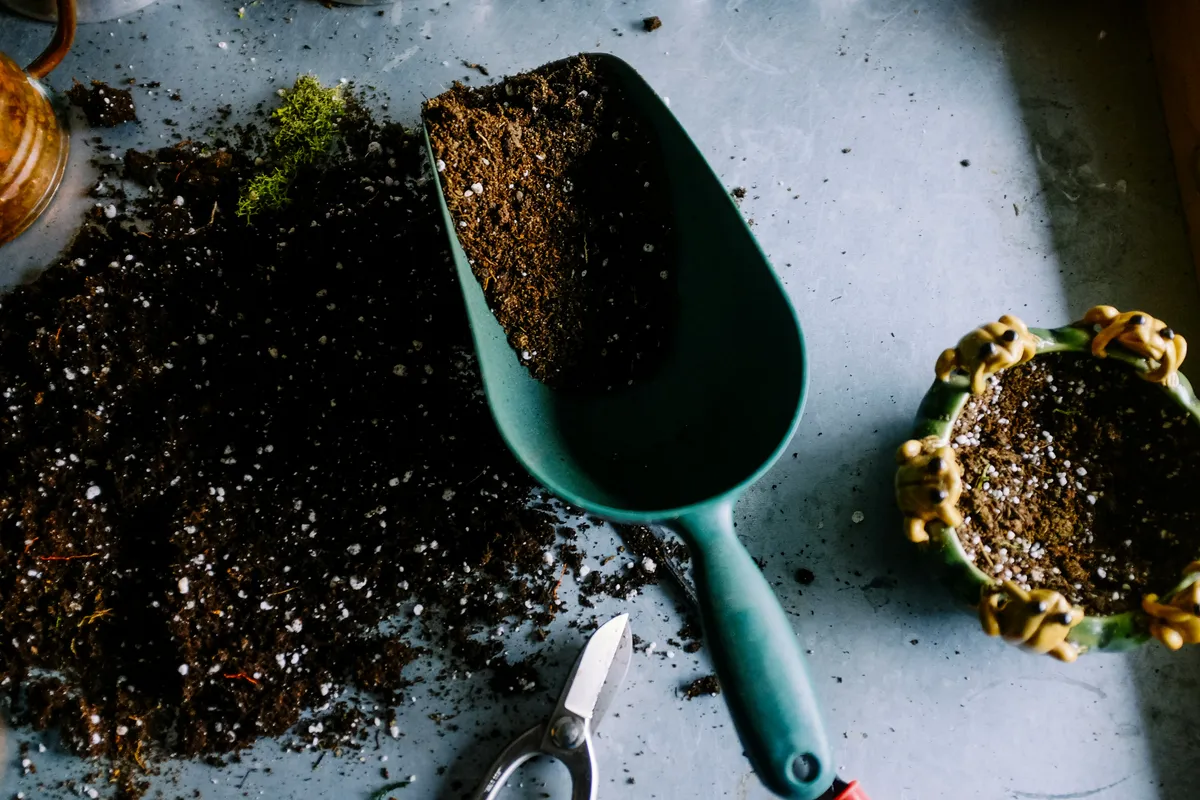
There is no single “best” houseplant soil recipe. A useful potting medium must hold a workable amount of water, leave air around roots, support the plant, and accept nutrients without becoming dense or waterlogged. The right balance changes with the plant, pot, indoor climate, and watering habits.
That is why copying a fixed online recipe can disappoint. A mix that dries appropriately in a warm, bright room may remain wet for too long in a cool, dim apartment. A small unglazed pot may need more water retention than a large plastic pot holding the same species. The practical goal is not to imitate a brand or chase a perfect ratio. It is to understand what each component contributes and adjust one variable at a time.
Start with the job of a container medium
Roots in a pot cannot explore surrounding ground for a better pocket of air, water, or nutrients. The limited root zone makes the medium especially important. University of Maryland Extension describes three central functions: supplying air, retaining water and nutrients, and anchoring the plant.
A functional houseplant medium therefore needs:
- Water-holding capacity: enough available moisture that fine roots do not dry immediately.
- Air-filled pore space: openings that remain after watering so roots can exchange gases.
- Drainage: a route for excess water to leave the root zone and the container.
- Structure: particles that resist collapsing into a dense mass too quickly.
- Manageable fertility and pH: conditions suited to the plant rather than an uncontrolled dose of amendments.
“Fast draining” does not mean that water merely runs down the side of a dry root ball. Peat-based mixes can become difficult to rewet when very dry. Pre-moistening the medium before potting helps it absorb water evenly, as recommended in Penn State Extension’s repotting guidance.
Why garden soil is usually the wrong base indoors
Straight garden soil is generally too heavy for a small indoor container. Its fine particles can reduce air space and slow drainage; it may also introduce weed seeds, insects, or plant pathogens. Penn State advises using a quality soilless potting mix for houseplants rather than garden soil.
The word “soilless” can sound artificial, but it simply means the product is built from container-friendly materials rather than field soil. Common ingredients include peat moss or coir, composted bark, perlite, and vermiculite. Commercial mixes may also contain lime, fertilizer, minerals, or a wetting agent. Read the bag before adding anything: doubling an included fertilizer or liming agent can create a new problem.
Outdoor container guidance sometimes permits a small amount of topsoil in very large planters. That exception should not be treated as a houseplant recipe. Indoor pots have less weather, wind, and solar drying, and they need a predictable, lightweight root environment.
What common ingredients actually change
| Component | Main contribution | Important limitation |
|---|---|---|
| Peat-based or coir-based potting mix | Fine-particle base that retains water and supports roots | Can stay too wet when used alone; peat-based media can resist rewetting after severe drying |
| Composted pine or fir bark | Larger particles that add structure and air space | Particle size and decomposition vary; old bark eventually breaks down |
| Perlite | Lightweight mineral that improves drainage and aeration | Dust can irritate; dampen before handling and avoid crushing it |
| Pumice | Durable mineral pore space and added weight | Heavier and often more expensive than perlite |
| Vermiculite | Holds water and nutrients while retaining some air | Too much can keep moisture-sensitive plants wet |
| Finished, reliable compost | Organic matter and some slowly available nutrients | Quality, salts, maturity, and pathogen risk vary; not automatically a complete fertilizer |
| Coarse mineral grit or coarse sand | Weight and drainage in certain succulent mixes | Fine or play sand can fill pores and make a mix denser |
Penn State’s propagation guide summarizes the useful contrast: vermiculite holds water well, while perlite and bark provide strong drainage and aeration. Those are tendencies, not guarantees. Particle size matters. A bag of finely degraded bark behaves differently from coarse orchid bark, and crushed perlite behaves differently from intact particles.
A safer way to create a custom mix
For most homes, the lowest-risk approach is to start with a reputable commercial soilless potting mix, then adjust its physical properties. Building entirely from raw peat, lime, fertilizer, and micronutrients requires more control over pH and nutrient concentration than most household growers can verify.
Use these recipes as small-batch starting points, not universal prescriptions:
General tropical foliage plants
- 2 parts all-purpose soilless potting mix
- 1 part coarse perlite or pumice
- 1 part fine-to-medium composted bark
This creates more large pore space than the base mix alone while retaining meaningful moisture. It can suit pothos, philodendron, monstera, and many other foliage plants when the container drains freely.
Plants that prefer more even moisture
- 3 parts all-purpose soilless potting mix
- 1 part perlite or fine bark
This is a reasonable trial for plants that decline when they dry severely. It is not permission to keep the pot saturated. Roots still need drainage and air.
Cacti and many succulents
- 1 part potting mix
- 1 part coarse mineral component, such as coarse sand intended for horticultural use, pumice, or perlite
University of Minnesota Extension gives one part potting soil to one part coarse sand as a porous starting mix for cacti and succulents. Species differ, so observe the plant and drying behavior rather than assuming every succulent has identical needs.
Seedlings and fresh cuttings
Use a clean, fine-textured seed-starting or propagation medium rather than a chunky mature-plant blend. Large bark pieces can create uneven moisture around tiny roots. Penn State notes that propagation media should be light, moist, well aerated, and relatively free of pathogens.
Orchids, carnivorous plants, mounted epiphytes, and plants grown in semi-hydro systems need specialized media and are outside these general recipes.
Match the mix to the pot and the room
The medium is only one part of the water system. Before adding more perlite or bark, consider the other variables.
| Observation | Likely adjustment to test |
|---|---|
| Mix remains wet for many days and the plant is in low light | Increase light if appropriate; use a smaller pot or add coarse aeration material at the next repot |
| Water races around a shrunken, dry root ball | Pre-moisten slowly and repeatedly; do not assume the mix retains too much water |
| Plant wilts very soon after a thorough watering | Check for a root-bound plant, damaged roots, a very small pot, or an excessively coarse mix |
| Mix has collapsed into a dense, muddy texture | Replace degraded medium; adding material only to the surface will not restore pore space below |
| White crust forms on the pot or medium | Investigate fertilizer concentration and irrigation-water salts before adding more fertilizer |
Unglazed clay loses moisture through its walls; plastic and glazed pots do not. Small pots dry faster than large pots. Strong light, warm temperatures, moving air, and an actively growing plant all increase water use. Any recipe should be judged in that complete context.
Every primary container should have an unobstructed drainage hole. A decorative cachepot can hold the draining nursery pot, but accumulated water should be emptied. Extra-coarse material mixed throughout the root zone can change porosity; a decorative layer at the bottom does not compensate for a dense medium or a pot with no outlet.
Mix and test a small batch
- Read the base-mix label. Note fertilizer, wetting agent, peat/coir, bark, and any stated plant use.
- Measure by volume. Use the same scoop for each component so the trial can be repeated.
- Control dust. Work in ventilation, wear gloves, and lightly dampen dusty perlite or dry media before mixing. Follow package safety directions.
- Pre-moisten evenly. Add water gradually until the medium is uniformly damp but not dripping.
- Pot one representative plant. Avoid converting an entire collection to an untested formula.
- Water thoroughly and let it drain. Record how the pot feels when saturated and how long it takes to approach the plant’s normal watering threshold.
- Observe for several watering cycles. Adjust only after separating a medium problem from light, pot size, root health, and watering technique.
A squeeze test can reveal gross problems: a damp mix should hold together lightly but separate again with gentle pressure. It should not behave like sticky mud or shed water as a hard, dusty clump. This is a practical screening tool, not a laboratory measurement of air porosity.
Fertility is separate from drainage
Perlite and bark do not feed a plant. Compost may contribute nutrients, but its analysis varies. A commercial base may already contain starter fertilizer. Check the label, then follow the fertilizer directions for the specific plant and product rather than adding concentrated amendments by instinct.
Do not add lime automatically. Peat can be acidic, but many packaged mixes are already adjusted. Different plants also prefer different pH ranges. Correcting an unknown pH with an unknown amount of lime is guesswork; a tested medium or a local Extension soil/media service is more reliable when pH is a suspected problem.
Reusing old potting medium
Media loses structure and nutrients over time. University of Maryland Extension suggests that disease-free outdoor container medium can be refreshed by combining it with fresh mix. For houseplants, reuse only material from healthy plants, remove old roots and debris, and reject any batch associated with root disease, persistent pests, sour odor, or severe salt buildup.
Sterilizing questionable medium in a household oven is not a good default: it can produce odors, does not restore structure, and requires temperature control. Replacing a small quantity is usually the more predictable choice.
The decision rule
A successful potting mix is one that supports healthy roots under the plant’s real conditions. Begin with a clean soilless base, add coarse structure only for a defined reason, use a draining container, and test a small batch. If the mix repeatedly stays saturated, collapses, or resists wetting, diagnose the whole container system before changing ratios again.
Custom mixing is valuable because it makes the root environment observable and adjustable, not because every houseplant needs a complicated recipe.
Sources
- Growing Media (Potting Soil) for Containers (University of Maryland Extension). Accessed August 5, 2026.
- Repotting Houseplants (Penn State Extension). Accessed August 5, 2026.
- Propagating Houseplants (Penn State Extension). Accessed August 5, 2026.
- Gardening in Containers (University of Georgia Cooperative Extension). Accessed August 5, 2026.
- Cacti and Succulents (University of Minnesota Extension). Accessed August 5, 2026.