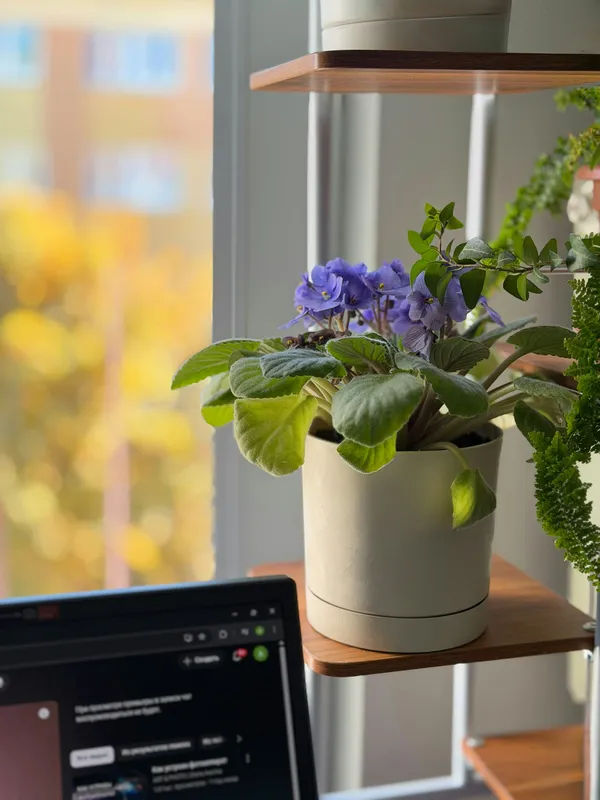
African violets are compact flowering houseplants, but their care is less forgiving of extremes than the word “violet” suggests. The familiar cultivated plants descend from species once placed in the genus Saintpaulia. Plants of the World Online accepts Streptocarpus ionanthus and lists Saintpaulia ionantha as a synonym. Nursery labels and older references still commonly use Saintpaulia, so either name may appear on the same kind of plant.
A healthy plant forms a low, fairly symmetrical rosette with firm leaves and repeated flower stalks. That result comes from steady conditions: usable light without scorching heat, a porous root zone that stays neither saturated nor bone-dry, room-temperature water, and restrained fertilizer. A single fixed schedule cannot account for differences in pot size, potting mix, season, indoor temperature, or light.
Establish a workable baseline
| Care factor | Useful starting point | Warning sign |
|---|---|---|
| Light | Bright, indirect window light or a properly positioned electric light | Long leaf stalks and few flowers, or bleached and crowded growth |
| Water | Water when the surface has begun to dry; drain the pot afterward | Persistent saturation, standing water, or severe wilt |
| Potting mix | Loose, porous, well-drained soilless mix | Dense, compacted mix that remains wet for long periods |
| Temperature | Stable indoor warmth away from cold glass and drafts | Chilled, water-soaked-looking tissue or slowed flowering |
| Fertilizer | Complete fertilizer at a low, label-directed rate during active growth | Crust on the mix or pot, burned leaf edges, or weak bloom after heavy feeding |
| Pot | Small draining container proportionate to the root system | Buried crown, blocked drainage, or a large wet volume around few roots |
Iowa State University Extension describes the central balance: African violets need enough light to flower, moist but well-drained mix, moderate indoor temperatures, and low-rate complete fertilizer. Adjust one factor at a time and judge the response in undamaged new leaves and later flower stalks. Existing spots, scorched tissue, and distorted leaves will not repair themselves.
Give the plant enough light to flower
Place an African violet near a bright window where strong midday or afternoon sun does not heat the leaves. An unobstructed north- or east-facing exposure is often a useful starting point, but compass direction alone is not a light measurement. Trees, screens, neighboring buildings, latitude, and season can make two east windows very different.
The plant’s shape provides useful evidence:
- Long petioles, an open rosette, dark thin leaves, and few flowers point toward inadequate light.
- Short, crowded growth with pale, yellowed, or bleached leaves can indicate excessive intensity.
- A compact rosette that produces flower stalks without bleaching suggests a workable position.
Electric lighting can supplement a dim window. Iowa State gives a broad example of 12 to 16 hours under fluorescent or LED lights positioned several inches above the plants, but fixture output varies. Start with the light maker’s plant-use instructions, keep foliage away from hot equipment, and change distance gradually. Provide a daily dark period rather than leaving a lamp on continuously.
Water the mix, not the calendar
Check the surface and the pot’s weight instead of watering on a named weekday. Water when the top of the mix has begun to dry but before the root ball becomes hard, shrunken, or severely wilted. Apply enough room-temperature water to moisten the root zone, then let the container drain fully.
Top and bottom watering can both work. Purdue University Extension advises keeping the crown dry and cold water off the leaves, whether water is applied to the mix from above or absorbed from a saucer below. For top watering, direct a narrow stream onto the potting mix beneath the leaves until water exits the drainage hole. For bottom watering, set the pot in shallow water only until the mix becomes moist, then remove it and discard the remainder.
Do not leave a conventionally potted violet standing in water. Continuous bottom watering can also move dissolved salts toward the surface. Purdue recommends periodic top flushing for bottom-watered plants so accumulated salts can drain away. A wick or reservoir system changes how water enters the mix, but it does not eliminate the need to inspect moisture, drainage, root health, and salt buildup.
African violet leaves do not “hate” all water. The more precise risks are cold water that causes visible spotting, water held in the crown, and foliage that stays wet under disease-favoring conditions. Blot an accidental crown spill and allow leaves to dry promptly. Do not mist as a substitute for watering the roots.
Use a porous mix and a proportionate pot
Fine African violet roots need both moisture and air. A packaged African violet mix or another fresh, porous soilless medium is a safer starting point than yard soil. University of Georgia Cooperative Extension recommends a sterilized or commercial violet mix and a container with drainage. Ingredient recipes are less important than performance: the medium should accept water evenly, drain, and regain air space as it dries.
Choose a pot only modestly larger than the existing root mass. An oversized container surrounds fine roots with more wet medium than they can use quickly. When repotting, keep the crown, the point where the leaves meet, above the mix. Do not bury it to stabilize a loose plant. A long bare “neck” can be corrected during a deliberate repot, but healthy leaves and the crown should remain above the surface.
Repot because the medium has compacted, drainage has slowed, salts have accumulated, the neck needs correction, or roots and plant size no longer fit the container. A calendar by itself is not proof that a larger pot is required. For broader help choosing a container, use the site’s houseplant pot guide rather than adding gravel or other material that does not correct a poorly draining mix.
Keep temperature and humidity in a household-safe range
African violets generally perform well in stable room temperatures. Iowa State gives 65–80°F as a useful range and notes that colder conditions can damage foliage while heat can slow growth and flowering. Keep the plant away from a cold windowpane, exterior-door draft, heating outlet, or air-conditioner stream.
Ordinary household humidity can be workable when water and light are managed well. Do not respond to every dry edge by saturating the potting mix or enclosing the plant. If the room is persistently dry, measure relative humidity before changing it and use the indoor humidity guide to avoid condensation or mold problems in the home. Good spacing and air movement are more useful than keeping leaves continually wet.
Fertilize lightly and watch for salts
Fertilizer supports growth only when light, temperature, and roots already permit growth. University of Florida IFAS Extension recommends dilute, regular fertilization and warns about soluble-salt injury. Check whether fresh potting mix already contains fertilizer, then use a complete water-soluble product whose label covers indoor flowering plants or African violets. Follow its rate and frequency rather than automatically applying “half strength” or feeding at every watering.
More phosphorus is not a reliable cure for a plant that will not bloom. Low light, unsuitable temperature, damaged roots, excess fertilizer, and insufficient fertilizer can all reduce flowering. A white or tan crust on the mix, pot, or saucer suggests soluble deposits. Pause fertilizer, confirm that the drainage hole works, and leach the mix with room-temperature water if the plant and pot can drain freely. The site’s houseplant fertilizer guide explains why adding nutrients before checking roots and light can make symptoms worse.
Diagnose patterns before treating them
| Pattern | Plausible causes to check first | First inspection |
|---|---|---|
| Few or no flowers | Insufficient light, temperature stress, too much or too little fertilizer | Compare new leaf shape, light duration, room temperature, and feeding record |
| Pale or bleached upper leaves | Excess light or heat | Check exposure during the brightest part of the day |
| Rings or pale spots on leaves | Cold water on foliage or physical splash injury | Review water temperature and application method |
| Limp plant in wet mix | Oxygen-starved or decaying roots, buried crown | Stop automatic watering and inspect drainage, crown, and roots |
| Rust-colored damage where petioles touch the pot | Fertilizer salts on a clay rim | Inspect the rim and surface for deposits |
| Distorted center growth | Mites, other pests, or crown injury | Isolate the plant and examine new growth with magnification |
| White cottony material | Possible mealybugs | Check leaf joints, undersides, pot rim, and nearby plants |
Clemson Cooperative Extension identifies excessive water, poor drainage, deep planting, contaminated medium, and pest infestations among important causes of decline. A soft crown or dark, mushy roots is more consequential than one old spotted leaf. Isolate a plant with a suspected pest or spreading disease, avoid unlabelled home remedies, and seek a local Extension diagnosis when the cause remains unclear. For help checking these problems and choosing a response, see the root-rot guide and mealybug guide.
Follow a repeatable care check
Once a week, look at the newest leaves, touch the mix, lift the pot if practical, and check the saucer or reservoir. Monthly, inspect the crown, leaf undersides, pot rim, and drainage opening; record any fertilizer application or major move. Remove spent flowers and fully dead leaves with clean tools without cutting into the crown.
The useful goal is not constant moisture or flowers every day. It is a stable rosette producing sound new leaves and recurring blooms under conditions the roots can sustain. When growth changes, review light, water, roots, temperature, and fertilizer in that order before adding another product.
Sources
- Streptocarpus ionanthus (H.Wendl.) Christenh. (Royal Botanic Gardens, Kew). Accessed August 25, 2026.
- All About African Violets (Iowa State University Extension and Outreach). Accessed August 25, 2026.
- African Violet Care (Purdue University Extension). Accessed August 25, 2026.
- Growing African Violets (University of Georgia Cooperative Extension). Accessed August 25, 2026.
- African Violet Diseases and Insect Pests in South Carolina (Clemson Cooperative Extension Home & Garden Information Center). Accessed August 25, 2026.
- African Violets (University of Florida IFAS Extension). Accessed August 25, 2026.