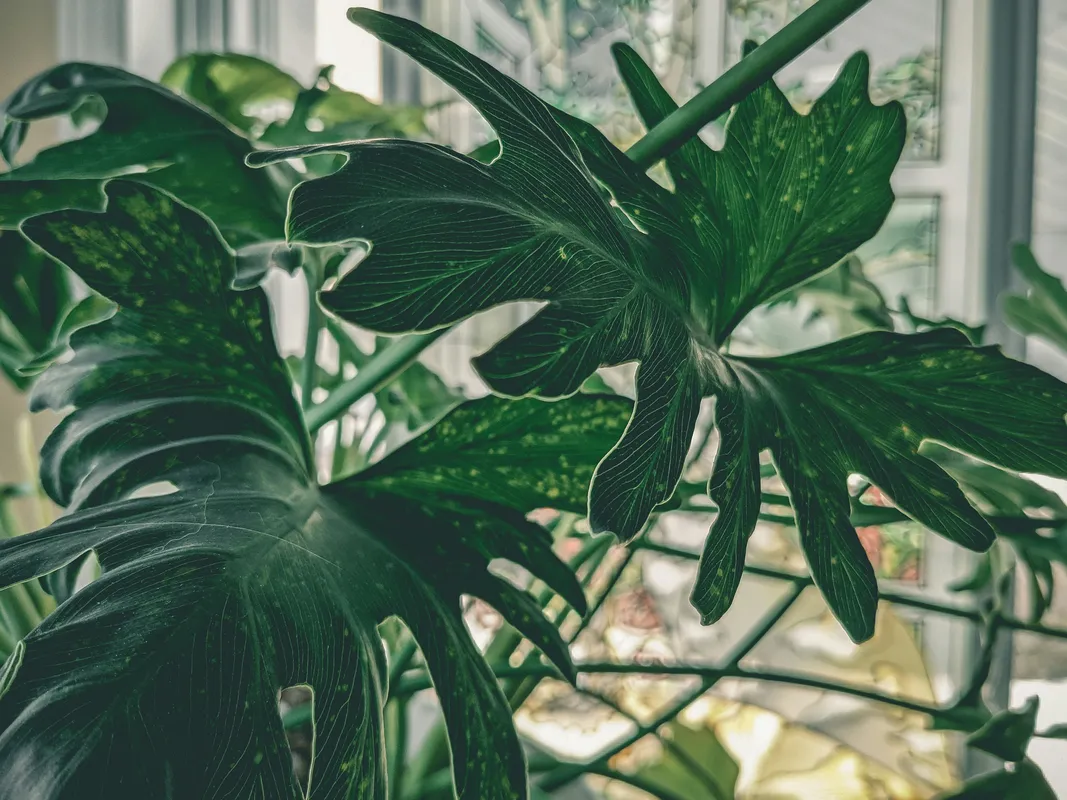
Relative humidity is one part of the growing environment
Relative humidity describes how much water vapor air contains compared with the maximum it could hold at the same temperature. The percentage can change when temperature changes even if no water is added or removed. A reading beside a cold window, heating vent, humidifier plume, or bathroom shower may therefore differ from the conditions across the rest of a room.
Humidity influences plant water loss. University of Georgia Cooperative Extension illustrates that, at the same temperature, a leaf loses water faster in very low relative humidity than at a higher level. That does not mean roots should be kept wetter to compensate. Root-zone watering, air humidity, light, temperature, and airflow interact, and excessive soil moisture can damage roots even while air is dry.
The practical objective is to identify a species that can tolerate the home, measure actual conditions, and make the smallest safe adjustment. Turning an occupied room into a tropical enclosure can create condensation, mold, and humidifier-maintenance problems long before it recreates a plant’s native habitat.
There is no universal houseplant percentage
Plants sold for indoor use come from deserts, seasonal forests, humid understories, tree canopies, and cultivated greenhouse lines. Leaf thickness, stomatal behavior, root condition, and acclimation all affect response. Penn State Extension states that an optimal humidity value is not exact and is not the same for every houseplant.
Penn State notes that indoor humidity during heating season can fall below 30 percent and cites a broad 30-to-60-percent building range from ASHRAE. For portable humidifier use, the EPA gives more conservative household guidance: do not humidify above 50 percent, and reduce output if condensation appears on windows, walls, or pictures.
Those recommendations serve different purposes. A plant source may describe conditions that favor a tropical species; EPA guidance addresses occupants and the building. In a shared living space, plant preferences do not override moisture, mold, respiratory, or property risks. A species that cannot perform within safe home conditions may be better suited to a small controlled enclosure or may not be a good match for that home.
Measure before changing anything
Use a digital hygrometer near the plant canopy, but outside direct mist and away from a vent, radiator, exterior glass, kitchen steam, or shower plume. Allow the sensor time to stabilize. Compare readings at several times over multiple days, including when heating or air conditioning runs.
Consumer hygrometers have measurement error. Two inexpensive units placed together may disagree. A second sensor can reveal a large discrepancy, but neither becomes a laboratory standard merely because they match. Use readings as a range and track meaningful trends rather than reacting to every one-percent change.
Record these details with humidity:
- room and exact sensor position;
- temperature;
- time and weather or heating status;
- recent watering or humidifier operation;
- condensation on glass or other surfaces;
- leaf and potting-mix condition.
This context prevents a temporary bathroom spike or direct humidifier plume from being mistaken for stable whole-room humidity.
Do not diagnose brown tips from humidity alone
Dry air can contribute to marginal browning or poor unfurling in sensitive plants, but those symptoms are not specific. Drought, salt accumulation, damaged roots, excessive fertilizer, hot or cold drafts, sun injury, and irregular watering can look similar. A leaf already browned will not turn green after humidity changes, so improvement should be judged by new growth and whether damage stops progressing.
Before increasing humidity, check:
- whether the species is documented as sensitive to dry air;
- whether root-zone moisture has been too wet or too dry;
- whether white mineral or fertilizer crust is present;
- whether foliage touches cold glass or sits in moving heated air;
- whether pests, especially mites, are visible under magnification;
- whether light and temperature match the species.
If soft lesions, spreading spots, gray growth, foul roots, or rapid decline appear, adding moisture may worsen the underlying problem. Penn State Extension’s indoor plant disease guidance emphasizes air circulation, avoiding overcrowding and overwatering, keeping leaves dry, and removing diseased tissue.
Compare humidity methods by scale and evidence
Choose tolerant plants and avoid dry-air sources
The lowest-risk strategy is matching plants to measured conditions. Cacti and many succulents generally tolerate drier air better than thin-leaved tropical species. Even for a humidity-sensitive plant, moving it away from a heating vent or cold window may reduce stress without adding water vapor to the building. Light at the new location must still be adequate.
Grouping plants may create a modest microclimate
Plants release water vapor through transpiration, so a group can differ from a single isolated pot. Penn State Extension describes grouping as a step commonly considered beneficial but notes that effectiveness likely depends on the number of plants and room size. Grouping is not a reliable substitute for measurement or a room humidifier.
Avoid packing foliage so tightly that leaves remain wet or air becomes stagnant. Leave space for inspection and isolate any plant with a suspected pest or disease.
Pebble trays have limited room-scale effect
Water evaporates from a tray, but the vapor disperses into the room. Penn State Extension concludes that a wet pebble tray makes almost no overall difference to room relative humidity. A sensor positioned immediately over a wide tray may detect a small local effect, but that does not justify claims of a fixed five- or ten-point increase.
If a tray is used to catch drainage, keep the pot above standing water unless the plant is intentionally managed with an appropriate sub-irrigation system. Empty runoff so roots do not remain saturated and pests do not gain a persistent water source.
Misting is temporary and wets leaves
Penn State Extension reports that the humidity increase from misting lasts only until droplets evaporate, potentially only minutes. Daily misting therefore does not establish stable room humidity. Wet foliage can also be undesirable where air movement is low or disease is present.
Misting may be part of a documented watering method for certain epiphytes, but that is different from controlling relative humidity for potted houseplants. Follow species-specific guidance rather than treating a spray bottle as a general solution.
Enclosures control a smaller volume
A terrarium, cloche, or plant cabinet can retain moisture around humidity-sensitive plants without humidifying an entire room. Penn State Extension identifies enclosed growing as an effective local approach. It also changes temperature, airflow, light transmission, and disease risk.
Use an enclosure only for compatible plants. Monitor both humidity and temperature, provide species-appropriate ventilation, keep electrical equipment rated for the environment, and respond to persistent condensation or disease. A sealed display is not maintenance-free.
A humidifier can change room humidity
A portable or central humidifier can make a measurable room-scale change, but it is also an indoor-air appliance that can disperse microorganisms and minerals when poorly maintained. EPA advises:
- use the unit only when conditions require it;
- do not raise indoor relative humidity above 50 percent;
- reduce output if nearby materials become damp or condensation forms;
- empty and refill portable units with clean water daily;
- use low-mineral water, such as distilled water, to reduce scale and mineral dispersal where appropriate;
- clean portable humidifiers every third day;
- follow the manufacturer’s cleaning, disinfectant, filter, and maintenance directions.
EPA also warns that steam vaporizers and boiling water can cause burns, especially around children. Product type, placement, cord routing, and access should reflect household risks. Never aim a plume directly at foliage, walls, books, electronics, or an unprotected sensor.
Product directions govern humidifier care
EPA provides general public-health guidance, but the appliance manual identifies which components can be submerged, which cleaners are compatible, how filters are replaced, and where the unit may operate. Unplug before cleaning. Do not mix cleaning chemicals, leave disinfectant residue in the tank, or add fragrance and plant products unless the manufacturer explicitly permits them.
If white dust appears, stop and review water mineral content and the unit’s demineralization instructions. If musty odor, visible film, or respiratory symptoms occur during use, discontinue operation and address the appliance and indoor-air concern. EPA recommends contacting a physician when respiratory symptoms appear associated with humidifier use.
Use a measured adjustment plan
- Identify the plant and find an authoritative species-specific humidity description.
- Measure canopy-level humidity and temperature across several ordinary days.
- Check water, roots, salts, light, drafts, and pests before attributing symptoms to dry air.
- Move the plant away from vents or cold glass if that improves conditions without sacrificing light.
- For modest needs, test grouping and remeasure rather than assuming a benefit.
- For a genuinely humidity-sensitive specimen, compare a ventilated enclosure with a properly maintained humidifier.
- If using a humidifier, follow EPA’s 50-percent ceiling, watch for dampness, and follow the appliance manual.
- Change one factor at a time and evaluate new growth over an appropriate period.
Decision guide
| Finding | What it suggests | Safer next step |
|---|---|---|
| Humidity is comfortable and growth is normal | No intervention is demonstrated | Continue monitoring |
| Sensor reads low only beside a heating vent | The location may be the main issue | Relocate within the plant’s light needs and remeasure |
| Brown tips occur with white crust on the mix | Dissolved salts may contribute | Review water and fertilizer before adding humidity |
| A sensitive species struggles while other conditions check out | Dry air remains plausible | Trial a measured local enclosure or maintained humidifier |
| Windows condense or walls feel damp | Indoor moisture is already excessive | Reduce output immediately and investigate moisture control |
| Leaves stay wet and spots spread | Disease risk may be rising | Stop misting, improve circulation, and seek diagnosis |
Humidity management should protect the plant, occupants, and building together. Measure first, treat symptoms as evidence rather than proof, reject methods that cannot change the relevant air volume, and follow public-health and manufacturer directions whenever a humidifier is used.
Sources
- Humidity and Houseplants (Penn State Extension). Accessed August 5, 2026.
- Growing Indoor Plants with Success (University of Georgia Cooperative Extension). Accessed August 5, 2026.
- Use and Care of Home Humidifiers (United States Environmental Protection Agency). Accessed August 5, 2026.
- Pest and Disease Problems of Indoor Plants (Penn State Extension). Accessed August 5, 2026.