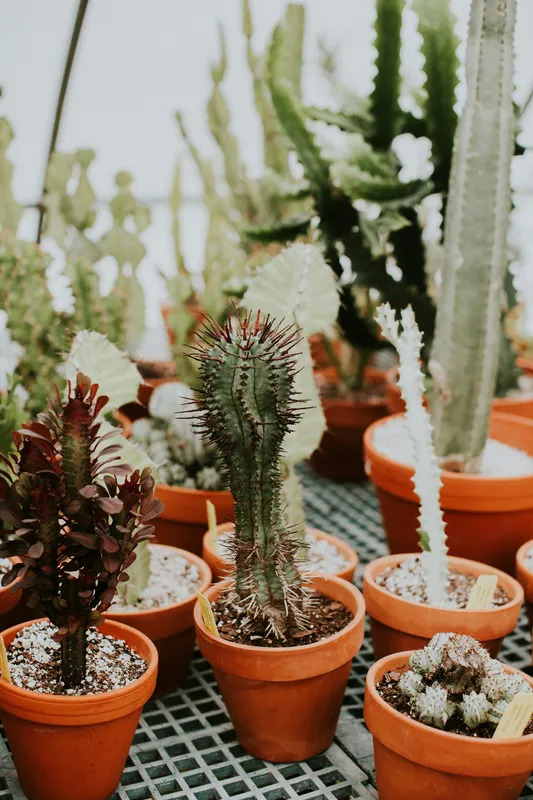
A useful houseplant pot does four things: it lets excess water escape, fits the current root system, moderates moisture in a way that suits the plant and caretaker, and remains stable in its intended location. Color and style can come after those decisions.
No material is universally best. An unglazed clay pot may help a dry-adapted plant lose moisture more quickly, while a nonporous plastic pot may reduce how often a moisture-loving plant needs water. The correct choice is a combination of plant biology, room conditions, and watering habits.
Start with a four-part decision
| Situation | Useful pot features | Main tradeoff to watch |
|---|---|---|
| Succulent or cactus in a humid room, especially with a frequent waterer | Drainage hole, modest size, porous unglazed clay | Mix may dry very quickly in heat or strong light |
| Fern or other plant that prefers more even moisture | Drainage hole, plastic or glazed container | Nonporous walls make overwatering less forgiving |
| Large or top-heavy floor plant | Broad, stable base or a weighted outer cachepot | Total weight can make safe watering and moving difficult |
| Decorative planter with no hole | Use it only as a cachepot around a draining inner pot | Hidden runoff must be emptied every time |
| Plant with a demonstrated need for consistent moisture | A well-designed self-watering pot may help | Reservoir systems are unsuitable for many plants that need a dry interval |
| Newly rooted cutting or small root ball | A small pot that closely fits the roots | A decorative oversized planter holds unnecessary wet mix |
This table is a starting point, not a substitute for identifying the plant. A pot cannot correct inappropriate light, a poorly matched potting mix, or watering on an inflexible schedule.
Drainage is the first requirement
University of Illinois Extension recommends containers with drainage holes for houseplants because excess water in a closed container can lead to waterlogging and root decline. A drainage hole also makes thorough watering practical: the mix can be moistened throughout, and the excess can leave rather than accumulating at the bottom.
Inspect the pot rather than trusting a label. The outlet should be open after the pot is filled, and the pot should sit high enough that a flat saucer does not seal the hole. A small piece of rigid screen can keep loose mix from escaping without plugging the outlet; avoid dense fabric or anything that prevents free flow.
Do not use gravel, pebbles, or broken pottery as a substitute for a hole. Illinois Extension’s container drainage guidance explains that a coarse layer at the bottom does not improve drainage through fine potting mix. Water remains in the mix above that interface, so the layer reduces usable root volume without solving the closed-container problem.
How to use a cachepot correctly
A no-hole decorative pot can still be useful as an outer cover:
- Keep the plant in a slightly smaller plastic or clay liner pot with unrestricted drainage.
- Remove the liner from the cachepot before watering.
- Water over a sink, tub, or collection tray until the root ball is evenly moist and runoff has slowed.
- Empty any water in the cachepot.
- Return the liner only after it has finished draining.
If the plant is too large to lift, design the setup so runoff can be removed reliably with an accessible tray. Do not allow the liner to stand in hidden water.
Size the pot to the roots, not the room
When a plant is genuinely root-bound, a new pot about 1 to 2 inches wider than the old one is usually a reasonable step. Penn State Extension recommends moving to a slightly larger container rather than making a dramatic jump. For very large plants, compare root-ball volume and depth as well as nominal diameter.
An oversized pot creates a large ring of mix that roots do not yet occupy. That extra mix can remain wet after the original root ball has used its available water, especially in low light or a nonporous pot. A bigger container therefore does not automatically mean fewer watering problems.
Before buying, slide the plant from its current pot and inspect it if this can be done safely. Dense circling roots, very little visible mix, and frequent drying despite thorough watering support a size increase. If there is ample mix and the roots are sparse, address watering, light, temperature, or mix structure before adding volume.
Depth matters too. Many shallow-rooted plants do not benefit from an unusually deep column of wet mix, while a tall plant needs enough root volume and base width to remain stable. Keep the plant at its existing planting depth when transferring it; do not bury the stem simply because the new pot is deeper.
Compare container materials
The University of Georgia Cooperative Extension notes that unglazed clay allows more air and moisture exchange through the pot wall, while glazed ceramic and plastic restrict that exchange. Material affects drying rate, but room temperature, light, airflow, plant size, and potting mix may have equally large effects. Check moisture rather than assuming a material follows a fixed watering schedule.
| Material or system | Effect on use | Often useful when | Important limitation |
|---|---|---|---|
| Unglazed terra cotta | Porous walls increase evaporation; pot is relatively heavy | A plant benefits from drying between waterings or a caretaker tends to water frequently | Requires closer moisture checks; can crack and may leave mineral deposits |
| Plastic nursery pot | Nonporous, light, inexpensive, and easy to lift from a cachepot | Moisture should be retained longer or the plant must be moved for watering | A large top-heavy plant may tip; wet mix dries more slowly |
| Glazed ceramic | Mostly nonporous and heavier than plastic | Decorative finish and stability are priorities | Heavy and breakable; verify that the drainage hole is functional |
| Concrete or stone planter | High mass can stabilize a large plant | A floor plant has a permanent, load-bearing location | Filled weight may be unsafe for one person to move or for a shelf to support |
| Cachepot plus liner | Separates appearance from drainage function | A decorative outer pot lacks a hole | Requires a routine for removing all hidden runoff |
| Self-watering container | A reservoir supplies water to the mix by capillary action | An identified plant benefits from relatively consistent moisture | Not a universal cure for missed watering; reservoir and wick must be managed correctly |
Illinois Extension describes self-watering containers as systems that move water from a reservoir by capillary action. They can fit plants with consistent-moisture needs, but they are generally a poor match for succulents and other plants that require the root zone to dry. Start with the plant’s moisture requirement, not the product category.
Match shape and stability to the location
A pot is part of a physical system that includes wet mix, foliage, a saucer, and sometimes a support. Test the system where it will live.
- Choose a broad base for a tall or asymmetrical plant.
- Confirm that a hanging-pot hook, shelf, or wall bracket is rated for the complete wet weight, not the empty container.
- Keep heavy and breakable pots away from ledges where children, pets, or a trailing vine could pull them down.
- Put a waterproof, adequately sized saucer beneath any pot placed on wood or another moisture-sensitive surface.
- Make sure drainage water can be emptied without lifting more weight than can be handled safely.
- Avoid narrowing pot openings that can trap a root ball and force destructive removal later.
If decorative stones are placed on the surface, remember that they can make moisture harder to assess and may be choking hazards. They do not improve drainage inside the pot.
Reuse and modify containers carefully
Used pots can be economical, but clean them before reuse and remove old roots, mineral crust, and potting residue. A pot that held a diseased plant should be sanitized using current Extension guidance for its material, or discarded if it cannot be cleaned safely. Never transfer the old mix from a diseased or pest-infested root ball into a healthy plant’s container.
Adding a drainage hole is not a casual fix for every decorative vessel. Some ceramic, glass, stone, or fiber-cement products can crack, shatter, release hazardous dust, or contain reinforcement when drilled. Follow the manufacturer’s instructions, use the specified bit and personal protective equipment, and do not modify a container of unknown composition. Using a removable liner is the safer option when the material is uncertain.
Pot-buying checklist
Before purchasing or repotting, answer each question:
- Identity: What moisture pattern does this plant require?
- Evidence: Is the root system actually crowded, or is another care problem causing the symptoms?
- Outlet: Does the inner plant pot have a working drainage hole?
- Size: Is the new container only modestly larger than the root ball?
- Material: Will its evaporation rate complement the potting mix, room, and watering habits?
- Stability: Will the complete, watered setup remain secure on its support?
- Runoff: Can every saucer, reservoir, or cachepot be inspected and emptied easily?
- Handling: Can the planted container be moved or serviced without an unsafe lift?
The best pot is not necessarily the most expensive or the most porous. It is the smallest stable container that gives the roots appropriate room, allows excess water to leave, and makes correct care repeatable.
Sources
- Get Started with Houseplants (University of Illinois Extension). Accessed August 5, 2026.
- Container Drainage Options (University of Illinois Extension). Accessed August 5, 2026.
- Growing Indoor Plants with Success (University of Georgia Cooperative Extension). Accessed August 5, 2026.
- Repotting Houseplants (Penn State Extension). Accessed August 5, 2026.