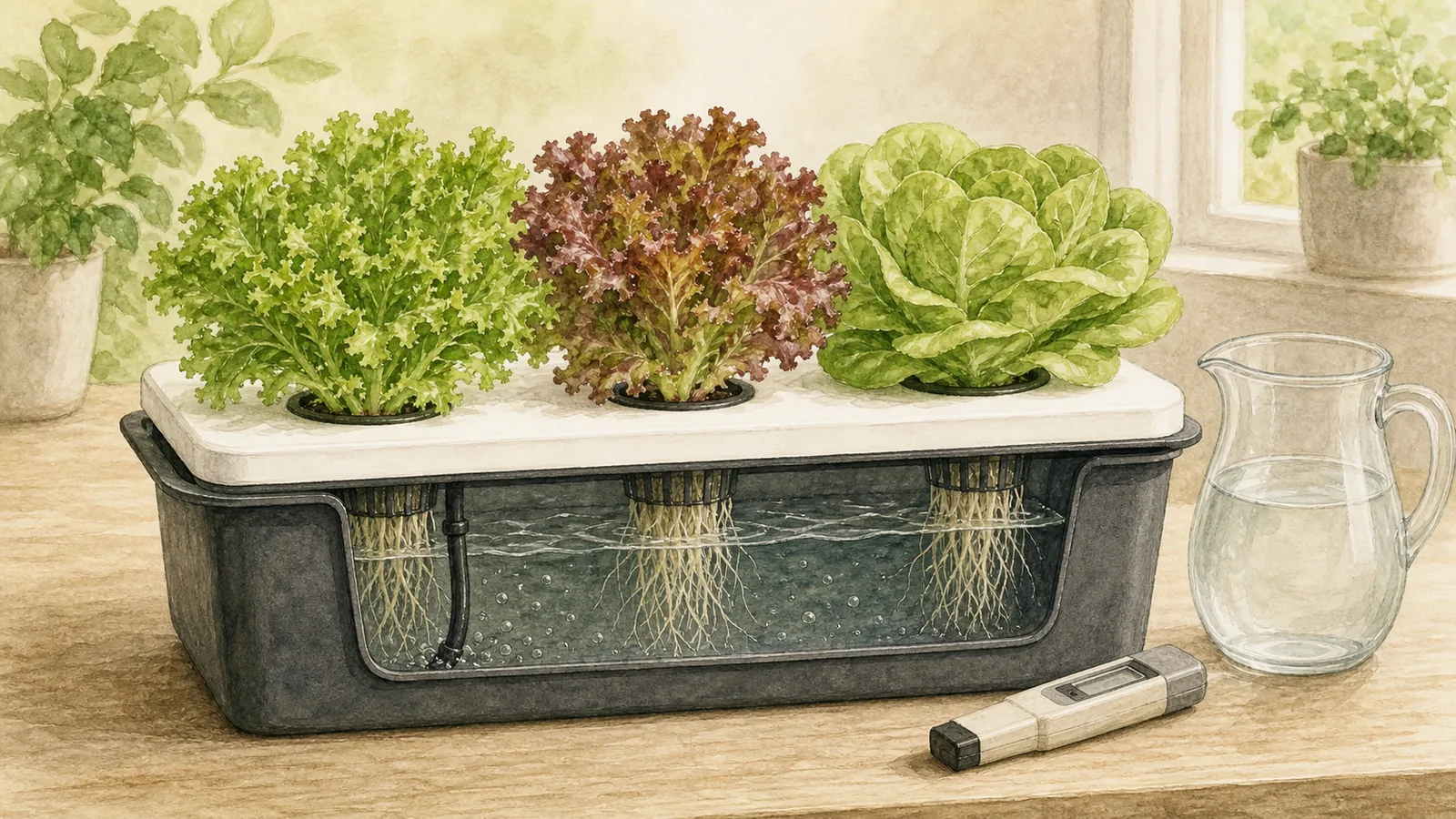
A lettuce experiment published on August 10, 2026, kept the same bulk hydroponic solution through 25 consecutive crop cycles and 707 days. Yield and nutrient uptake remained consistent even though the researchers did not empty the reservoirs after each harvest. That result sounds like permission to keep a countertop garden running forever. It is not.
The useful lesson is more interesting: a reservoir can sometimes be reused when water and every essential nutrient are replenished according to what the crop removes. The experiment depended on a calculated refill recipe, automated pH control, aeration, repeated tissue and solution measurements, controlled conditions, and adjustments between studies. It did not show that topping off an ordinary home unit with tap water or a fixed dose of bottled fertilizer will stay balanced for two years.
What the researchers actually did
The Utah State University study involved three deep-flow hydroponic studies in a glass greenhouse. Researchers grew three lettuce cultivars: Grand Rapids, Red Sails, and Rex. They used opaque 56-liter containers and maintained solution volume with a refill formula based on mass balance. Each container held eight plants of one cultivar and received continuous aeration at five liters of air per minute. The greenhouse ran at a 25/20°C day/night split, and automated equipment maintained the root-zone pH at 5.8.
Mass balance starts with a simple accounting idea. Nutrients added to a closed system must remain in the solution, enter the crop, or leave through another measured pathway. The researchers estimated how much dry plant material could be produced per liter of water transpired, combined that estimate with target whole-plant nutrient concentrations, and used the result to calculate the refill solution.
That refill was not plain water. Small, frequent additions replaced transpired water while supplying nutrients in proportions intended to match plant uptake. The solution was aerated, pH was actively controlled, and plant tissue and remaining solution were analyzed. When calcium, magnesium, sulfur, boron, and copper accumulated in an early study, later recipes supplied less of them. Potassium nitrate was adjusted to maintain nitrogen without continuing the calcium buildup.
The 707-day result came from 25 repeated plantings in the first study. Later studies refined the nutrient formula and tested a direct comparison: retaining the bulk solution versus replacing it after harvest. In that comparison, fresh replacement raised solution electrical conductivity but did not increase yield or nutrient uptake. It also did not reduce tipburn.
Why the EC number can mislead
Electrical conductivity, or EC, estimates how well a solution carries electrical current. Dissolved fertilizer salts increase that conductivity, so EC is a quick way to check the total ionic strength of a fresh fertilizer mix. It does not identify which ions are present.
That limitation becomes important in a reused reservoir. Lettuce can remove nitrogen, phosphorus, potassium, and manganese faster than it removes calcium, magnesium, or sulfur. A reservoir can therefore retain enough slowly absorbed ions to produce a respectable EC reading while running short of a nutrient the crop needs.
Purdue Extension’s EC guide makes the same distinction: a recycled solution can have a very different nutrient composition from a fresh mix even when the two share an EC value. EC is a useful total signal, not an ingredient list.
The new study pushed this point further. In the refined zero-discharge treatment, lettuce grew well at an EC near 0.3 millisiemens per centimeter. The fresh-replacement treatment was maintained near 1.0, yet the higher value did not improve growth. Those numbers should not become a new universal target. They describe a carefully designed, low-residual system whose active nutrients were continually replaced in the refill solution.
What the study did not prove
Several tempting conclusions go beyond the evidence:
- Each cultivar community used one tank in the long-running setup. Repeated harvests showed stability over time, but the design did not provide independent tank-level replication for each cultivar.
- It did not test every hydroponic crop, fertilizer, water source, reservoir size, temperature, or disease pressure.
- It did not show that EC and pH can be ignored. The study used automated pH control and measured solution chemistry.
- It did not show that a premixed fertilizer can be added indefinitely at its original full strength.
- It did not prove that cloudy, contaminated, overheated, or poorly aerated solution should be preserved.
- It did not offer a beginner-safe household recipe for concentrated acids or individual fertilizer salts.
The researchers used reagent-grade salts and concentrated acid in a controlled facility. Those methods require chemical knowledge and safeguards that do not belong in a casual kitchen experiment. A home grower should follow the instructions for the specific fertilizer and system rather than reverse-engineer the paper’s formula.
Light also matters. The trial maintained a daily light integral above 25 moles per square meter per day, which the authors describe as higher than common commercial and research levels. Yield differences among plantings tracked light. A dim countertop system cannot expect the same growth rate simply because its reservoir is managed carefully. The site’s grow-light guide explains why duration and intensity must be considered together.
A conservative reuse plan for a home system
The paper supports better observation, not a promise that dumping is obsolete. A home grower can use this decision sequence:
- Start with the manufacturer or crop program. Use a nutrient product intended for edible hydroponic crops and follow its mixing, replacement, sanitation, and harvest directions.
- Record the starting water. Source-water EC, alkalinity, sodium, calcium, and other dissolved minerals become part of the reservoir. A refill strategy that works with low-mineral water may not work with hard or saline water.
- Measure consistently. Calibrate EC and pH meters as their instructions require. Record readings, water additions, fertilizer additions, crop stage, temperature, and visible plant response.
- Top up deliberately. Replacing water lost to transpiration is not the same as replacing the nutrients harvested in leaves. Avoid alternating between random water-only and full-strength fertilizer additions.
- Keep oxygen and temperature in range. A nutrient calculation cannot rescue roots from a failed air pump, blocked circulation, or overheated solution.
- Reset when sanitation or chemistry is uncertain. Slime, bad odor, root disease, algae that cannot be controlled, an incorrect chemical addition, meter failure, or unexplained crop decline is a reason to stop and clean. Protecting an old reservoir record is not the goal.
For a fresh lettuce solution, a separate Purdue lettuce trial found better average growth at its two lower tested EC levels, 1.3 and 2.0 dS/m, than at 2.9 or 3.9 dS/m. That finding reinforces a broader principle: more dissolved fertilizer is not automatically better. It does not override the directions for a different product, crop, system, or water source.
When a reservoir replacement still makes sense
A full change can be a useful diagnostic reset. Consider it when the crop has shown a persistent imbalance, source water contributes unwanted salts, an unknown amount of nutrient was added, roots have declined, equipment was contaminated, or the next crop has meaningfully different requirements.
Dispose of spent nutrient solution according to the product label and local rules. Do not pour a concentrated fertilizer solution into a storm drain, stream, pond, or other surface water. When permitted, a properly diluted solution may have a landscape use, but local requirements and the actual ingredients matter.
The durable takeaway
The headline result is not “never change hydroponic water.” It is that stable production does not require chasing a high EC or discarding a well-managed solution by habit. The successful system replaced what lettuce removed, watched what accumulated, and refined the inputs with measurements.
For home growers, that means EC should be treated as one clue, not a complete nutrient report. Reuse can be reasonable while roots are healthy, equipment is clean, the crop is performing, and additions follow a known program. When those conditions break, a clean reset is better than trying to imitate a 707-day research result with incomplete information.
Sources
- Using mass-balance principles to optimize nutrition of lettuce (Frontiers in Plant Science). Accessed August 24, 2026.
- Details of Electrical Conductivity Measurements in Greenhouse Production (Purdue University Extension). Accessed August 24, 2026.
- Optimal Fertilizer Solution Concentration for Hydroponic Lettuce Production (Purdue University Extension). Accessed August 24, 2026.
- Hydroponics Systems: Nutrient Solution Programs and Recipes (Penn State Extension). Accessed August 24, 2026.