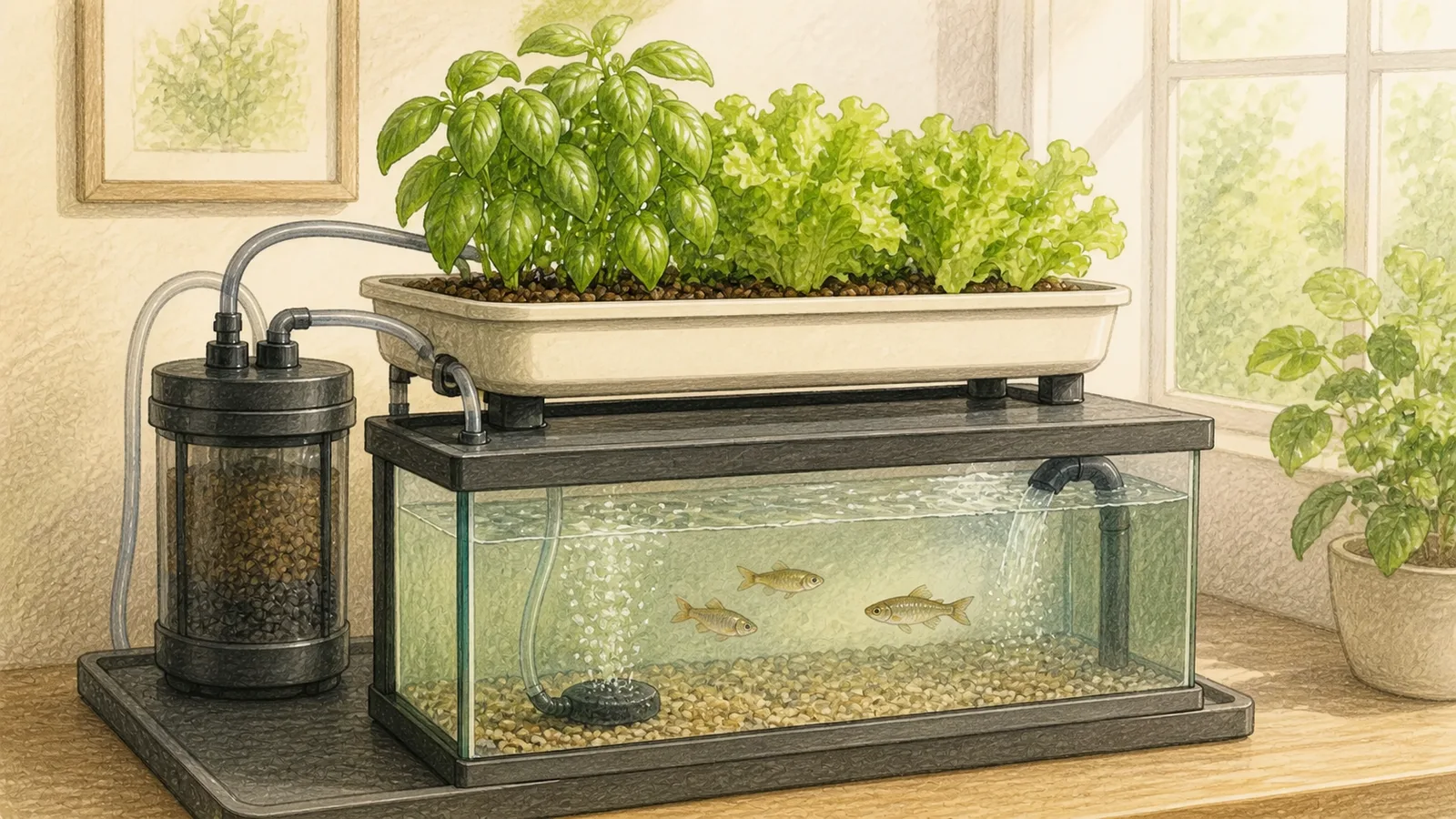
A basil plant can grow above a fish tank, but that does not make the setup self-balancing. A working aquaponics system is a recirculating aquaculture system joined to a soilless plant system. Fish, nitrifying microbes, plants, water movement, oxygen, and filtration all have to function together.
That distinction matters because the common shortcut of placing a plant basket over an ordinary aquarium leaves several jobs unplanned. Fish still produce solid waste and ammonia. Microbes still need an oxygenated surface on which to live. Plant roots need oxygen and support. The pump must move enough water without overflowing the grow bed. The fish and crop must also tolerate the same temperature and water chemistry.
The result can be a rewarding household project, but it is closer to maintaining a small life-support system than decorating a tank.
What counts as aquaponics
In the basic loop described by Oklahoma State University Extension, water leaves the fish tank, passes through solids removal and biological filtration, reaches the plant unit, and returns to the tank. Microbes convert ammonia or ammonium first to nitrite and then to nitrate. Plants take up nitrate and other dissolved nutrients while the cleaned water recirculates.
Every part has a distinct job:
- Fish tank: provides stable water volume and enough room for the chosen fish.
- Mechanical filtration: captures uneaten feed and solid waste before it accumulates in roots or plumbing.
- Biofilter: provides oxygenated surface area for nitrifying microbes. In a small media-bed design, the growing media may perform some or all of this job.
- Plant bed: holds roots in a media bed, a nutrient-film channel, or a floating-raft unit.
- Water pump and return: circulate water through the loop without draining or overflowing the fish tank.
- Aeration: supplies oxygen to fish, microbes, and roots. Water movement alone may not provide enough.
- Test equipment: tracks pH, ammonia, nitrite, nitrate, and temperature. A dissolved-oxygen meter is especially useful when stocking or system load increases.
A decorative aquarium with pothos roots in the water can be a planted aquarium, but it is not automatically an edible-food system. It may use treatments, fertilizers, materials, or livestock choices that were never selected for that purpose.
Start with the loop, not the fish
New tanks do not arrive with a mature biological filter. The microbes that process ammonia need time, oxygen, suitable temperature and pH, and enough surface area to establish. Adding a full fish load before that filter is ready can expose fish to harmful ammonia and nitrite.
Oklahoma State’s media-bed guide describes fishless and fish-in cycling methods. For a first household system, fishless cycling is the more conservative choice because the filter can be established and tested without using live fish as an ammonia detector. Follow a recognized cycling method or work with an aquaculture professional; random feed, fertilizer, or household ammonia additions can produce unknown concentrations or introduce unsuitable ingredients.
The system is not cycled merely because water looks clear. A practical readiness check uses repeated water tests to show that an added, measured ammonia source is being processed without persistent ammonia or nitrite accumulation. Continue testing after fish are introduced, because a filter sized for a light startup load may not handle a sudden increase in fish, feed, or temperature.
Water quality is a shared compromise
Fish, plants, and nitrifying microbes do not have identical preferences. FAO’s small-system guidance identifies dissolved oxygen, pH, temperature, total nitrogen, and alkalinity as central measurements. It gives broad small-system reference points of at least about 5 milligrams per liter dissolved oxygen, pH 6 to 7, and 18 to 30°C (64 to 86°F). Those are not universal settings.
A trout system, a goldfish system, and a warm-water food-fish system cannot share one temperature prescription. The correct range must work for the exact fish, crop, and microbial filter. Test-kit instructions, supplier guidance, and regional Extension advice should take priority over a generic internet chart.
Watch trends as well as single readings. Rising ammonia can reflect overfeeding, too many fish, a dead organism, reduced water flow, low oxygen, or a damaged biofilter. Falling pH can affect nitrification and fish health. A warm tank holds less oxygen than a cooler one, while fish and microbes may consume oxygen faster. Treat an unusual reading as a reason to reduce stress and identify the cause, not as permission to pour in several corrective products at once.
Match the fish, crop, and room
Leafy crops and herbs are the easiest place to begin because they generally demand less light and nutrition than fruiting tomatoes, cucumbers, or peppers. Basil, lettuce, pak choi, and other greens can suit a balanced system, provided their temperature and light needs match the fish.
Choose fish only after answering four questions:
- Is the species legal to possess, transport, and raise at the address?
- Can the room and equipment hold its required temperature year-round?
- How large will it become, and what social group or tank shape does it need?
- Is the goal ornamental fish, food fish, or simply plant production?
Tilapia appears in many aquaponics examples, but it is a tropical fish and is restricted in some states. It is not a default household recommendation. Contact the relevant state wildlife, agriculture, or aquaculture regulator before buying a regulated species. Never release aquarium fish into a pond, creek, or other natural water. The U.S. Fish and Wildlife Service explains how released aquarium fish can damage waterways and native communities.
If the real goal is a few kitchen herbs rather than keeping fish, a simple hydroponic or soil-based setup is usually cheaper and easier. Aquaponics makes sense when caring for the aquatic animals is part of the goal, not when fish are treated as a fertilizer dispenser.
Keep chemicals out of the shared loop
The fish tank and plant bed share the same water, so a product aimed at one half can harm the other. Ordinary hydroponic fertilizer can expose fish to unsuitable nutrient concentrations. Many aquarium medications can affect the biofilter or create food-crop concerns. Plant pesticides can be toxic to fish, including some products marketed as natural.
The Southern Regional Aquaculture Center guide hosted by Oklahoma State advises against pesticides in aquaponic crops and warns that fish treatments may be absorbed by vegetables. Use physical exclusion, sanitation, traps, removal, and other system-compatible integrated pest management first. If fish are ill, obtain aquatic veterinary or qualified aquaculture guidance rather than treating a connected edible system by guesswork.
Do not convert a medicated display aquarium into a food garden without evaluating every prior treatment and material. Food-grade system parts, fish-safe plumbing, and known inputs are easier to verify in a purpose-built unit.
Plan for the failure, not just the normal day
Pumps clog. Air tubing slips. Power fails. A siphon can stop or a return can overflow. Because fish and microbes continuously consume oxygen, a quiet pump failure can become urgent before the plants show any symptom.
Before adding fish, test the complete system with water only:
- unplug the water pump and confirm that backflow does not overflow any tank or bed;
- block a drain briefly and confirm that water cannot reach an outlet or floor;
- mark the normal operating water level and the maximum safe fill line;
- install a screened overflow path to a safe container or drain;
- keep plugs, power strips, and controllers dry and above splash level, routing cords according to the equipment maker’s instructions;
- use equipment rated for the location and properly installed ground-fault protection; the CPSC recommends GFCI protection where electrical equipment is near water, and a qualified electrician should handle installation when required or uncertain;
- keep a spare air pump, tubing, and air stone, plus a power-outage plan appropriate to the fish load.
An open tank is also a drowning hazard. Oklahoma State’s small-system guide says fish tanks must be protected so children and pets cannot fall in. Use a securely fastened cover or barrier designed to prevent access, place the system where it cannot be climbed, and do not treat loose mesh as a childproof cover.
The system also needs daily observation. Confirm that fish are behaving normally, pumps and air stones are running, returns are flowing, no water is leaking, and feed is being eaten. Remove uneaten feed rather than letting it decay. FAO emphasizes adequate aeration and circulation, conservative stocking, and avoiding overfeeding because excess waste consumes oxygen and destabilizes water quality.
Harvest it like food
Aquaponic produce is not sterile. University of Vermont Extension explains that recirculating water can spread contamination and that water-contact surfaces can become food-contact surfaces. Design the system to keep production water off edible leaves, clean appropriate water- and food-contact surfaces, keep harvest tools dedicated and clean, and exclude pets from the growing and harvest area.
The FDA recommends rinsing homegrown produce under running water before preparing or eating it. Do not use soap, detergent, or commercial produce wash. Washing reduces surface bacteria but does not eliminate every risk, which is why clean inputs and equipment matter throughout the growing cycle.
Fish intended for food add another layer of rules involving species, feed, health treatments, harvest, and processing. Follow state requirements and qualified aquaculture guidance rather than assuming an ornamental-fish routine transfers to food production.
A sensible first build
For a beginner who genuinely wants both fish and herbs, a roomy, purpose-built media-bed system is easier to understand than a tiny desktop novelty. Use a covered tank sized for the mature fish, a stable grow bed with inert media, accessible plumbing, generous aeration, and room to service every component. Keep the initial fish and plant load below the system’s theoretical maximum.
Start with one or two leafy crops, record water-test results, and change only one variable at a time. Do not expand until ammonia and nitrite remain controlled, plants are growing, fish behavior is normal, and the household can maintain the routine during weekends, vacations, and outages.
The key question is not whether a plant can sit above a fish tank. It is whether the entire loop can keep fish, microbes, and plants within compatible conditions every day. When the answer includes filtration, cycling, testing, aeration, legal species, safe inputs, and a failure plan, the setup has moved from aquarium decoration toward real home aquaponics.
Sources
- Principles of Small-Scale Aquaponics (Oklahoma State University Extension). Accessed August 24, 2026.
- Nitrification and Maintenance in Media Bed Aquaponics (Oklahoma State University Extension). Accessed August 24, 2026.
- Recirculating Aquaculture Tank Production Systems: Aquaponics (Integrating Fish and Plant Culture) (Oklahoma State University Extension). Accessed August 24, 2026.
- Seven Rules of Thumb to Follow in Aquaponics (Food and Agriculture Organization of the United Nations). Accessed August 24, 2026.
- The Ornamental Fish Trade: An Introduction with Perspectives for Responsible Aquarium Fish Ownership (University of Florida IFAS Extension). Accessed August 24, 2026.
- Selecting and Serving Produce Safely (U.S. Food and Drug Administration). Accessed August 24, 2026.
- Don't Let It Loose (U.S. Fish and Wildlife Service). Accessed August 24, 2026.
- Produce Safety in Hydroponic and Aquaponic Operations (University of Vermont Extension). Accessed August 24, 2026.
- GFCI Fact Sheet (U.S. Consumer Product Safety Commission). Accessed August 24, 2026.