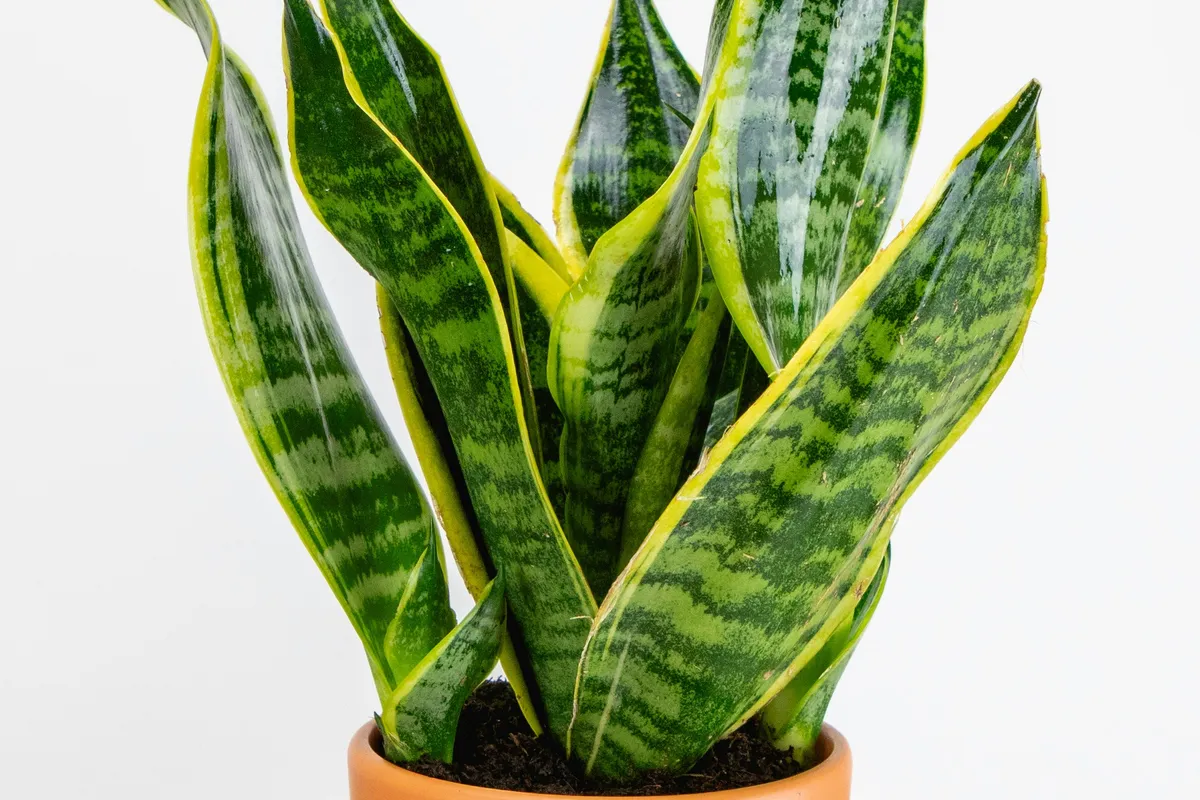
Snake plants offer two practical propagation routes at home: divide an established clump, or root upright sections cut from a leaf. Division preserves an existing crown and is the better choice when the parent has rooted offsets. Leaf sections can produce several starts from one healthy leaf, but patterned cultivars may not reproduce the parent’s leaf markings.
The familiar species is accepted as Dracaena trifasciata, although Sansevieria trifasciata remains common on plant labels. The Royal Botanic Gardens, Kew records the accepted name and its synonyms. Confirm the parent’s identity before labeling propagated plants, especially when a collection contains more than one species or cultivar sold under the broad name “snake plant.”
Once the new plant is established, the snake plant care guide covers watering, light, pests, toxicity, and routine maintenance.
Choose the method before cutting
Use the parent plant’s structure and the desired result to decide:
| Situation | Better starting method | Main tradeoff |
|---|---|---|
| Several crowns or offsets share a crowded pot | Division | Produces fewer plants, but each piece begins with roots and shoots |
| A patterned or edge-variegated plant must keep its appearance | Division | A viable rooted division is required |
| A healthy green leaf is available but there are no offsets | Leaf sections | Rooting and new shoots take patience |
| One leaf needs to become several starts | Leaf sections | Every section must remain right-side up |
| The plant is weak, soft at the base, or declining rapidly | Pause and diagnose | Propagation material must be sound |
Penn State Extension identifies both division and leaf cuttings as propagation options and describes offsets arising from the plant’s underground rhizomes. Division uses that existing growth instead of asking a detached leaf section to form an entirely new plant.
Leaf sections have one important genetic limitation. Iowa State University Extension and Outreach notes that chimeral leaf variegation may be lost when snake plants are propagated this way. A yellow-edged cutting, for example, may eventually produce an all-green shoot. Division is the more dependable route when preserving the parent’s pattern matters.
Prepare a clean work area
Gather a sharp knife or pruners, clean containers with open drainage holes, labels, and fresh propagation medium. A shallow tray can contain loose mix while the plant is out of its pot. If several cultivars are being handled, label the containers before making cuts.
Wash hands and remove soil and plant debris from the work surface. Clean cutting blades before starting and again after working on unhealthy tissue. The University of Maine Cooperative Extension emphasizes sanitary tools, containers, and media because cut surfaces are vulnerable to decay organisms. A sharp blade also leaves a cleaner wound than a crushed or torn cut.
Use a loose, clean medium intended for containers or propagation. The goal is physical support plus both moisture and air around forming roots. University of Illinois Extension recommends well-drained rooting media and warns against media that remain excessively wet. Garden soil is a poor substitute in a small indoor pot because it can compact and drain unpredictably.
Method 1: divide a rooted clump
Division fits a plant that already has two or more distinct crowns, shoots, or offsets. It is easiest to evaluate while repotting, when the root ball is already accessible.
- Water according to need, not as a ritual. Work with a root ball that can be handled without being either waterlogged or so dry that every root snaps away.
- Slide the plant out of its pot. Support the leaf bases and root mass rather than pulling on a single leaf. If the root ball sticks, loosen the container edge or compress a flexible nursery pot.
- Expose the connections. Gently remove enough loose mix to see where crowns, roots, and thick rhizomes join. Do not strip every root bare merely to make the division look tidy.
- Identify viable sections. Each division should retain a sound shoot or crown, a firm piece of rhizome, and useful roots. A leaf without roots is a cutting, not a division.
- Separate at a natural junction. Tease sections apart when they release easily. If a rhizome must be cut, make one deliberate cut with the cleaned blade instead of sawing through surrounding roots.
- Remove only failed tissue. Soft, collapsing material should not enter the new pot. If rot is extensive or the boundary between sound and failed tissue is unclear, stop and use the root-rot identification guide before proceeding.
- Pot each division at its previous depth. Set the crown above the mix rather than burying the leaf bases. Firm the medium just enough to hold the plant upright, then water as needed and allow all excess to drain.
A newly divided plant may pause while damaged roots recover. Do not respond automatically with extra water or fertilizer. Keep it in stable, appropriate light and judge moisture in the mix before watering again. The repotting guide can help you choose a container size and care for the plant as it settles in.
Method 2: root upright leaf sections
Choose one firm, mature leaf without spreading lesions, a soft base, or obvious pest damage. Removing many leaves from a small parent reduces the tissue available for photosynthesis, so take only the material the parent can spare.
- Remove the leaf cleanly. Cut near its base without damaging neighboring crowns.
- Divide it into sections. Make pieces large enough to remain upright and to place securely in the medium. Exact dimensions are less important than using healthy tissue and preserving orientation.
- Mark the basal end immediately. The end that was closer to the roots must go down. Make the bottom edge angled or add a pencil mark while every piece is still in order. Turning a section upside down prevents normal rooting.
- Allow wet cut surfaces to become dry to the touch. Keep pieces clean and out of harsh sun while preparing containers; do not impose a fixed waiting period regardless of room conditions.
- Insert the lower end into pre-moistened medium. Bury only enough to stabilize the section. Deep burial reduces the air available around the base.
- Settle the medium without saturating it. Water gently if needed, let the container drain fully, and never leave it standing in runoff.
- Provide stable light and warmth. Bright, indirect light supports the cutting without the heat and water loss of abrupt intense sun.
The NC State Extension Gardener Handbook explains that successful cuttings depend on a balance of moisture, aeration, light, temperature, and sanitation. That balance matters more than a calendar promise. Rooting speed changes with the cutting, medium, and growing environment, and roots form before a new shoot becomes visible.
Soil rooting is the main method here because it avoids a later transfer from water to potting mix. A whole leaf or correctly oriented sections can be rooted in water, but submerging too much tissue, ignoring decay, or potting fragile water-grown roots carelessly adds another transition. Water rooting is an optional observation method, not a shortcut or a guarantee.
Care while roots and shoots form
Check the medium itself rather than watering on the same weekday. A container should stay lightly moist enough to support developing roots but airy enough that the buried end does not remain saturated. Empty any outer pot or saucer after watering. A very large pot holds more wet medium than a small cutting can use, so choose a container proportionate to the material being rooted.
Do not tug on cuttings repeatedly to test them. That can tear new roots. Instead, watch for the section to remain firm and eventually produce a shoot from below the surface. A motionless leaf is not proof of failure; a softening, translucent, or foul-smelling base is a reason to inspect.
If one section begins to collapse:
- Isolate it from the others.
- Remove it from the medium and inspect the buried end.
- With a clean blade, recut above failed tissue only if a substantial firm section remains.
- Relabel the basal end before replanting.
- Discard a cutting if decay continues through the usable tissue.
- Reassess drainage and watering before replacing it beside healthy cuttings.
Avoid fertilizer while a cutting has no established root system. Fertilizer does not create roots and can increase soluble salts in a small volume of medium. Once a new shoot is growing and roots hold the mix together, transition gradually to normal snake-plant care.
When a propagation is established
A rooted division is established when it remains firm in the pot and resumes growth. A leaf cutting reaches the next stage after it has both roots and a new shoot; the original leaf section may remain visible for a long time. Do not separate a tiny shoot merely because it appears. Allow it to build roots and leaf area first.
Move an established start into a slightly larger draining container only when its root system warrants the change. Keep the same planting depth and avoid a sudden move into intense sun. Record the cultivar name and propagation method on the label, including “leaf cutting” where the resulting color may differ from the parent.
For another technique that uses individual leaves, compare the species-specific steps in propagating a jade plant. The shared principles are clean cuts, correct medium, and restrained watering; the plant structures and handling details are not interchangeable.
A concise propagation checklist
- Confirm that the parent material is firm, healthy, and correctly identified.
- Choose division to preserve a patterned cultivar or use an existing rooted offset.
- Choose leaf sections to multiply healthy green material.
- Clean the work area, blade, pots, and labels before cutting.
- Keep every leaf section in its original up-and-down orientation.
- Use fresh, airy medium and a container with working drainage.
- Keep conditions stable and allow time for roots and shoots to develop at their own pace.
- Remove decaying material promptly and correct the moisture problem.
- Wait for roots and active growth before fertilizing or repotting.
Propagation succeeds by matching the method to the plant. Division preserves an existing rooted crown; leaf sections ask healthy tissue to rebuild roots and shoots. Keeping that distinction clear prevents the two most avoidable disappointments: losing variegation and planting a leaf section upside down.
Sources
- How to Propagate Houseplants by Leaf Section Cuttings (Iowa State University Extension and Outreach). Accessed August 25, 2026.
- Plant Propagation in Maine (University of Maine Cooperative Extension). Accessed August 25, 2026.
- Cuttings (University of Illinois Extension). Accessed August 25, 2026.
- Extension Gardener Handbook: Propagation (NC State Extension). Accessed August 25, 2026.
- Snake Plant: A Forgiving, Low-maintenance Houseplant (Penn State Extension). Accessed August 25, 2026.
- Dracaena trifasciata (Prain) Mabb. (Royal Botanic Gardens, Kew). Accessed August 25, 2026.