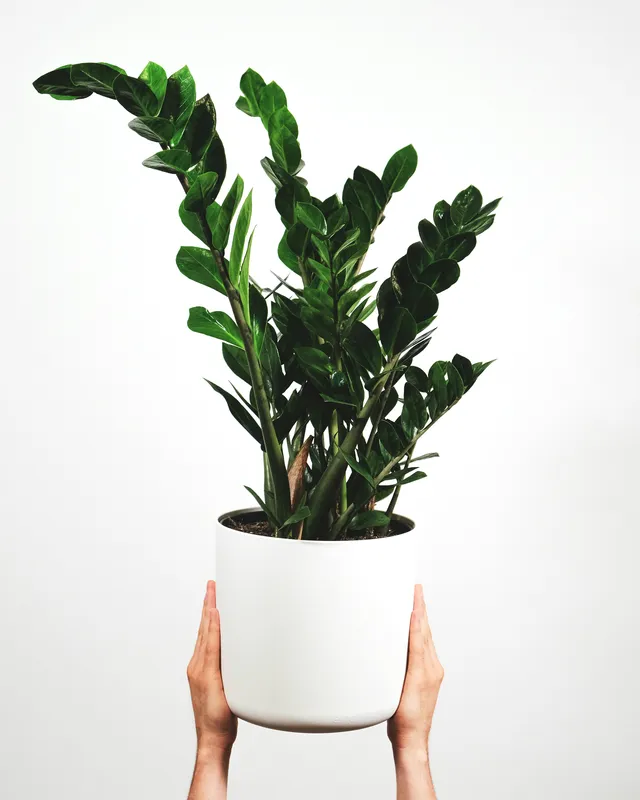
Division turns one established ZZ plant into two or more rooted plants. It works because Zamioculcas zamiifolia grows from thick underground rhizomes that store water and produce roots and compound leaves. The upright structures commonly called “stems” are thick leaf stalks bearing glossy leaflets. Plants of the World Online accepts Zamioculcas zamiifolia and places its native range from Kenya south to KwaZulu-Natal in seasonally dry tropical habitat.
This guide covers rhizome division only. Leaflet cuttings are another propagation method, but they take a different setup and much longer to form a rhizome. Repotting an intact plant is also a separate choice: a crowded ZZ does not have to be divided merely because it needs a safer container.
Decide whether division fits the plant
Choose a mature, healthy plant with several visible growth points and enough underground structure to make complete sections. Division is useful when:
- distinct clusters already occupy different parts of the pot;
- expanding rhizomes have distorted or cracked the container;
- the root ball is difficult to hydrate evenly; or
- multiple established plants are the actual goal.
Do not divide a recently stressed plant simply to investigate one yellow leaf. A ZZ with soft tissue, a foul root zone, or persistent wilt in wet mix needs diagnosis before propagation. The site’s root-rot guide covers that inspection. A healthy plant that only needs more room can remain whole and follow the low-stress repotting guide.
Iowa State University Extension describes division as separating a plant into smaller whole pieces with healthy vegetative parts and identifies ZZ plant as suitable for the method. Larger divisions generally recover faster than very small ones. There is no evidence-based rule that every division needs an exact count of two or three leaves.
Early spring is a convenient time because improving light can support recovery, but an indoor plant can be divided at another time when it is healthy and conditions are stable. Avoid combining division with a major move into harsh light, a cold draft, or another preventable stress.
Protect people, pets, and the workspace
ZZ plant contains calcium oxalate. The North Carolina Extension Gardener Plant Toolbox lists the plant as poisonous and describes vomiting or diarrhea after enough leaf material is consumed. Keep removed leaves, rhizomes, mix, and tools away from children and animals. Wear gloves if sap or plant debris irritates skin, avoid touching the face, and wash hands and tools after the work. Contact the appropriate poison-control or veterinary service if ingestion occurs; do not induce vomiting unless a professional directs it.
Cover the work surface so every rhizome can remain supported. Prepare:
- clean gloves and eye protection appropriate to the task;
- a clean, sharp knife or pruners for connections that will not separate by hand;
- fresh, well-drained indoor potting mix;
- clean containers with open drainage holes; and
- labels for the new pots.
Sterilize cutting blades according to the tool maker’s directions. Do not mix disinfectants, and let a treated blade dry before it touches plant tissue.
Make the root ball workable
The root zone should be cohesive enough to slide from the pot but not saturated. If the mix is hard and pulling away from the container, water early enough that excess can drain before division. If it is already wet, wait for it to become workable. “Water the day before” is not a universal instruction because pot size, mix, light, and season change drying time.
Remove a flexible nursery pot by laying it on its side, supporting the leaves near the base, and easing the root ball free. Cut or break a disposable container only when doing so can be controlled safely. Do not pull upward by a leaf stalk.
Brush or tease away enough loose mix to see the rhizomes and major roots. Full rinsing is usually unnecessary, but neither is there a botanical rule that ZZ roots must never touch water. The goal is visibility with the least damage. Support heavy rhizomes so their weight does not tear fine roots.
Map complete divisions before cutting
Look for natural gaps between rhizomes. Each planned division should retain:
- at least one firm, healthy rhizome;
- a useful group of sound roots; and
- at least one healthy compound leaf or active growth point.
The University of Illinois Extension similarly recommends selecting a healthy rhizome section with an attached aboveground shoot and adequate roots, then separating it by hand or with a clean sharp tool. That is a functional test, not a fixed stem-count formula.
Gently flex neighboring sections to find connections. Untangle roots with fingers where practical. If a thick connection must be cut, expose it, choose a line that preserves the most roots on both sides, and make one controlled cut. Do not saw blindly through the center of the root mass.
Set aside any tissue that is soft, translucent, hollow, foul-smelling, or extensively discolored. A firm tan or brown outer surface is not automatically rot, so compare texture and odor before removing tissue. Division is not a substitute for diagnosing an unhealthy plant.
Match each division to a draining pot
Choose a pot only modestly wider than the roots and rhizome section it will hold. A small division in a large volume of wet mix is harder to manage. The container material matters less than an open drainage hole, a proportionate size, and watering that responds to the mix.
University of Florida IFAS Extension confirms that ZZ can be propagated by separating and potting its tuber-like rhizomes. Its commercial production guidance also shows that rhizome size and number affect how quickly a pot fills. Those greenhouse production measurements are not household pot recipes, but they reinforce a useful principle: size the new container to the actual division rather than an arbitrary leaf count.
Add enough fresh mix to hold the plant at its former depth. Spread the roots without forcing sharp bends, then fill around them and firm gently so large air pockets collapse. Keep the rhizome near the same soil level it occupied before; burying leaf bases deeply can hold moisture against tender tissue.
Water enough to settle the mix if the division is healthy and the container drains freely, then empty runoff. If you made a large fresh cut, judge its condition rather than relying on a fixed drying timer. Handle the division cleanly, avoid further injury, and keep the mix from staying saturated.
Use plant-based aftercare
Place divisions in bright, indirect light while roots reestablish. Clemson Cooperative Extension notes that ZZ tolerates lower light but grows faster in bright indirect light, while direct sun can damage leaves. Keep the new pots in conditions similar to the parent rather than moving them immediately to the darkest or brightest available spot.
Check moisture below the surface and consider the pot’s weight. Water when the root zone has dried substantially, then wet the mix evenly and drain it. Do not water every few days to “help roots recover,” and do not impose a two- or three-week interval on every home. A small warm pot and a large cool pot will not dry together.
Fresh commercial mix may already contain fertilizer. Wait until the division is stable and producing or sustaining sound growth, then follow the fertilizer label if feeding is needed. A preset four- or six-week pause is less useful than checking the mix label, root condition, season, and growth.
Judge recovery without disturbing the rhizome
Existing leaves should remain firm, although an injured or older leaf can yellow after division. One yellow leaf does not prove that the whole section is failing. New growth may be slow because ZZ is naturally slow-growing. Avoid digging up a firm plant repeatedly to look for change.
Investigate when several leaves yellow while the mix stays wet, the base softens, the pot develops an odor, or the division becomes loose because roots are declining. Check drainage and moisture first. If inspection becomes necessary, remove the root ball once, document what is found, and correct the cause rather than cycling through water, fertilizer, and fungicide guesses.
| Observation | Check first | Response |
|---|---|---|
| Division leans in loose mix | Pot size, planting depth, root placement | Reposition once and support temporarily without burying the base |
| Mix stays wet for a long time | Oversized pot, low light, blocked drainage | Improve conditions and delay watering |
| Leaflets bleach or brown on one side | Direct sun or abrupt exposure change | Move back from intense light and monitor new tissue |
| One old leaf yellows | Physical injury and normal turnover | Remove only after it is fully declining; watch the remaining plant |
| Base becomes soft | Persistent moisture or damaged tissue | Isolate and inspect roots and rhizome promptly |
A successful division is not the greatest possible number of pieces. It is a small set of complete, healthy plants, each with a firm rhizome, useful roots, sound leaf tissue, and a pot whose moisture can be managed.
Sources
- Zamioculcas zamiifolia (G.Lodd.) Engl. (Royal Botanic Gardens, Kew). Accessed August 25, 2026.
- How to Propagate Houseplants by Division and Offsets (Iowa State University Extension and Outreach). Accessed August 25, 2026.
- Houseplant Spotlight: The ZZ Plant (University of Illinois Extension). Accessed August 25, 2026.
- Cultural Guidelines for Commercial Production of Interiorscape ZZ (Zamioculcas zamiifolia) (University of Florida IFAS Extension). Accessed August 25, 2026.
- ZZ Plant (Zamioculcas zamiifolia): Indoor Care, Growing Tips & Plant Guide (Clemson Cooperative Extension Home & Garden Information Center). Accessed August 25, 2026.
- ZZ Plant (Zamioculcas zamiifolia) (North Carolina Extension Gardener Plant Toolbox). Accessed August 25, 2026.