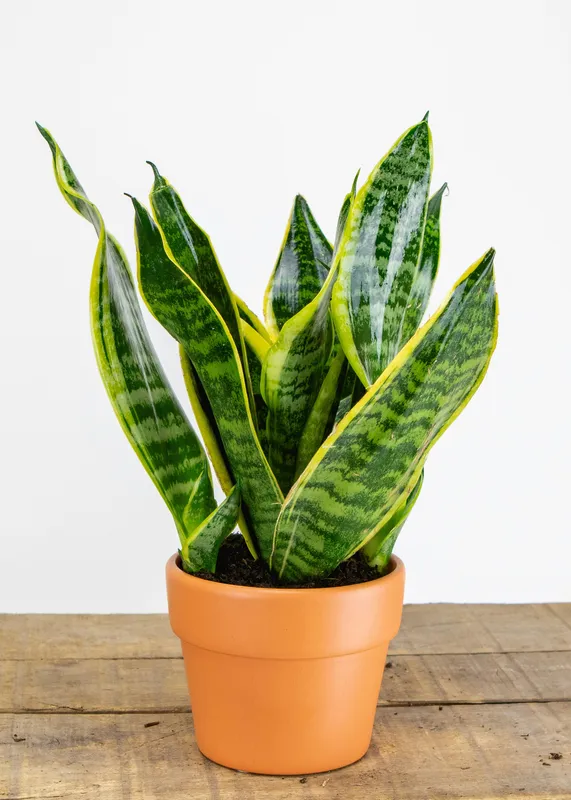
Snake plants tolerate a wider range of indoor conditions than many foliage plants, but they are not unkillable. The most consequential failure is usually a wet, poorly aerated root zone. Low light, cold exposure, unstable pots, pests, and physical damage can also produce symptoms that should not automatically be blamed on watering.
The accepted name for the familiar banded species is Dracaena trifasciata. It was long sold as Sansevieria trifasciata, and that older name still appears on labels. North Carolina Extension lists it as an erect, clumping, succulent perennial in the asparagus family, Asparagaceae. Other plants sold as “snake plants” may be different Dracaena species or cultivars, so growth form and size can vary.
Establish a workable baseline
| Care factor | Useful target | What to avoid |
|---|---|---|
| Light | Bright indirect light or limited gentle direct sun; lower light is tolerated | Total darkness or an abrupt move into hot, intense sun |
| Water | Soak the root ball, drain fully, then wait until the mix has dried | Small frequent splashes, standing runoff, or calendar-only watering |
| Potting mix | Loose, well-drained container mix | Dense garden soil or decomposed mix that remains saturated |
| Container | Working drainage hole and a stable base | Sealed decorative pot used without a draining liner |
| Temperature | Stable indoor warmth away from cold glass and drafts | Frost, cold drafts, or leaves pressed against a winter window |
| Fertilizer | Only during active growth and at the product label rate | Feeding a stressed plant or trying to force faster growth |
Penn State Extension recommends well-drained mix, containers with drainage holes, and watering only after the medium dries. Missouri Botanical Garden likewise describes the plant as drought tolerant but identifies overwatering as a common cause of root rot.
Light: tolerant does not mean light-free
A snake plant can persist in lower light, but brighter appropriate light generally supports stronger growth. Very dim placement slows both growth and water use, which means the pot may remain wet much longer after watering. A schedule that worked beside a bright window can become excessive after the plant moves into a dark corner.
Place the plant where it receives bright, indirect light or a limited period of mild direct light. North Carolina Extension reports tolerance of very low light and partial-day sun, while Penn State advises bright indirect light and protection from direct sun that could burn leaves. These recommendations are compatible: acclimated plants tolerate a range, but a sudden large increase is risky.
Move a plant toward stronger light in stages over a week or more. Existing pale, dry patches will not turn green again, so judge the change by undamaged new growth. Rotate only when needed for balanced presentation; repeatedly changing location makes water use harder to assess.
Water from evidence, not an interval
There is no universally correct “every three weeks” rule. Pot size, material, root density, mix, light, airflow, and season all change drying time. A small terra-cotta pot near a bright window may dry far sooner than a large glazed pot in low winter light.
Before watering:
- Test the mix below the surface with a finger, wooden skewer, or moisture assessment appropriate to the pot’s depth.
- Lift smaller pots and compare their weight with the weight just after a thorough watering.
- Check that no runoff is hidden inside a cachepot.
- If the mix is dry through most of the root zone, water slowly and evenly until excess exits the drainage hole.
- Let the pot finish draining and empty the saucer or outer pot.
Do not pour water repeatedly into the center of a tight rosette. Missouri Botanical Garden specifically cautions against water sitting in the rosette, and the root zone still needs even moisture. If dry mix has pulled away from the sides and water races through the gap, apply water in several slow passes so the root ball can rehydrate, then drain it completely.
Pot and mix choices
Use a packaged cactus, succulent, or other freely draining container mix. The exact ingredients matter less than the result: the mix should accept water, drain, retain some moisture for roots, and regain air space as it dries. Yard soil alone is too dense and unpredictable for most indoor containers.
Choose a pot only modestly larger than the root ball and confirm that its outlet works. Tall cultivars can become top-heavy; Penn State recommends a heavier container for taller forms. A weighted cachepot can provide stability, but the inner pot must be removed or otherwise allowed to drain, and accumulated water must be discarded.
Repot because the root mass has crowded out most mix, rhizomes are distorting the container, drainage has failed, or the medium has broken down. Do not repot simply because a fixed number of years has elapsed. Dense rhizomes can crack a pot. During repotting, keep the plant at the same depth and avoid placing a small root system in a large volume of wet mix.
Diagnose symptoms before acting
| Symptom pattern | More likely causes | What to inspect before treatment |
|---|---|---|
| Yellow leaf with a soft or translucent base | Saturated mix, cold injury, or root/crown decay | Moisture at depth, drainage, odor, and root firmness |
| Leaves wrinkle or fold inward while mix is dry | Prolonged water deficit | Whether the entire root ball is dry or water has bypassed it |
| Wrinkled leaves while mix remains wet | Damaged roots unable to take up water | Roots and rhizomes; do not add more water automatically |
| Dry tan patch on the window-facing side | Sunscald or contact with hot/cold glass | Recent location change and temperature exposure |
| Brown tip on an otherwise firm leaf | Old physical damage, salt accumulation, dryness, or temperature stress | Pattern across old versus new leaves and recent care changes |
| Plant leans or falls | One-sided growth, unstable container, loose root system, or basal decay | Pot stability and tissue firmness before staking |
| White cottony clusters or fine stippling/webbing | Mealybugs or spider mites | Leaf bases, undersides, and nearby plants |
A single yellow leaf is not enough to diagnose root rot. Older leaves can age naturally, and mechanical damage often leaves a permanent scar. Look for a pattern: several softening leaves, persistently wet mix, a failing base, and soft roots together are much stronger evidence of excessive moisture.
If root or rhizome rot is suspected
Stop watering and remove the plant from any standing runoff. If the base is collapsing, the mix smells abnormal, or decline continues while the pot stays wet, slide out the root ball and inspect it.
- Healthy roots and rhizomes should be firm.
- Failed tissue is soft, collapsing, and often discolored.
- Use a clean, sharp tool to remove only clearly failed sections.
- Keep at least one sound shoot with firm rhizome and roots in each salvageable division.
- Repot into clean, freely draining mix in a container sized to the remaining root system.
- Discard contaminated mix rather than using it for another plant.
Do not apply fertilizer, peroxide, cinnamon, or an unlabeled fungicide as a substitute for correcting drainage. When most of the crown or rhizome is affected, or the diagnosis is uncertain, contact a local Cooperative Extension office or plant diagnostic clinic.
Feeding, cleaning, and propagation
Snake plants grow slowly, particularly in lower light. Fertilize only when the plant is actively producing growth, using a houseplant fertilizer according to its label. More fertilizer cannot compensate for inadequate light, and accumulated salts can injure roots. If a plant is stalled, check light and root condition before feeding.
Wipe dust from the leaves with a damp cloth while supporting each blade. Leaf-shine products are unnecessary. Inspect the bases and both sides for mealybugs and spider mites, the occasional pests identified by both Penn State and North Carolina Extension. Isolate an infested plant while confirming the pest and selecting a treatment labeled for indoor houseplants.
Division is the most direct propagation method: separate a sound offset with roots and rhizome during repotting, then place it in a snug draining pot. Leaf cuttings are also possible, as noted by Missouri Botanical Garden, but they take time and may not reproduce the appearance of every variegated cultivar. A cut leaf will not repair itself, so remove damaged foliage only when it is failing or its appearance is unacceptable.
Child and pet safety
Snake plant should not be described as pet-safe. The ASPCA Animal Poison Control Center identifies saponins as the toxic principle and lists nausea, vomiting, and diarrhea after ingestion by dogs or cats. North Carolina Extension also flags the plant as a concern for children and notes that sap can irritate skin.
Keep the plant and fallen pieces out of reach, especially because stiff leaves can also poke eyes. Wear gloves if sap irritates the skin, wash hands and tools after cutting, and do not induce vomiting after an exposure unless a medical or veterinary professional directs it. For a child, contact Poison Control in the United States at 1-800-222-1222 or the appropriate regional service. For a pet, contact a veterinarian or animal poison-control service promptly; difficulty breathing, repeated vomiting, marked weakness, or severe symptoms require urgent care.
Monthly care checklist
- Confirm the plant still receives usable light and is not touching hot or cold glass.
- Check moisture at depth and inside the cachepot before deciding to water.
- Verify that the drainage outlet is open and discard runoff.
- Inspect leaf bases and undersides for pests, softness, or new discoloration.
- Compare new growth with older leaves rather than expecting old damage to heal.
- Check that tall foliage and the filled pot remain stable around children and pets.
- Fertilize only during active growth and only according to the label.
Snake plant care is forgiving when the root zone is allowed to dry and the container drains, but successful care still depends on observation. Diagnose the whole pattern before changing water, light, or soil.
Sources
- Snake Plant: A Forgiving, Low-maintenance Houseplant (Penn State Extension). Accessed August 5, 2026.
- Dracaena trifasciata (North Carolina Extension Gardener Plant Toolbox). Accessed August 5, 2026.
- Dracaena trifasciata (Missouri Botanical Garden Plant Finder). Accessed August 5, 2026.
- Snake Plant (ASPCA Animal Poison Control Center). Accessed August 5, 2026.