An ongoing multistate outbreak linked to alfalfa sprouts is a useful reminder that sprouts and microgreens are not interchangeable foods. They may begin with similar seeds, but their growing conditions, harvest stages, and food-safety risks are different.
As of August 24, 2026, the FDA outbreak investigation reports 55 illnesses across 15 states, four hospitalizations, and no deaths. The investigation involves multiple strains of Shiga toxin-producing E. coli and Salmonella Agona. FDA says not to eat, sell, or serve Calco or Everything Sprouts-brand alfalfa sprouts and advises cleaning and sanitizing surfaces or containers they touched.
The investigation is ongoing, so case counts, distribution details, and affected products can change. Check the FDA page itself rather than relying on an old social post or screenshot.
The immediate action is product-specific
The current advisory concerns alfalfa sprouts grown by Everything Sprouts and sold under the Calco and Everything Sprouts brands. It does not name every sprout or microgreen product. If a package matches the advisory, return it or discard it as FDA directs. Do not taste it to decide whether it is safe; harmful bacteria do not reliably change appearance, smell, or flavor.
Clean refrigerator shelves, containers, utensils, and counters that touched the affected product. Use a cleaning and sanitizing method appropriate for the surface and follow the product label. Anyone who ate the named sprouts and develops symptoms resembling an STEC or Salmonella infection should follow FDA’s advice to contact a health care provider.
This article cannot determine whether a particular illness came from sprouts. Severe symptoms, dehydration, bloody diarrhea, or concern about a child, older adult, pregnant person, or person with a weakened immune system warrant prompt professional guidance.
Sprouts and microgreens use different systems
Both crops begin with germinating seed, but the similarities stop quickly.
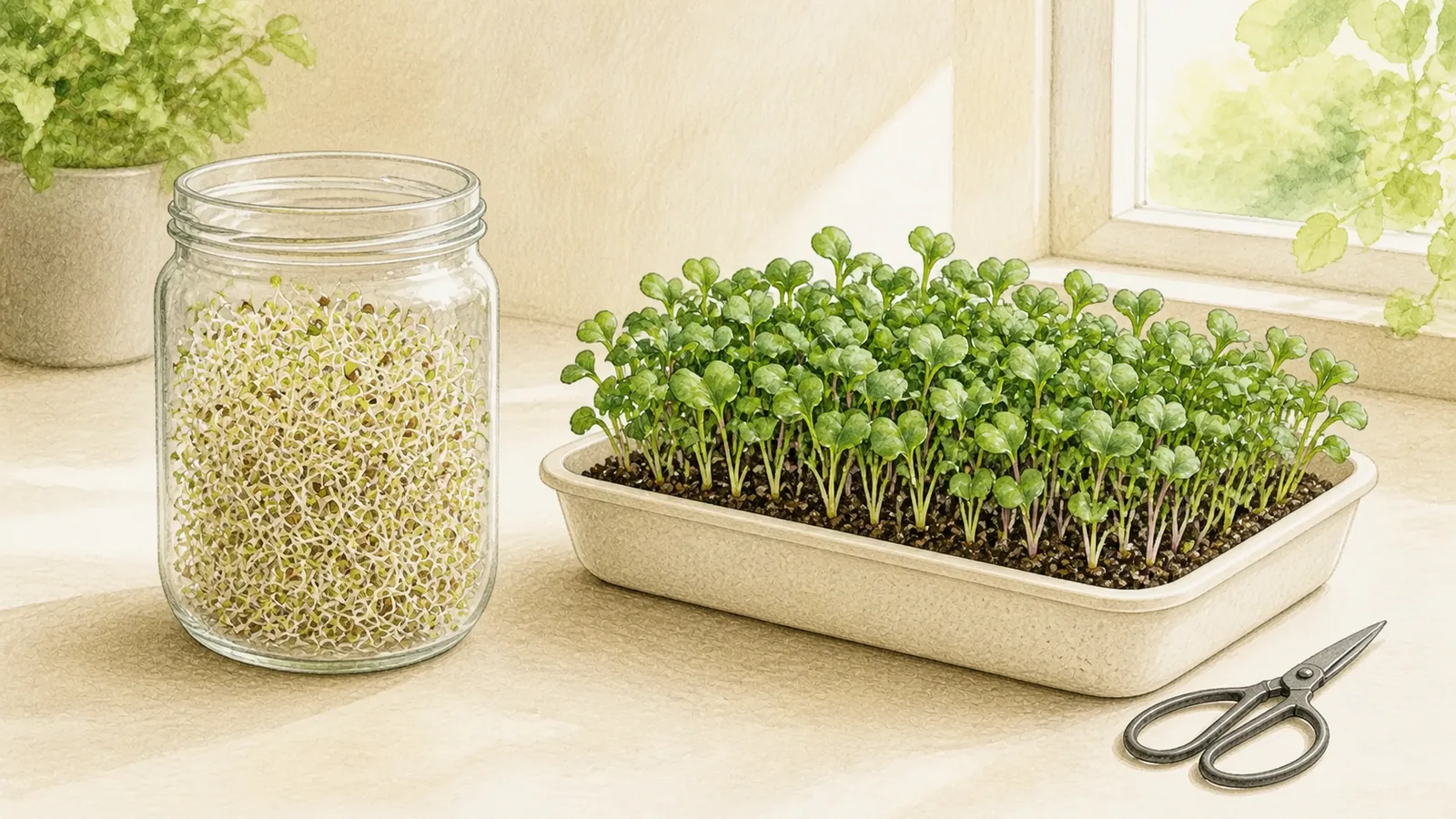
Sprouts are usually grown in warm, very moist conditions without soil or another solid growing medium. The seed, root, stem, and small leaves may all be eaten. Harvest often happens within days, while the crop is still in the germination stage.
Microgreens grow longer in soil, a mat, or another substrate, usually with light after germination. The edible stems and young leaves are cut above the growing medium, leaving roots and seed remains behind. They are commonly harvested after the cotyledons open and around the appearance of the first true leaves.
That distinction matters because the warm, wet, nutrient-rich conditions used for sprouting also favor rapid bacterial growth. FDA’s sprout guidance describes seed as a frequent source in outbreaks. A pathogen can be present in or on a seed before it reaches a kitchen.
Microgreens are generally considered lower risk than sprouts, but lower risk does not mean risk-free. They are raw produce grown in moist conditions and can be contaminated by seed, water, growing media, hands, animals, tools, or storage containers. Penn State Extension’s food-safety guidance emphasizes prevention throughout production rather than relying on a final rinse.
Homegrown does not automatically mean safer
A clean-looking jar and careful owner cannot guarantee pathogen-free sprouts. FDA warns that bacteria inside cracks in seed can be extremely difficult to wash away and can multiply during sprouting even when the process looks clean. Growing the crop at home removes some commercial handling steps, but it does not remove hazards already present in seed.
This is especially important for people at higher risk of severe foodborne illness. FDA produce guidance says children, older adults, pregnant people, and people with weakened immune systems should avoid raw or lightly cooked sprouts of any kind. It lists thoroughly cooked sprouts as the safer choice.
Seed treatments are not a household guarantee. Do not improvise bleach, vinegar, peroxide, heat, or other disinfection recipes and assume the result is sterile. Concentration, contact time, temperature, seed structure, and the location of contamination all matter. A treatment can damage seed while still failing to eliminate pathogens.
Microgreens still need preventive controls
For households that want a short-cycle indoor crop, microgreens provide a different growing method. They still need edible-crop seed, potable water, clean equipment, a reputable medium, controlled moisture, clean harvest tools, and prompt refrigeration. Those controls reduce risk; they cannot promise zero contamination.
Follow the indoor microgreens method for tray setup, lighting, moisture, mold look-alikes, harvest, and between-crop cleanup.
A decision table for the kitchen
| Situation | Practical response |
|---|---|
| Package matches the current Calco or Everything Sprouts advisory | Do not eat it; return or discard it and clean contacted surfaces |
| Package identity is missing and it may be affected | Follow FDA’s current advisory; when identity cannot be confirmed, the cautious choice is disposal |
| Raw sprouts are intended for a higher-risk person | Avoid serving them; ask that person’s clinician about safer choices |
| Home sprouting seed is old, unlabeled, or not sold for edible production | Do not use it for food |
| Microgreen tray smells sour, is slimy, or has widespread decay | Discard the entire tray; do not salvage it with rinsing |
What this outbreak should change
The lesson is not that every small indoor crop is unsafe. It is that visual cleanliness and local production are not substitutes for food-safety controls. Sprouts deserve particular caution because their production environment can amplify a small amount of contamination and because the whole germinated seed is eaten.
Microgreens use a different system and can be a practical household crop, but their safety depends on prevention: appropriate seed, potable water, clean equipment, suitable media, controlled moisture, clean harvest, and cold storage. When an active outbreak notice names a product, follow the official notice first. When growing at home, build the routine around controls rather than confidence.
Sources
- Outbreak Investigation of Shiga Toxin-producing E. coli & Salmonella: Sprouts (August 2026) (U.S. Food and Drug Administration). Accessed August 24, 2026.
- Standards for the Growing, Harvesting, Packing, and Holding of Sprouts for Human Consumption (U.S. Food and Drug Administration). Accessed August 24, 2026.
- Fruits, Veggies and Juices: Food Safety for Moms-to-Be (U.S. Food and Drug Administration). Accessed August 24, 2026.
- Selecting and Serving Produce Safely (U.S. Food and Drug Administration). Accessed August 24, 2026.
- Ensuring Food Safety in Microgreens Production (Penn State Extension). Accessed August 24, 2026.
- A Step-By-Step Guide for Growing Microgreens at Home (Penn State Extension). Accessed August 24, 2026.