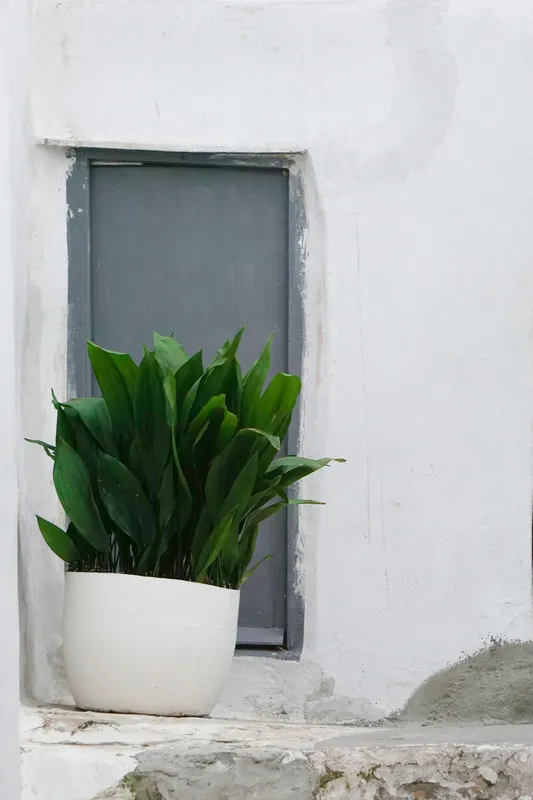
A cast-iron plant fills a pot with tall, leathery leaves rather than a tangle of branches. Each blade rises on its own stalk, making a mature clump look full without needing a trellis. Give those leaves room beside a chair or along a hallway where they will not be bent every time someone passes.
The name to look for is Aspidistra elatior. NC State’s plant profile describes a slow-growing evergreen that spreads by rhizomes, the horizontal stems beneath the leaves. Expect a gradual increase in the clump, not a quick cascade of new foliage.
Before buying, look at the whole clump rather than choosing by pot size alone. Part the leaves gently and check their bases and undersides. Keep the nursery label: a named variegated cultivar gives you a reference for which stripes or spots are normal. Leave a plant with unexplained damage or visible pests behind, and use the nursery checklist if you are comparing several pots.
A dimmer room still needs light
Cast-iron plant suits partial to deep shade and grows well in a container. Direct sun can damage its leaves. Indoors, start with a place that receives filtered daylight, such as near a curtained window, then watch where the sun actually falls during the day.
The RHS growing guide notes that growth becomes slower in very poor light and variegated leaves may revert to green. A dark corner that keeps the plant alive is not necessarily a place where it will fill out. If new growth is your aim, try a brighter position without exposing it to direct sun.
Leave space between foliage and a radiator or heating vent. Ordinary household air is suitable; this plant does not need a special humidity setup. Wipe dusty leaves gently with a damp cloth, supporting each leaf from underneath.
Water by the pot’s condition
Its drought tolerance gives you some forgiveness, but it is not a reason to keep the whole root ball bone-dry. During active growth, aim for moisture with good drainage. Water less often when growth slows in winter, while avoiding both complete drying and a permanently soggy pot.
Before watering, feel below the surface of the mix and lift the pot if its size allows. Maryland Extension recommends using moisture and changes in pot weight instead of a fixed calendar. A freshly watered pot feels heavier; a drying one becomes lighter. If the mix beneath the surface is still wet and the pot remains heavy, wait and check again.
When water is needed, pour slowly over the mix until excess drains from the bottom. Let it finish draining, then empty the saucer. If a nursery pot sits inside a decorative container, take it out to water and check for trapped water before returning it. Drainage holes are useful only when the runoff has somewhere to go.
Yellow foliage alone cannot tell you whether to water. Both excessive wetness and dryness can cause trouble. Check the mix, drainage and recent conditions before changing the routine. For a pot that stays wet and begins to collapse, use the root-rot inspection guide.
Let the clump earn a larger pot
Iowa State advises infrequent repotting for cast-iron plants. A slow plant need not move into a larger container every spring. Inspect the roots when they begin appearing through the drainage holes. If repotting is needed, choose a pot only a little larger, use a draining houseplant mix, and keep the plant at its previous depth. The repotting guide walks through handling a crowded root ball.
Spring is also the time to divide a large clump. Iowa State’s division guidance explains how to retain leaves, stems and roots in each new plant. Keep several leaves and a rooted section of rhizome together in each division; cutting a single leaf off the plant will not give you an equivalent clump. Use a clean, sharp tool and pot the divisions at their former depth. Smaller divisions will take patience to look full again.
Feed during growth, not to force it
Use a general houseplant fertilizer at its labeled dilution when the plant is actively growing. Iowa State’s houseplant guidance ties feeding to growth and available light; a plant in a dim position needs less fertilizer than one growing vigorously. Pause feeding when growth slows in the darker months.
Check whether fresh potting mix already contains fertilizer before adding more. Extra feed will not turn a naturally slow clump into a fast-growing plant, and excessive fertilizer can injure roots. If growth has stalled, review light and root conditions first instead of increasing the dose.
Check the leaves while you clean them
Look along the stalks and leaf undersides for scale, mealybugs or fine speckling associated with mites. A tough leaf does not make the plant pest-proof. Identify a pest before applying a treatment; the early pest signs guide can help distinguish what you are seeing.
ASPCA lists Aspidistra elatior as non-toxic to cats and dogs. That classification is not an invitation to let a pet chew the foliage or potting mix. Keep the pot stable and discourage nibbling so the plant can keep its long leaves intact.
Sources
- How to Care for Houseplants (Iowa State University Extension and Outreach). Accessed October 13, 2026.
- Aspidistra elatior (North Carolina Extension Gardener Plant Toolbox). Accessed October 13, 2026.
- How to grow aspidistras (Royal Horticultural Society). Accessed October 13, 2026.
- Watering Indoor Plants (University of Maryland Extension). Accessed October 13, 2026.
- Easy Low-Maintenance Houseplants (Iowa State University Extension and Outreach). Accessed October 13, 2026.
- How to Propagate Houseplants by Division and Offsets (Iowa State University Extension and Outreach). Accessed October 13, 2026.
- Cast Iron Plant (ASPCA Poison Control). Accessed October 13, 2026.