Recipes
Simmered Daikon in a Light Dashi Broth
Simmer thick daikon rounds in a lightly seasoned dashi broth, with skewer checks for tender centers and a complete guided cooking card.
Jump to recipe ↓Recipe
- Total time
- About 60–80 minutes; check tenderness
- Method
- Simmer
- Difficulty
- Moderate
- Allergens
- Soy · Wheat may be present in soy sauce · Fish may be present in dashi
About 4 small side portions
Allow about 60–80 minutes; the root and slice thickness affect cooking time. Both timers prompt a check, not automatic doneness. Contains soy; soy sauce may contain wheat and dashi may contain fish.
Equipment: Small saucepan that fits the daikon in one layer, knife, peeler, cutting board, measuring jug and spoons, colander, skewer, cooking parchment, scissors, tongs, broad spoon and food thermometer for reheating.
Ingredients
- 500 g daikon, weighed before peeling
- 500 ml prepared unsalted dashi, at normal broth strength; use kombu dashi for a plant-based version
- 1 tablespoon regular Japanese soy sauce
- 1 teaspoon granulated sugar
- 1/2 teaspoon fine salt
- Water for the initial cooking and to maintain the liquid level
Method
Wash and cut even rounds
Wash hands and rinse the daikon under running water before peeling; do not use soap on the root. Cut into rounds about 3 cm thick, halving broad pieces. Trim the sharp edges with a peeler. On a stable board, make a shallow cross about one quarter of the way into one flat face.
Convert a measurement for this stepStart the first simmer
Set the daikon in the saucepan, add water to cover, and bring to a boil. Reduce the heat to a steady gentle simmer.
Convert a measurement for this stepCheck the center
Start a 20-minute first-check timer once simmering. Stay nearby, keep the pieces covered with water and test the thickest piece with a skewer. Continue until the skewer passes through the center without a hard core, checking every few minutes if needed; the first timer may not be long enough.
Convert a measurement for this stepDrain and prepare the drop lid
Turn off the burner. Carefully drain and briefly rinse the daikon in a colander. Cut a parchment circle slightly smaller than the saucepan, with a small steam opening in the center.
Convert a measurement for this stepAdd the light broth
Return the daikon to the saucepan in one close layer. Add dashi, soy sauce, sugar and salt. The liquid should cover the pieces; use a better-fitting pan if there are wide gaps, or add a little water if just short. Bring to a gentle simmer and lay the parchment on the pieces, entirely inside the pan.
Convert a measurement for this stepSimmer gently in the seasoning
Once the broth is simmering gently, cook for about 20 minutes. Stay nearby and avoid stirring the softened rounds. Add a little hot water if evaporation exposes them. Check that the center remains tender and the pieces hold together, then turn off the burner.
Convert a measurement for this stepServe or refrigerate promptly
With the burner off, remove the parchment carefully and lift the pieces into bowls with some broth. Refrigerate leftovers promptly in shallow containers, within two hours or one hour above 90°F (32°C). Keep at 40°F (4°C) or below, use within four days, and reheat to 165°F (74°C).
Convert a measurement for this step
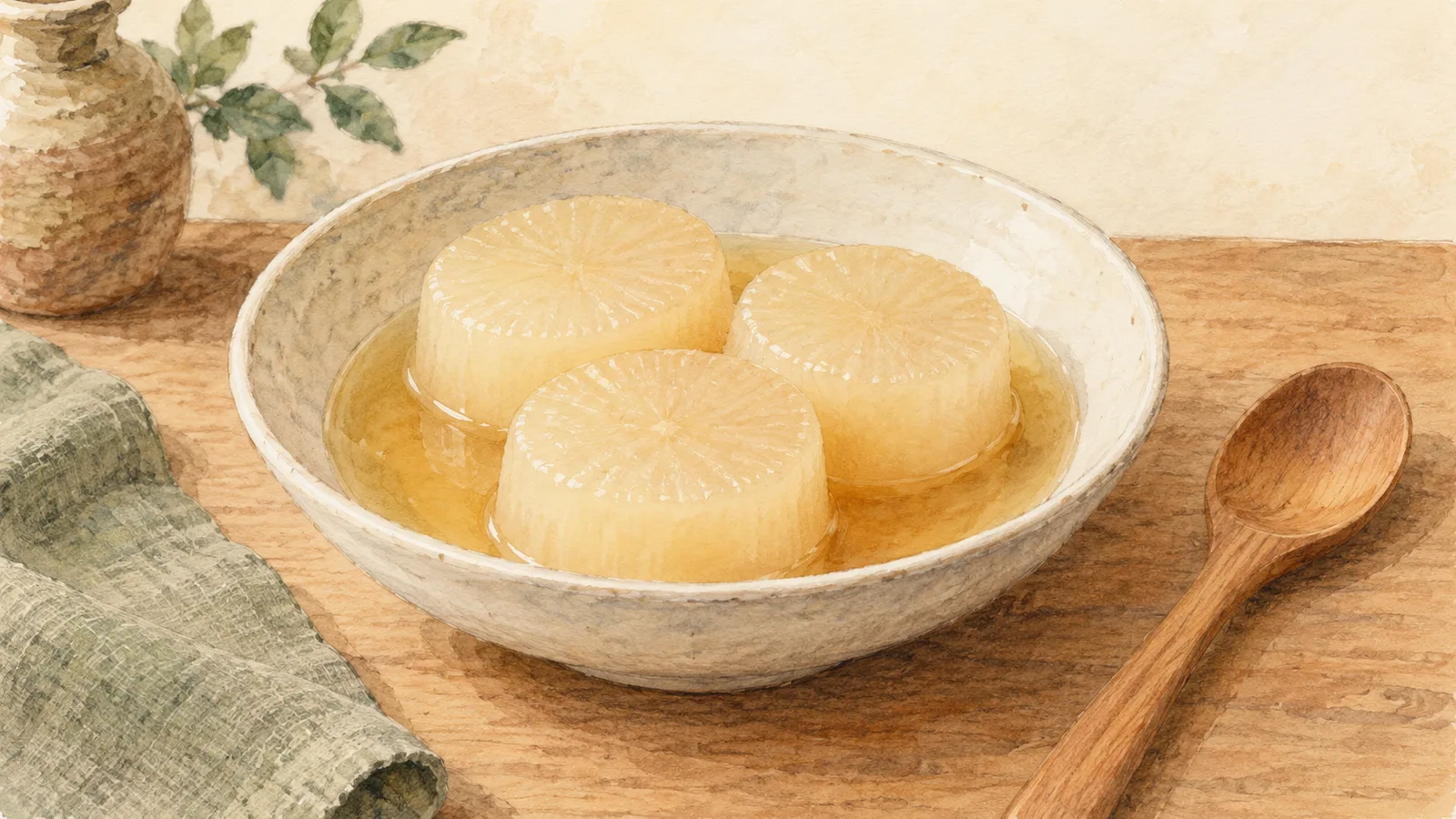
A thick piece of daikon can be tender enough to divide with a spoon while still holding its round shape. A pale dashi broth suits that texture: serve a few pieces in a small bowl, with enough liquid to keep each bite moist.
This version takes its light seasoning proportions from Yumiko's daikon fukumeni at RecipeTin Japan, using her sugar alternative to mirin. The initial plain-water cooking follows the approach in Kikkoman's simmered daikon preparation. Here the daikon is served warm after simmering; there is no long room-temperature soak.
Fit the pan to the pieces
Arrange the rounds in one close layer before heating. A wide skillet spreads 500 ml of broth too thinly; a small saucepan that fits the pieces is more useful. Halve unusually broad rounds if that helps them fit, keeping their thickness similar. The broth should cover them without a tall stack.
Make the parchment drop lid while the pan is cold. It rests on the ingredients inside the saucepan, with a small opening for steam. Keep every edge inside the pan, away from the burner, and lift it with tongs or another utensil when checking.
Check the dashi and soy sauce
Use prepared, unsalted dashi at normal broth strength. A concentrate needs dilution according to its label before measuring. Fish-based dashi and kombu dashi give different results; choose kombu dashi if you want a plant-based dish, and check the full ingredient list.
Regular Japanese soy sauce works here. The finished broth may be darker than one made with usukuchi, the lighter-colored soy sauce used in the source recipe. Do not substitute thick Chinese dark soy sauce simply because it is already open; the soy sauce guide explains the distinction.
Serve with something more substantial
These are small vegetable side portions. Pair them with steamed salmon and rice, or add them to a meal built around tofu. Use a broad spoon to lift each piece so its softened edges do not crumble.
For leftovers, transfer the daikon and broth to shallow containers promptly. FoodSafety.gov’s leftovers guidance recommends refrigeration within two hours, or one hour above 90°F (32°C), use within four days, and reheating to 165°F (74°C). Keep the refrigerator at 40°F (4°C) or below. Do not leave the pan out overnight to absorb more flavor.
Wash the root before peeling it; FDA’s produce-cleaning advice explains why cleaning comes before cutting, even when the outer layer will be removed.