Recipes
Gilgeori Toast: Cabbage and Egg in a Warm Sandwich
Toast buttery bread around a cabbage-and-egg patty, then finish with ketchup and a little sugar. Includes a complete recipe and safe cooking checks.
Jump to recipe ↓Recipe
- Total time
- About 20–25 minutes
- Method
- Pan-fry and assemble
- Difficulty
- Moderate
- Allergens
- Egg · Wheat · Milk · Check bread and condiment labels
1 substantial sandwich
Allow about 20–25 minutes; timing is an estimate and depends on vegetable cutting and the skillet. Uses US measuring spoons. Contains egg, wheat and milk; check bread and condiments for other allergens. Stay at the stove during toasting and frying.
Equipment: Kitchen scale, knife, cutting board, mixing bowl, fork, measuring spoons, 10–12-inch nonstick skillet, wide spatula, thin-tip food thermometer and a clean serving plate.
Ingredients
- 2 slices white sandwich bread or milk bread
- 60 g green cabbage, finely shredded into short pieces
- 15 g carrot, cut into fine, short matchsticks
- 1 small scallion (about 5 g), thinly sliced
- 2 large eggs
- 1 small pinch fine salt
- 2 tablespoons unsalted butter, divided equally between bread and filling
- 1 teaspoon sugar, or less to taste
- 1 tablespoon ketchup
Method
Prepare the vegetables and work area
Keep the stove off. Wash hands with soap for 20 seconds. Remove the cabbage’s outermost leaves, rinse the vegetables under plain running water without soap, and pat dry. Weigh and cut the cabbage, carrot and scallion. Set out the bread, butter, seasonings and a clean serving plate.
Convert a measurement for this stepCoat the shreds with egg
Beat the eggs and salt with the fork, then mix in all the vegetables. Keep this raw mixture and its utensils separate from the serving plate. Wash your hands after handling egg shells; do not taste the raw filling.
Convert a measurement for this stepToast both slices
Melt 1 tablespoon butter in the skillet over medium-low heat. Toast the bread on both sides until lightly golden, turning and watching it closely; work one slice at a time if necessary. Move the toast to the clean plate. Lower the heat if the butter darkens or smokes.
Convert a measurement for this stepCook the cabbage-and-egg patty through
Melt the remaining tablespoon of butter over medium-low heat. Add the filling, spread it evenly into a rectangle slightly larger than the bread, and tuck loose shreds into the edge. Cook until the bottom is golden and firm enough to lift, roughly 3–4 minutes. Turn carefully with the wide spatula and cook the second side, reducing the heat if it browns too fast. Continue until no liquid egg remains and the center reaches 160°F (71°C), checking from the side with the thermometer clear of the pan. Time and surface color alone are not doneness checks. Stay beside the pan throughout.
Convert a measurement for this stepSwitch off the heat and build the sandwich
Turn off the burner. Use a clean utensil to place the cooked patty on one toast slice. Sprinkle with the sugar, spread the ketchup over it and cover with the second slice. Cut with a clean knife and serve. Refrigerate any leftovers promptly at 40°F (4°C) or below, within two hours or one hour above 90°F (32°C); discard food left out longer. Use within three to four days and reheat to 165°F (74°C). Wash raw-egg-contact bowls and utensils before reuse.
Convert a measurement for this step
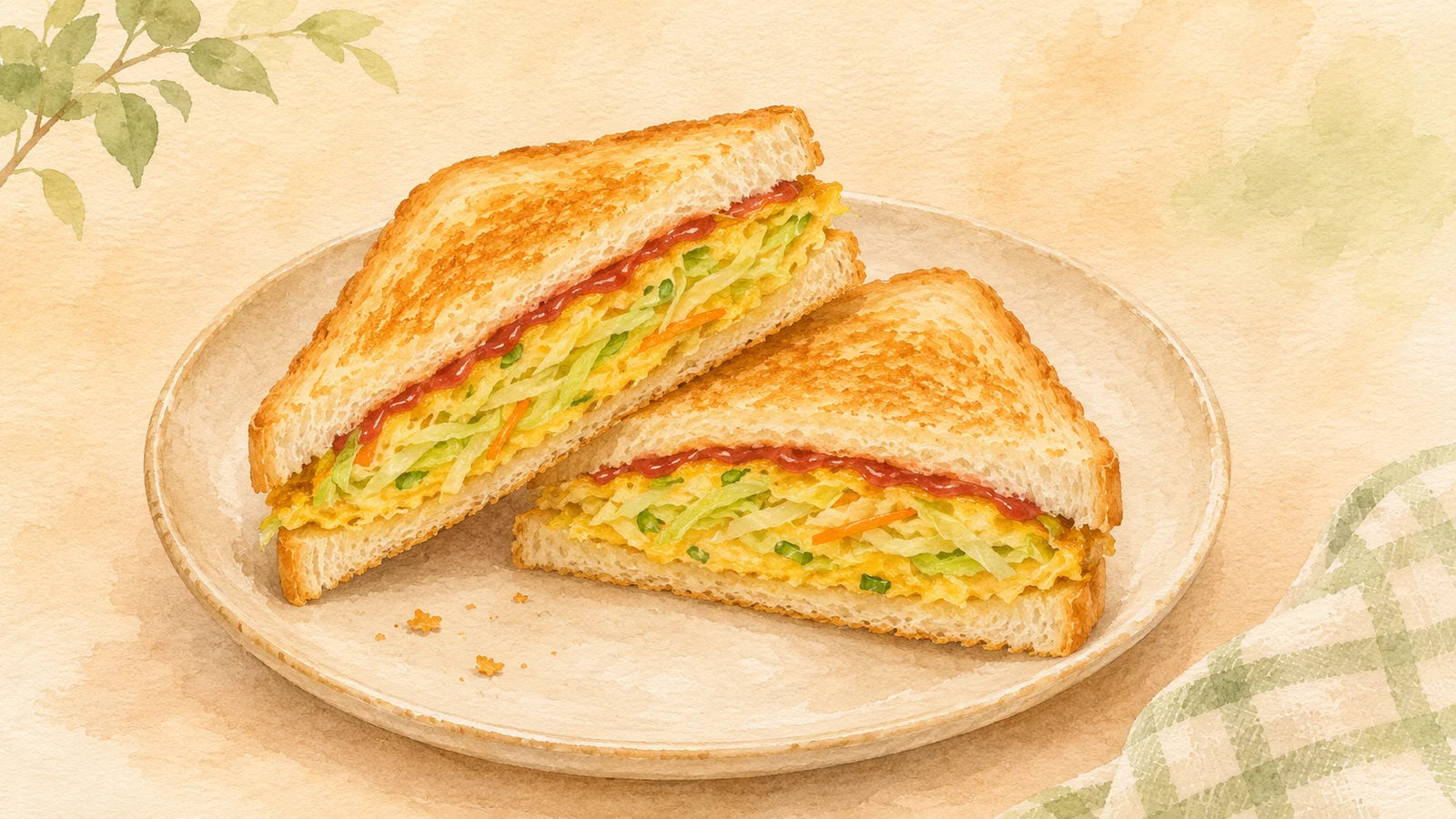
The cabbage looks like too much until it meets the egg. In gilgeori toast (길거리 토스트), a heap of fine vegetable shreds becomes a golden patty between buttery toast, with ketchup and a little sugar bringing a sweet edge to the savory filling. Make one sandwich first: it is easier to shape and turn a single patty than to manage a crowded skillet.
Give the cabbage room inside the egg
Use firm green cabbage, sliced into thin, short shreds, rather than broad strips that drag out of the sandwich. The carrot and scallion should be small enough to mix through it. If knife work is new to you, the carrot matchstick guide helps you make narrow pieces; shorten those pieces for this filling.
This version adapts the vegetable-and-egg toast described by Hyosun at Korean Bapsang and Maangchi, with the two-egg approach also used by Sue Pressey at My Korean Kitchen. It uses two eggs to hold a modest quantity of vegetables, cooks all the cabbage in the patty, and toasts the bread before frying the filling. The cooking times are estimates; use the physical checks in the card.
Let the crust catch up with the center
The first side must hold together before you turn it. Slide a wide spatula beneath the patty and support it as you flip; tucking loose shreds into the edge is easier than rescuing a broken mound. If the surface browns quickly, lower the heat. Dark toast or a browned egg crust cannot tell you whether the center is cooked.
Use a thin-tip thermometer from the side, with the sensing area in the middle of the filling and clear of the pan. The FDA’s egg guidance gives 160°F (71°C) for dishes containing eggs. Keep the plate, serving knife and cooked-food utensils separate from the raw egg bowl.
Finish while the bread is warm
A small sprinkle of sugar and a thin layer of ketchup give this sandwich its sweet-savory finish. Start with the card’s amounts rather than soaking the bread in sauce. Add the top slice and eat while the edges still have some crunch.
For a second sandwich, prepare another portion and repeat the attended cooking steps. Keep your attention on the skillet while the egg cooks. If you need to save it, follow the card’s cold-storage limits; the crust will soften, so immediate serving gives the best texture. Produce preparation follows FDA guidance on cleaning vegetables.