Kitchen skills
Cut Carrot Matchsticks for Slaws and Stir-Fries
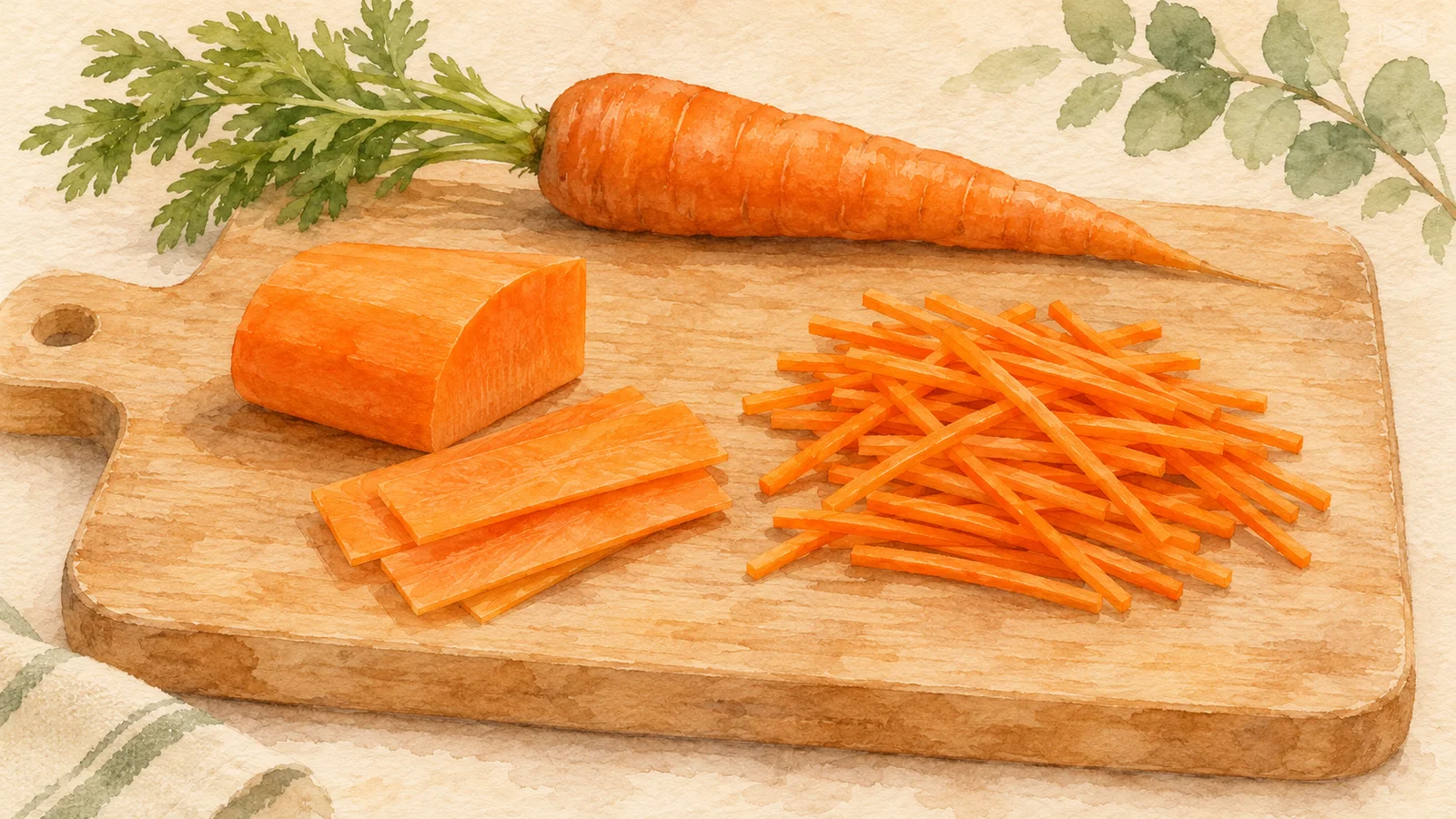
A carrot cut into thin matchsticks brings a clean crunch to a slaw and cooks quickly in a stir-fry. The useful trick is to make flat planks first. Once those lie securely on the board, turning them into narrow strips is much easier than trying to shave pieces from a rolling carrot.
For a general-purpose cut, aim for sticks about 2 inches (5 cm) long and ⅛ inch (3 mm) thick. Follow your recipe if it asks for a different size. The Institute of Culinary Education’s julienne guide uses similar dimensions; at home, consistent thickness matters more than producing identical ends.
Start with a stable board and a clean carrot
Wash your hands, then rinse the carrot under running water before peeling it. Scrub away soil and dry it with a clean towel. FDA’s produce guidance recommends washing even when the skin will be removed, and advises against soap or produce wash. Use clean utensils and keep raw meat, poultry and seafood away from the carrot, especially if it is going straight into a salad.
Peel if desired, trim the ends and use a sharp knife you can control. Set the cutting board securely before starting. Put an empty bowl nearby for finished strips so they do not crowd the cutting area.
Make short sections, then planks
Cut across the carrot into roughly two-inch lengths. Work on one section at a time. Slice a thin piece from one long side to create a flat base, then turn that base onto the board. Kikkoman’s carrot-cutting guide uses this flat-side-down approach to keep the carrot steady.
With the section resting on that base, cut lengthwise into thin planks. Aim for the same thickness all the way along each plank. If your first slice is thick, make the next one thinner rather than trying to force a last-second correction while the blade is moving.
You can trim the curved sides into a rectangular block for very tidy sticks, but you do not need to discard edible carrot to make a weeknight slaw. Keep clean trimmings for another dish or stock. Slightly rounded edge pieces are fine when a perfect square cross-section is unimportant.
Turn the planks into strips
Lay a plank flat and slice along its length at the same spacing you used for its thickness. A small stack saves some cutting, but start with one or two planks. If they slide, separate them and cut individually. A tall pile is harder to hold steady.
Curl the fingertips of your guiding hand inward and keep the thumb tucked behind them. Good Food’s knife-skills guidance describes this claw grip. Move slowly, keep your attention on the blade and stop to reposition the carrot whenever your grip becomes awkward. Leave a small end piece for another use rather than chasing the last sliver under your fingers.
Look at the pile before adding it to dinner. Separate unusually thick sticks and recut them if they can be held safely. Thin strips and chunky batons in the same pan will not soften at the same pace.
For kinpira gobo, match the carrot’s width to the burdock. For carrot and daikon refrigerator pickles, use the cut specified in that recipe. A grater makes shreds and a peeler makes ribbons; either can be useful, but neither gives you this distinct little stick to bite through.