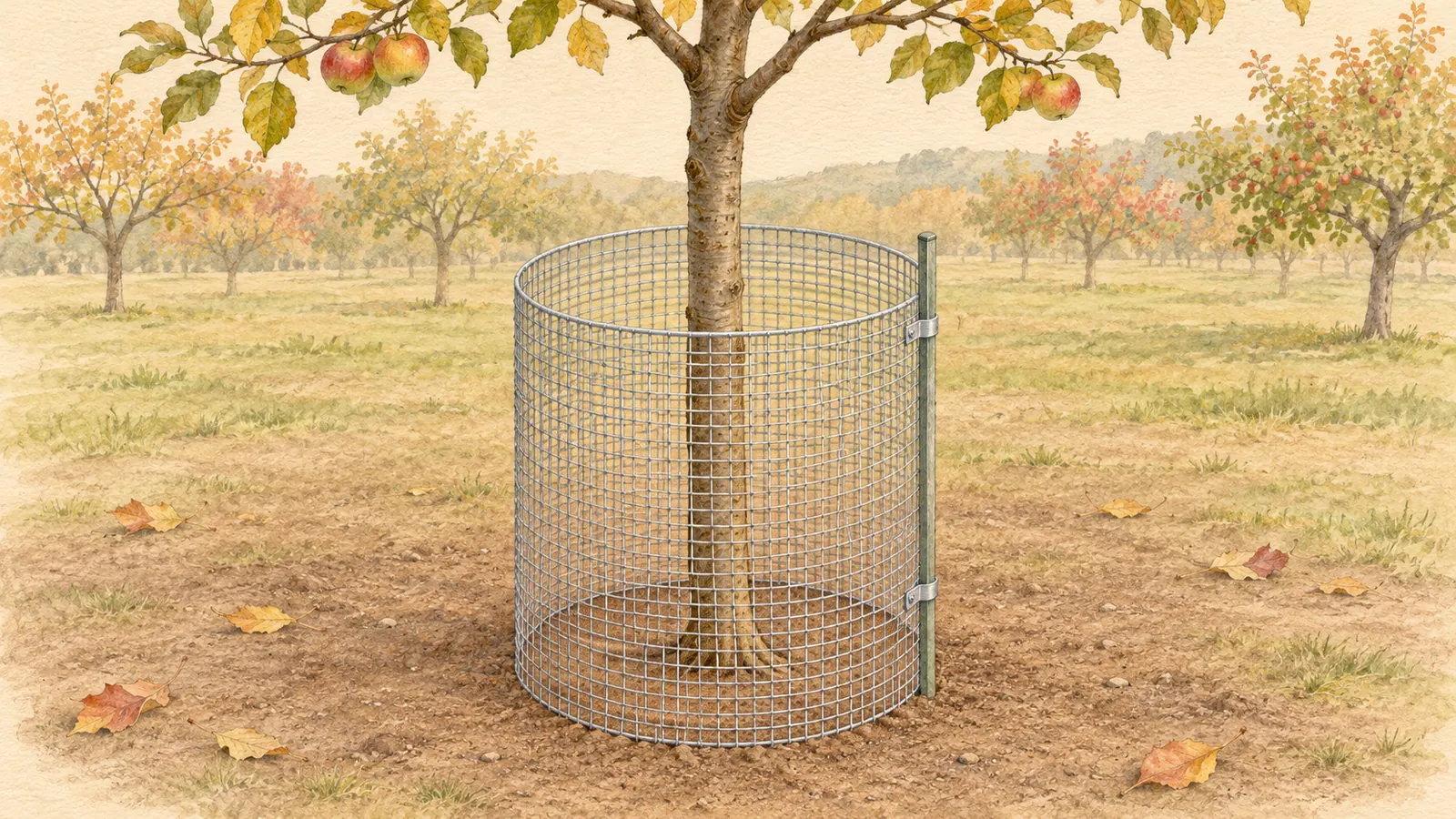
Before the ground freezes, walk around your youngest trees and picture where the snow will pile up. The drift beside the driveway may come halfway up a sapling. A rabbit standing on it can chew bark far above a guard that looked tall enough in autumn. Down at soil level, a vole needs only a gap beneath the wire. A good winter guard closes both routes while giving the trunk room to grow.
Start with the tree and the feeding marks
Give young fruit trees and other thin-barked saplings an early look. An apple tree with one slender trunk can lose bark around its entire circumference in a small patch of feeding. Rabbits may also clip off twigs, leaving a clean, angled cut. Check low branches as well as the trunk, especially if last winter’s snow brought the branches within reach. A narrow cylinder around the trunk leaves those branch tips exposed. A wider fence around the plant makes more sense when the low shoots need protection too.
Voles tend to work closer to the soil, sometimes under a cover of snow or matted grass. Winding trails revealed as the snow melts can point you toward a tree worth inspecting. They tell you where to look, but you still need to examine the bark. A crack on the sunny side of an otherwise intact trunk raises a different question. The guide to winter sunscald explains what that injury looks like and when a light-colored wrap can help.
Size the cylinder from the snow line
Choose hardware cloth with quarter-inch openings for a trunk exposed to both rabbits and voles. Despite its name, hardware cloth is stiff wire mesh. Hold a piece loosely around the widest part of the trunk you intend to protect. Wisconsin Extension recommends an inch or two of clearance between the mesh and the bark. Check that space all the way around, including at a bulge near the base of a grafted tree. Allow extra mesh at the seam so the edges overlap.
For height, measure from the highest snow surface you reasonably expect beside that particular tree. Minnesota Extension recommends extending the cylinder 18 to 24 inches above that level for rabbits. If you commonly have a foot of settled snow, that puts the top roughly 30 to 36 inches above the soil. Add the length that will go below ground before cutting the mesh. A tree beside a shoveled path can need a taller piece than one out in the open lawn.
Seat the bottom edge and brace the mesh
Clear tall grass from the immediate area so you can see where the trunk enters the ground. Pull mulch back from the bark. Wear gloves when cutting and handling the wire. Form the cylinder, join the overlapping edges to each other and turn sharp ends away from the tree. Fastening the seam to the trunk would defeat the air gap you just measured.
Where voles are a concern, set the lower edge into the soil. Iowa State Extension recommends burying the mesh two to three inches. UC Integrated Pest Management gives a deeper four-to-six-inch recommendation for vole guards. Use local Extension guidance for your soil and vole pressure. If a root blocks the planned circle, move the mesh farther out so you can seat it without cutting the root. Leave the original soil level against the trunk as it was.
Close the soil against the buried edge and support the cylinder so it stays upright. Fasten it to a stake outside the mesh if it needs bracing. Give the rim a gentle push from several directions. It should hold its shape and stay clear of the bark. Look down into the cylinder before leaving. Remove trapped leaves and grass, and check that there is no open seam or lifted corner at the back.
Check again after the first deep snow
Walk the whole perimeter after a heavy snowfall or after plowing nearby. Check the uphill or drifted side first. If packed snow has made a step up to the top, clear enough of it away to restore the clearance, or refit a taller barrier. Look for a bent section pressing on the trunk and for tunnels or fresh feeding inside. A guard can appear straight from the house even after the bottom has shifted.
Keep leaves and mulch from accumulating inside the mesh during thaws. Dense cover can shelter voles right beside the bark. If damage continues, look for an entry point at the soil, the seam or the top before adding another layer of wire. The Chicago Botanic Garden describes how snow depth changes the protection a tree needs. A trunk guard also leaves the higher canopy available to deer. Chewed tips above the guard may call for protection around the whole tree.
At snowmelt, open the guard and read the bark
Once snow cover is gone and winter feeding pressure has eased, remove the seasonal cylinder and inspect the full circumference. A strip of missing bark on one side can leave living tissue around the rest of the trunk. A continuous ring of missing bark is much more serious. Girdling interrupts the movement of sugars from the leaves to the roots. Fresh leaves above an injury in spring are not proof that the tree will recover.
Photograph the whole trunk and the injury from several sides. For extensive damage, ask your local Extension office or a qualified arborist to assess how much living bark remains. Paint and wound dressings cannot reconnect a severed ring. Keep the guard for next winter if it is sound, but measure the tree again before reinstalling it. A cylinder that slipped over this year’s sapling may press directly against next year’s bark.
Sources
- Rabbit Ecology and Damage Management (University of Wisconsin–Madison Division of Extension). Accessed November 2, 2026.
- Protecting trees and shrubs in winter (University of Minnesota Extension). Accessed November 2, 2026.
- How to Protect Trees and Shrubs from Animal Damage Over Winter (Iowa State University Extension and Outreach). Accessed November 2, 2026.
- Voles (Meadow Mice) (University of California Statewide IPM Program). Accessed November 2, 2026.
- Protect from animal damage (Chicago Botanic Garden). Accessed November 2, 2026.