A young tree can stand in freezing air while one sunny side of its trunk warms sharply. When that warmth disappears, the living tissue under thin bark can be injured. The damage may show later as a long, sunken or cracked patch, often on the south or southwest side.
That is the concern behind winter sunscald protection. A pale trunk covering helps limit solar warming; it is not a blanket that makes an unsuitable tree winter-hardy. Start by deciding whether your tree needs one, then put its removal date on the calendar before you fit it.
Which trees deserve a closer look?
Young maples, lindens, crabapples and cherries are among the susceptible trees listed by Minnesota Extension. Pay particular attention to a newly planted tree with thin bark and an exposed southern or western side. A trunk that recently lost the shade of lower branches also deserves attention.
Thick, rough bark provides more protection. Do not wrap every established tree simply because autumn has arrived. Ask your local Extension office or arborist about the species and site if you are unsure. Utah State’s sunscald guide notes that some thin-barked fruit trees can remain vulnerable as they age, so the tree’s birthday alone is a poor stopping rule.
Walk around the tree and look at what shades the lower trunk. A building or evergreen on its south or west side can change that exposure. For a future planting, Utah State suggests considering a position north or east of buildings or evergreens for winter shade. Check the whole site against the tree’s growing needs before choosing that position. For a tree already in place, use the exposure you have when discussing protection; a sunny label on the nursery tag does not tell you whether the trunk needs winter care.
Choose a pale seasonal covering
For this method, use white commercial paper tree wrap intended for winter trunk protection. Colorado State recommends light-colored crepe-paper wrap; Minnesota recommends white reflective materials and cautions against dark or brown coverings that absorb heat.
Recommendations for plastic guards differ by region and product. A rigid animal guard is not interchangeable with paper wrap, and ordinary plastic film is not a substitute. If you already use a guard, check its fit and purpose with local guidance instead of adding another tight layer. Skip dark fabric and burlap wrapped directly around the trunk for this sunscald method.
Wrap upward without binding the tree
Inspect the bark first. Photograph an existing wound before covering anything, and get advice about substantial damage rather than hiding it for the winter.
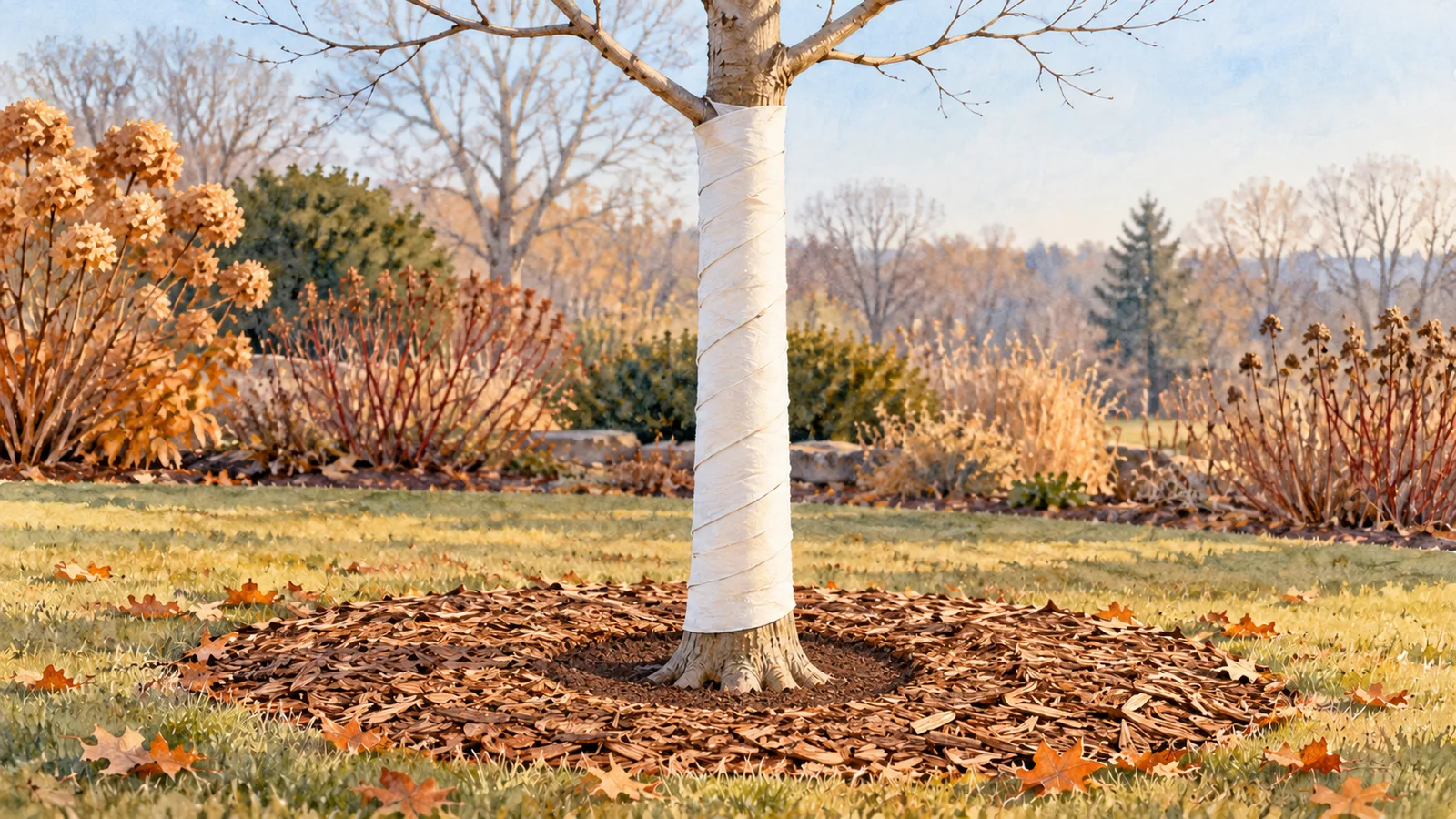
Following Colorado State’s wrapping method, begin near ground level and spiral upward to the first branch, overlapping each turn by roughly one-third of the wrap’s width. Keep the paper in contact with the trunk without stretching it into a tight band. Follow its fastening instructions, securing the end to the wrap itself. Never drive staples or nails into bark.
Leave the root flare visible and keep soil and mulch off the trunk. If the base already disappears beneath a mound, the tree-planting guide explains the depth problem. Wrapping does not correct a buried flare.
Plan for spring, then check through winter
Put the wrap on in late fall and remove it in spring after the local frost risk has passed. Iowa State gives November and April as its seasonal example; use your local climate rather than those dates everywhere. Wrap is not meant to stay on through the growing season.
Check periodically for slipping, damage or a tight fastening. Remove and refit material that constricts the trunk. At spring removal, inspect the bark rather than covering it again immediately. Utah State warns that wrap left on into the growing season can shelter pests. Reassess protection the following fall as the bark thickens.
Protect the bark without neglecting the roots
Iowa State’s winter-damage guidance emphasizes retaining lower branches where practical, avoiding trunk wounds and preventing drought stress. Check the original root ball and surrounding soil during dry autumn weather, and water when needed until the ground freezes. Keep mowers and string trimmers away from the bark.
If you find a damaged patch, note which direction it faces, when you first saw it and whether it has changed since the previous photograph. Send a close view and a view of the whole tree to your Extension office or arborist. Iowa State notes that the precise cause of sunscald is not fully understood. A southwest-facing crack is a useful clue, not enough on its own to diagnose every bark injury.
Paper wrap is not dependable protection against rabbits or deer. Those problems may need a separate, correctly fitted barrier with room for trunk growth and allowance for snow depth. Nor does wrap repair bark that has already died. A large split, extensive missing bark or damage circling the trunk warrants an arborist’s assessment. Do not coat an open wound with tar or wound paint, and do not carve away bark to try to make the split look tidy.
Sources
- Wrapping Trees For Winter (Colorado State University Extension). Accessed October 19, 2026.
- Protecting trees and shrubs in winter (University of Minnesota Extension). Accessed October 19, 2026.
- Winter Damage on Trees (Iowa State University Extension and Outreach). Accessed October 19, 2026.
- Should I wrap the trunks of newly planted trees? (Iowa State University Extension and Outreach). Accessed October 19, 2026.
- Sunscald Injury or Southwest Winter Injury on Deciduous Trees (Utah State University Extension). Accessed October 19, 2026.