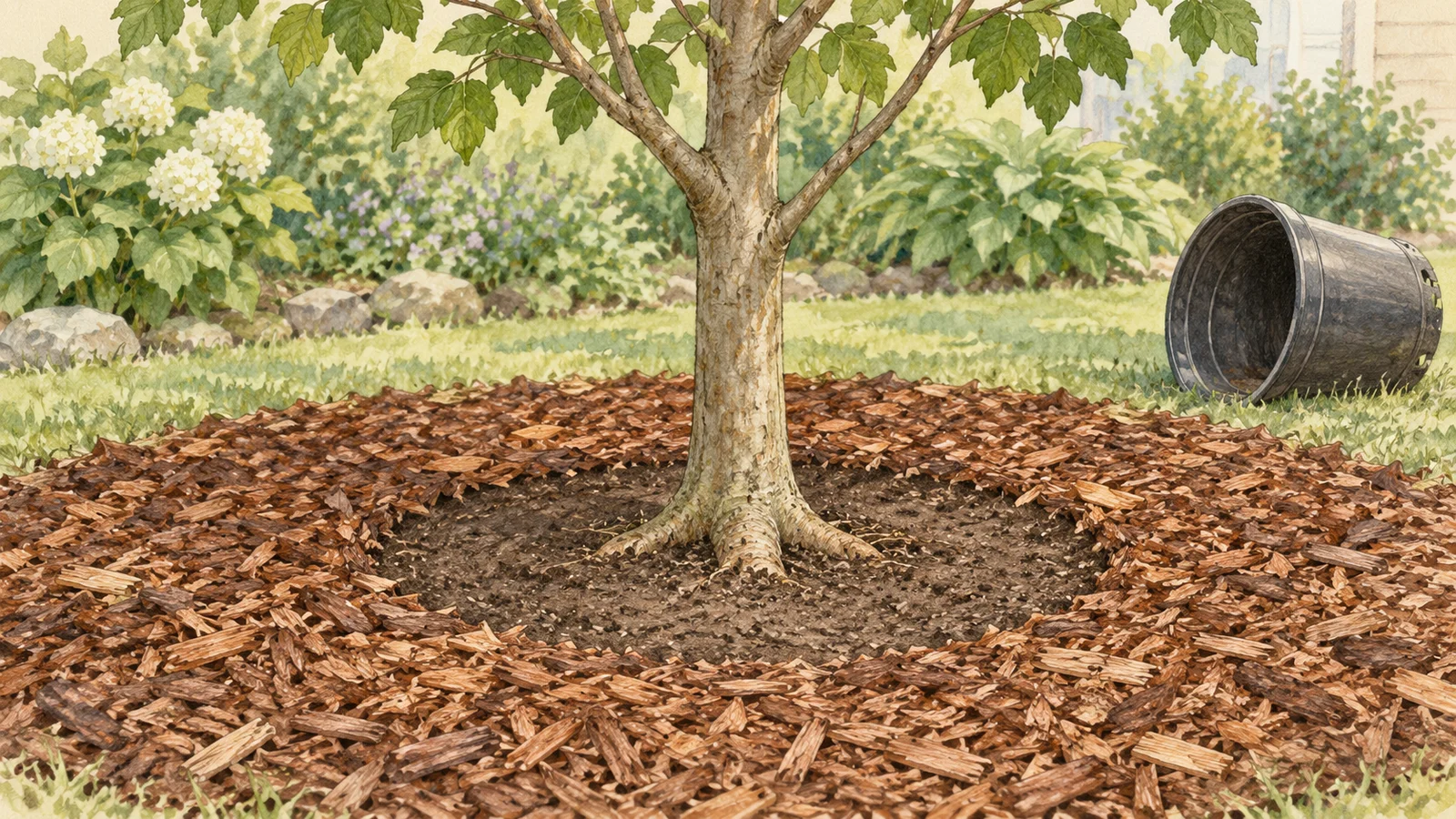
A tree should widen where its trunk meets the ground. If the trunk disappears into the soil like a fence post, stop before adding the last shovelful. The place where the first substantial roots spread out, called the root flare, may already be buried inside the nursery pot.
Find that junction before you decide how deep to dig. A container’s rim and its old potting-mix surface are convenient landmarks, but neither proves that the tree was growing at the right depth. This method is for a small container-grown tree you can handle safely; a heavy specimen needs suitable lifting equipment and experienced help.
Check the place before opening the pot
Match the tree’s mature size, light needs and tolerance of your soil to the site. The small-yard fruit-tree guide can help if you are still choosing. In the United States, contact 811 before digging and follow your local utility-location process; a shallow planting hole can still encounter buried services. Look overhead for wires too.
Do not work soil that is frozen or so wet that it smears. Cool planting weather can reduce stress, but the best season depends on the species and climate. Ask a local Extension office about a questionable late-season purchase rather than treating an October date as permission everywhere.
University of Minnesota Extension emphasizes drainage as well as light. If water stands at the site, solve the site problem or choose a suitable species. Gravel at the bottom of a hole does not turn wet soil into a well-drained planting bed. Keep the root ball moist while you arrange the planting site.
Open the root ball and look
Lay the pot on its side and support the root ball as you slide it out. Squeeze or carefully cut a stubborn container instead of hauling the tree out by its trunk. Remove the pot completely.
Gently brush excess mix away from the trunk until you locate the flare and the first main roots. Then inspect the sides and bottom. Fine roots that can be eased outward are different from thick woody roots circling the ball. Do not assume that a tight spiral will unwind underground.
Minnesota’s Urban Forestry Research & Outreach guidance explains why woody circling roots can keep growing in that pattern. For severely pot-bound stock, its studied correction removes the outer root mat from the sides rather than merely scratching a few lines through it. Root-ball shaving is substantial work: ask the nursery to demonstrate the correction on your tree, or choose better-rooted stock before buying. A thick root crossing tightly against the trunk deserves assessment, not a guess with a saw.
Measure from the flare, then dig
Measure the distance from the exposed flare to the bottom of the root ball. That is the depth you are working with. Measure the ball’s width as well; plan a hole roughly two to three times as wide, with sloping sides and a firm, undisturbed bottom.
Keep the flare visible at the finished soil surface, or slightly above it where local planting guidance calls for that. Never put a buried flare below grade just to match the old potting-mix line. Maryland Extension’s planting guide recommends measuring root-ball depth only after excess soil over the flare has been removed.
Lay a straight board or shovel handle across the hole to show the surrounding ground level. Lower the tree by supporting its root ball, then check the flare against that line. Look from two directions to check that the trunk is upright. Correct the hole now if it is too deep; loose soil beneath the ball can settle and carry the tree downward.
Backfill without making a rich little pot
Return the excavated soil around the root ball. Do not replace it with bags of potting mix or create a pocket of compost. The roots need to grow into the surrounding ground. Break up large clods and settle the soil gently as you fill; water helps close air pockets. Keep checking the tree’s position so it does not lean while you work.
Skip fertilizer at planting. The International Society of Arboriculture also advises against automatic staking: a tree that stands securely may not need it. If the root ball rocks in wind, get an appropriate support arrangement and a removal plan. Ties should not become permanent bands around growing bark.
Spread a broad, shallow layer of wood-chip mulch, about two to three inches deep. Leave an open space around the trunk and keep the flare uncovered. Mulch should cover the surrounding soil, not form a cone up the tree. Remove turf from that mulched area so you are not mowing against the bark.
Water the root ball, then keep checking it
Water slowly over the root ball and the backfilled soil. A lawn sprinkler that dampens the grass is not proof that water reached the tree’s original roots. Check beneath the mulch and into the root ball itself; those areas can dry at different rates.
Minnesota’s establishment guidance calls for frequent watering at first, with intervals widening as roots establish. Use that as a reminder to check daily during the first couple of weeks, then adjust watering to the actual moisture, rainfall, heat and soil. Keep the root zone moist without repeatedly soaking already saturated ground. A passing shower may wet leaves while leaving the ball dry.
Continue checking after the planting weekend. Establishment takes much longer than a few days, especially for a larger tree. Expand the watered area as roots spread, and check that mulch has not drifted against the trunk.
If the tree has already sunk
Pull mulch away first so you can see the soil line. A recently planted small tree may need lifting and resetting; topping up mulch will only hide the depth problem. Maryland Extension notes that damage from deep planting can take several seasons to show.
For an established tree with buried bark, large girdling roots or declining growth, consult an arborist before excavating or cutting. The work may require careful root-collar excavation. A clear view of the flare is useful; a trench full of accidentally severed roots is not a repair.
Sources
- Planting a Tree or Shrub (University of Maryland Extension). Accessed October 10, 2026.
- Planting and transplanting trees and shrubs (University of Minnesota Extension). Accessed October 10, 2026.
- Box Cutting Containerized Root Systems (University of Minnesota Urban Forestry Research & Outreach). Accessed October 10, 2026.
- Planting a Tree (International Society of Arboriculture). Accessed October 10, 2026.
- Watering newly planted trees and shrubs (University of Minnesota Extension). Accessed October 10, 2026.
- Trees Planted Too Deeply (University of Maryland Extension). Accessed October 10, 2026.