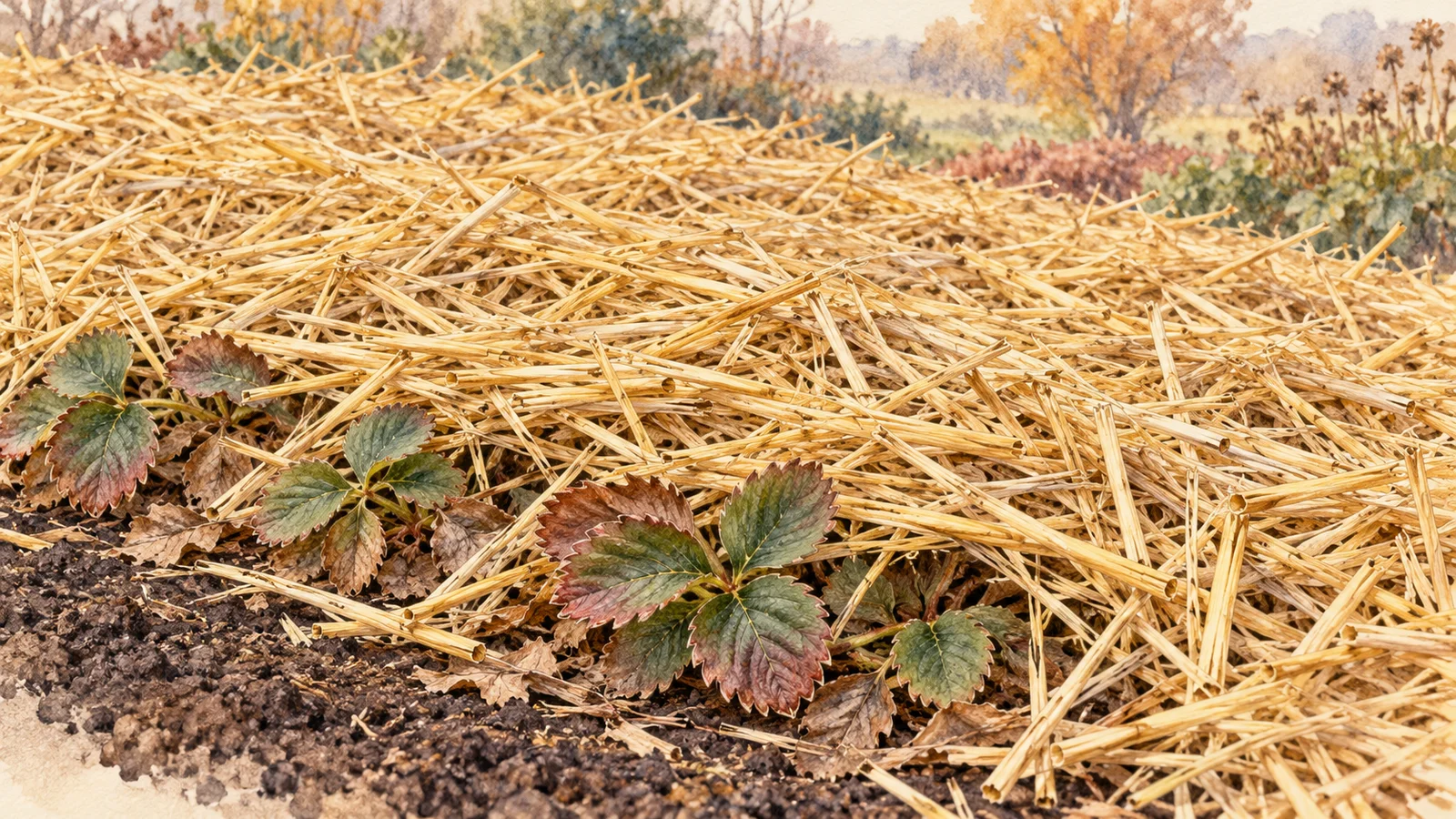
A strawberry bed needs two well-timed visits: one to cover resting plants before severe winter cold, and another to uncover them as growth returns. Spread straw too early and you interfere with the plants’ autumn adjustment. Leave it over new leaves too long in spring and the protection becomes an obstacle.
This plan is for established June-bearing strawberries growing in the ground in a cold-winter climate. It is not a universal October chore. Annual strawberry plantings in warm regions, plants grown on plastic, and pots exposed on a balcony need advice suited to those systems. If you do not know which kind you planted, check the nursery label or ask your local Extension office before applying a winter routine.
Put the straw nearby; wait to spread it
Buy or set aside clean, weed-free straw before you need it. Having the material ready lets you respond to conditions without covering an actively growing bed just because a free afternoon appears on the calendar. Keep it where you can reach it after a wet or frosty spell.
The aim is to protect the crowns and roots from severe cold and repeated freezing and thawing. New Hampshire Extension describes winter mulch as protection against injury and heaving. Snow can insulate a bed, but a forecast for a snowy winter does not guarantee continuous coverage. An exposed patch during a cold spell still needs attention.
Wait for the plants to harden and become dormant. Minnesota Extension’s straw-mulch guide uses soil temperatures at or below 40°F (about 4°C) for three consecutive days as a cue. A soil thermometer is more useful here than one afternoon’s air temperature. Check conditions in the bed, and do not interpret the first light frost or snowfall as an automatic instruction to cover it.
Local timing varies. Iowa State gives different November windows even within Iowa; New Hampshire describes application after the ground freezes. Those examples explain why a date from another region should not overrule what your own bed and weather are doing. If severe cold is arriving while plants still seem active, seek local advice rather than relying on a distant calendar.
Choose loose straw, not a mat of leaves
Use straw you can separate and spread evenly. Check the material before carrying it across the bed: avoid obvious weed seed heads and keep scraps of bale twine out of the planting. Lay the pieces loosely rather than pressing a solid slab from a bale onto the plants.
A pile of autumn leaves may be convenient, but it is a poor substitute for this particular job. Iowa State’s leaf-mulch guidance warns that leaves can form layers that hold excess moisture and ice without providing adequate protection. Use those leaves elsewhere according to the fallen-leaf guide, rather than treating every available organic material as interchangeable.
Do not give the bed a severe haircut before covering it. New Hampshire’s winter-fruit guidance advises against substantial fall pruning. This winter task is separate from renovating a June-bearing bed after harvest. If the rows have become crowded or overgrown, note that for the appropriate seasonal work instead of cutting away the entire canopy now.
Cover the plants, then check the coverage
For a home bed, Iowa State recommends 3–5 inches of loose material, which settles to roughly 2–4 inches. Spread it across the dormant plants, including their crowns. This is a temporary winter blanket over the planting, not the open ring you would leave around a tree trunk.
Work from the path or bed edge so you can see where the plants are. Check several places as you spread: a tall tuft of straw in one spot does not compensate for a bare crown beside it. Use a ruler if it is difficult to judge depth against the flattened foliage. You are measuring the loose covering, not tamping it down to make a neat surface.
Look again after wind or rain has shifted and settled the straw. Redistribute material where a patch has blown clear. Keep the bed location marked so it does not become an unnoticed shortcut through the winter garden. Mulch reduces risk; it cannot promise survival through every combination of exposure, drainage and cold.
Lift a corner when spring growth approaches
Do not wait for leaves to force their way through a thick winter layer. Start inspecting beneath the straw as spring warms. Check more than one plant, including a sheltered part of the bed that may warm sooner.
Use new leaves, soil temperature and the forecast together. Minnesota recommends removal as the soil reaches about 40°F and leaves emerge, with a short delay if a severe cold spell is imminent. Prolonged covering can delay the crop; exposing new growth before a freeze has its own risk. An emerging leaf may be pale beneath the straw, so do not look only for dark green foliage.
Gently move the bulk of the straw into the aisles or bed edges, keeping a light layer around plants as summer mulch. New Hampshire’s strawberry fact sheet describes using the removed straw in the aisles and returning it over plants for a predicted overnight frost. Avoid dragging a rake through the crowns. Keep the removed material accessible while spring freezes remain possible, and watch the forecast especially closely once flowers appear. Winter survival and protecting an open blossom are different jobs; an uncovered, growing bed still needs a spring frost plan.
Sources
- When should I mulch my strawberries? (Iowa State University Extension and Outreach). Accessed October 25, 2026.
- Adding and removing straw mulch for strawberries (University of Minnesota Extension). Accessed October 25, 2026.
- How do I prepare my backyard fruits for winter? (University of New Hampshire Extension). Accessed October 25, 2026.
- Are leaves a suitable mulch for strawberries? (Iowa State University Extension and Outreach). Accessed October 25, 2026.
- Growing Fruit: Strawberries (University of New Hampshire Extension). Accessed October 25, 2026.