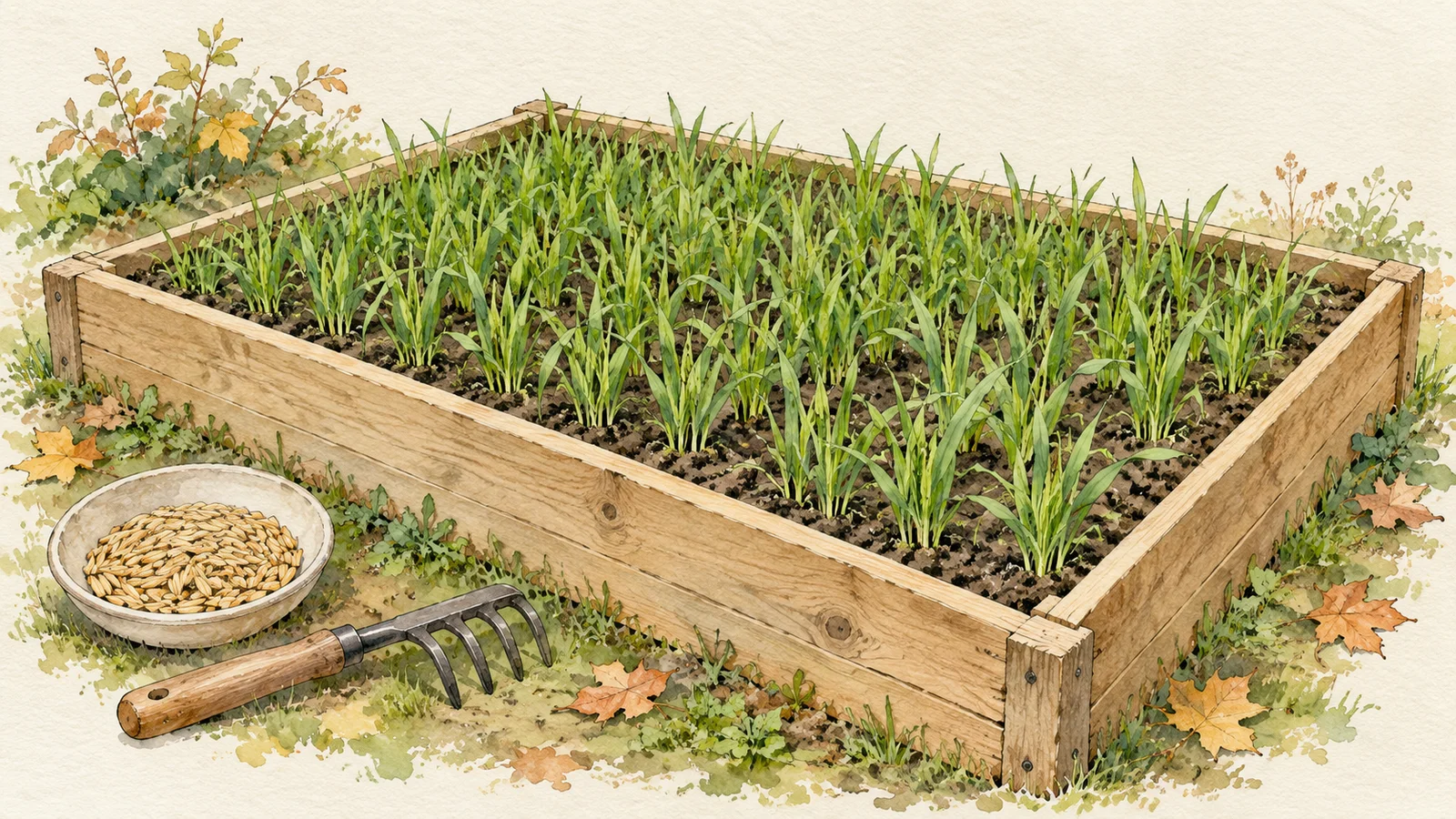
An empty vegetable bed does not have to stay bare all winter. A cover crop puts living roots into that space and leaves plant material behind for the soil. But a vigorous green bed can become an awkward job when it is time to sow carrots or set out seedlings. Choose the crop with that next planting in mind.
For a first attempt, use one bed or a clearly marked part of it. Write down when the space becomes free, what you want to plant there next and when that next crop needs the bed. Those three dates are more useful than a seed packet promising a long list of soil benefits.
Start with the spring bed you want
A bed reserved for early peas needs a different plan from one waiting for warm-weather transplants. Cover crops have to fit both ends of the gap. They need time to establish now, and any surviving growth must be killed before it competes with the vegetables later.
The University of Maine’s cover-cropping guide makes this planning connection explicit. It also cautions that a heavy crop such as winter rye can make a fine seedbed for small seeds difficult to prepare. A transplant can fit into a cleared opening; a row of tiny seeds needs more attention to the surface around it.
Do not assume every empty bed needs the same treatment. You might use a cover crop in the summer-tomato bed and shredded leaves over the bed you need early. If your local sowing window has already closed, mulch is a useful choice for this winter.
Oats are a manageable first option in cold winters
Spring oats, Avena sativa, grow during cool weather and commonly die over winter in colder regions. Their dead tops then protect the surface while gradually breaking down. Maryland Extension recommends oats for beginners and for gardeners who want an early spring vegetable bed.
That does not mean oats die everywhere, or that you can sow them whenever the last tomato comes out. Check a local extension planting window and ask about winter survival in your area. A mild winter can leave plants alive when you expected a brown mat.
In New Hampshire, UNH Extension describes late-summer or early-fall oats as a winter-killed cover and notes that many cover crops need planting by mid-September. A late-September reader in a cold climate may already be too late. In spring, inspect the bed: new green growth calls for a removal plan, not an assumption that the crop is finished.
Cereal rye earns its place only with a removal plan
Winter cereal rye, Secale cereale, tolerates later fall sowing than many alternatives and can survive cold winters. It is a useful option when the local window allows it, but it resumes growth in spring. Buy seed identified as cereal rye; annual ryegrass is a different plant. Purdue’s home-garden guide warns that annual ryegrass can become difficult to control.
Do not count on clipping young rye once and planting vegetables straight through it. The Iowa State species guide warns about incomplete termination and rye’s effects on seed germination. Mowing for a reliable kill depends on growth stage; waiting for flowering can be too late for your early vegetables.
In a small bed, digging out surviving plants may be practical. Smothering is another option, but it takes time: Iowa State’s termination guide gives roughly two to six weeks. Its general recommendation is to terminate cover crops two to three weeks before vegetable planting. Treat those as planning ranges, not a guarantee that green plants under a tarp are dead on a chosen date. Inspect for survival and regrowth.
If you cannot fit that work and delay into spring, choose a locally reliable winter-killed crop or mulch instead.
Sow for the area you actually have
Measure the inside growing area of the bed. A four-by-eight-foot bed contains 32 square feet, so a seed rate given per 100 square feet must be multiplied by 0.32. For example, Maryland’s single-species oat rate of three to four ounces per 100 square feet works out to about one to 1.3 ounces for that bed. Use your supplier’s appropriate rate and depth for the seed you buy; do not empty a large packet just because the bed looks sparse.
Move old mulch aside, remove weeds and prepare a reasonably even soil surface. Scatter seed evenly, cover it to the recommended depth and ensure contact with soil. Water gently if rain does not supply moisture for germination. Purdue notes that established garden beds generally do not need fertilizer added specifically for the cover crop. Existing fertility questions are better handled with a soil test than an automatic extra feeding.
Keep the seed label with your bed notes. For a mixture, record every species: one component dying over winter does not mean all the others will. Use the mixture’s sowing instructions rather than adding a full single-crop rate of each seed.
Leave the dead cover useful
Once a winter-killed cover is truly dead, you can move the residue aside for planting rows or open individual planting spaces. UNH describes planting transplants through the remaining material with little soil disturbance. Avoid working wet soil that sticks to tools and compresses into a dense lump.
Check again after planting for living cover-crop shoots and weeds. A dead surface cover and a growing competitor are different things. Keep a short note of what survived, how much clearing the bed needed and whether the next crop went in on time. That gives you a practical basis for choosing the next cover crop, without committing every bed to the same experiment.
Sources
- Cover Crops For Gardens (University of Maryland Extension). Accessed September 30, 2026.
- Cover Crops in the Home Garden (Purdue University Extension). Accessed September 30, 2026.
- Low and No-Till Gardening (University of New Hampshire Extension). Accessed September 30, 2026.
- Cover Cropping for Success (University of Maine Cooperative Extension). Accessed September 30, 2026.
- How to Terminate Cover Crops in the Vegetable Garden (Iowa State University Extension and Outreach). Accessed September 30, 2026.
- Types of Cover Crops for Use in Home Vegetable Gardens (Iowa State University Extension and Outreach). Accessed September 30, 2026.