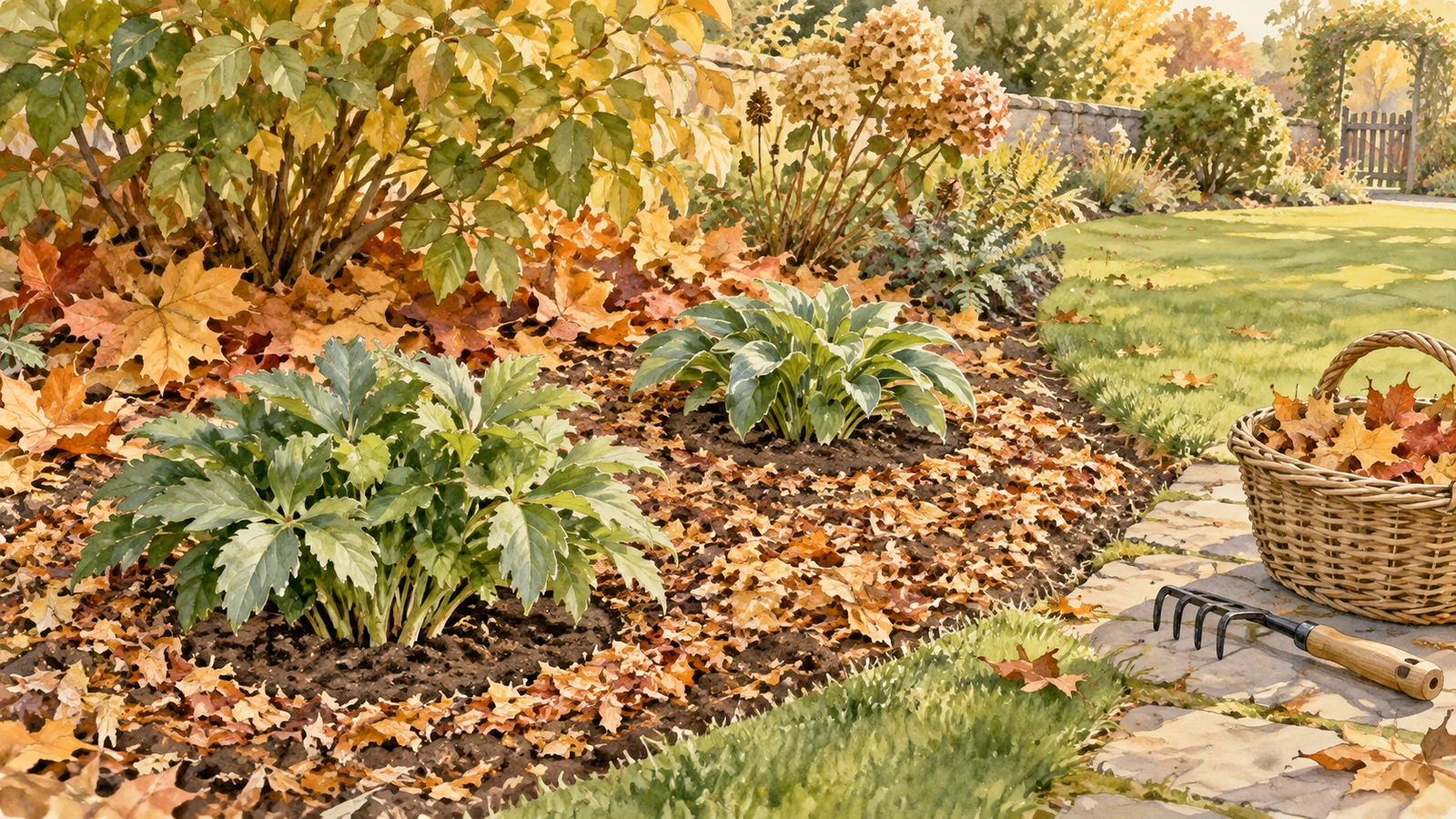
The leaves collecting along a fence can cover bare soil somewhere else in the garden. Before gathering them all into one pile, decide which part of the yard needs attention. A lawn, a shrub border and a bed of small perennials can each use a different approach.
Leaf mulch is simply leaves spread over the soil surface. As they decompose, they add organic matter; while they remain on top, they help moderate moisture and temperature and reduce weed growth. Minnesota Extension’s mulch guide explains these benefits. The useful amount is the amount your planting can accommodate, not the entire season’s leaf fall.
Leave a quiet corner whole
Leaves already lying loosely beneath shrubs or in a woodland-style border may need very little attention. Maryland Extension recommends keeping leaves whole where possible for wildlife. Leaves on the lawn can be moved intact to another part of the yard.
Choose a place where they can stay without covering low foliage, blocking a path or piling against bark. Rake gently into that area rather than shredding everything first. Leaving whole leaves and making finely chopped mulch serve different purposes; you can do both in different parts of the same yard.
Keep these leaves separate from crop debris you were advised to remove for a pest problem. For example, Maryland’s fall guidance calls for removing infested bean and cucumber debris. A habitat corner is not a reason to ignore a known garden sanitation problem.
Shred the portion going around small plants
Chopped leaves are easier to distribute between closely spaced plants. For leaves you choose to shred, work when they are dry and follow the mower or leaf shredder’s operating instructions. Keep stones, branches and other debris out of the material. There is no need to pulverize every leaf into dust.
Pull weeds before spreading the mulch. For a shrub bed, Maryland’s mulching guide recommends a 2–3-inch layer of leaves, especially shredded leaves. Count the mulch already there toward that depth. If a bed already has two inches of bark, another three inches of leaves is too much.
Around smaller perennials, keep their crowns, where stems meet the soil, uncovered. Distribute leaves through the spaces between plants instead of dumping a mound over each one. Preserve a visible gap at tree trunks; Maryland recommends about three inches between mulch and bark. Particular plants may need less mulch, so use their care requirements before a general depth rule.
A lawn needs visible grass
A leaf layer suitable for a bed can overwhelm turf. If you mulch leaves into the lawn with a mower, make regular passes while leaves are dry rather than waiting for a thick, wet blanket.
Minnesota Extension’s lawn guidance suggests switching to leaf collection when less than half the lawn surface is visible. Move the excess to a suitable bed or compost collection. That threshold is a practical lawn check, not a target depth for a garden border.
After mowing, look down through the fragments. If grass is still buried, the job is to remove some material, not to keep adding finer pieces. You can also rake leaves off the lawn intact and skip shredding when a nearby habitat area has room.
Give the surplus somewhere to go
If the beds are covered and the lawn is clear, keep the remaining leaves for another use. Illinois Extension describes making leaf mold by dampening leaves and storing them in bags with small holes, placed in contact with the ground. Over time, the leaves partly decompose into a material that can be used as mulch. The pace varies with the leaves, their size and their moisture, so do not count on a finished batch by a particular weekend.
You can also save dry leaves as the carbon-rich material for a compost pile that will receive greener, wetter ingredients later. Separate visibly diseased leaves before collecting a supply. If a tree has a diagnosed disease, follow the disposal advice for that disease rather than assuming a cool leaf pile will eliminate it.
Make room for next spring’s planting
An empty vegetable bed can remain covered during winter, but it will need another look before sowing. Pull the covering aside from the seed rows so you can prepare and sow into soil. Leave room for small seedlings to emerge and develop without a blanket of leaves over them.
New Hampshire Extension’s garden-mulch guidance recommends applying natural mulches around crops after growth has begun and the soil has warmed. That spring decision depends on the crop and local conditions; it does not follow automatically from the date when the autumn leaves arrived.
Check beneath the covering
Revisit mulched beds after rain. Pull back a small patch and feel the soil underneath. Wet leaves do not prove that water reached the roots: Maryland’s excess-mulch guidance warns that light watering may wet only the mulch.
Redistribute material that has collected against stems or settled into deep pockets. Check the total depth before adding more later in the season. Decomposition makes replenishment useful over time, but an annual top-up is not automatically necessary.
For plants spending winter in containers, use the separate potted-perennial overwintering guide. A layer of leaves on top of a pot does not answer the larger question of protecting its exposed root ball.
Sources
- Don’t Rake Fall Leaves, Recycle Them (University of Illinois Extension). Accessed September 16, 2026.
- Garden Mulches (University of New Hampshire Extension). Accessed September 16, 2026.
- November Gardening Tips and Tasks (University of Maryland Extension). Accessed September 16, 2026.
- Mulching Trees and Shrubs (University of Maryland Extension). Accessed September 16, 2026.
- Excess Mulch Problems (University of Maryland Extension). Accessed September 16, 2026.
- Fall Leaf Mulching Is Good for Your Lawn (University of Minnesota Extension). Accessed September 16, 2026.
- Mulching for Soil and Garden Health (University of Minnesota Extension). Accessed September 16, 2026.