Read the name before choosing the season
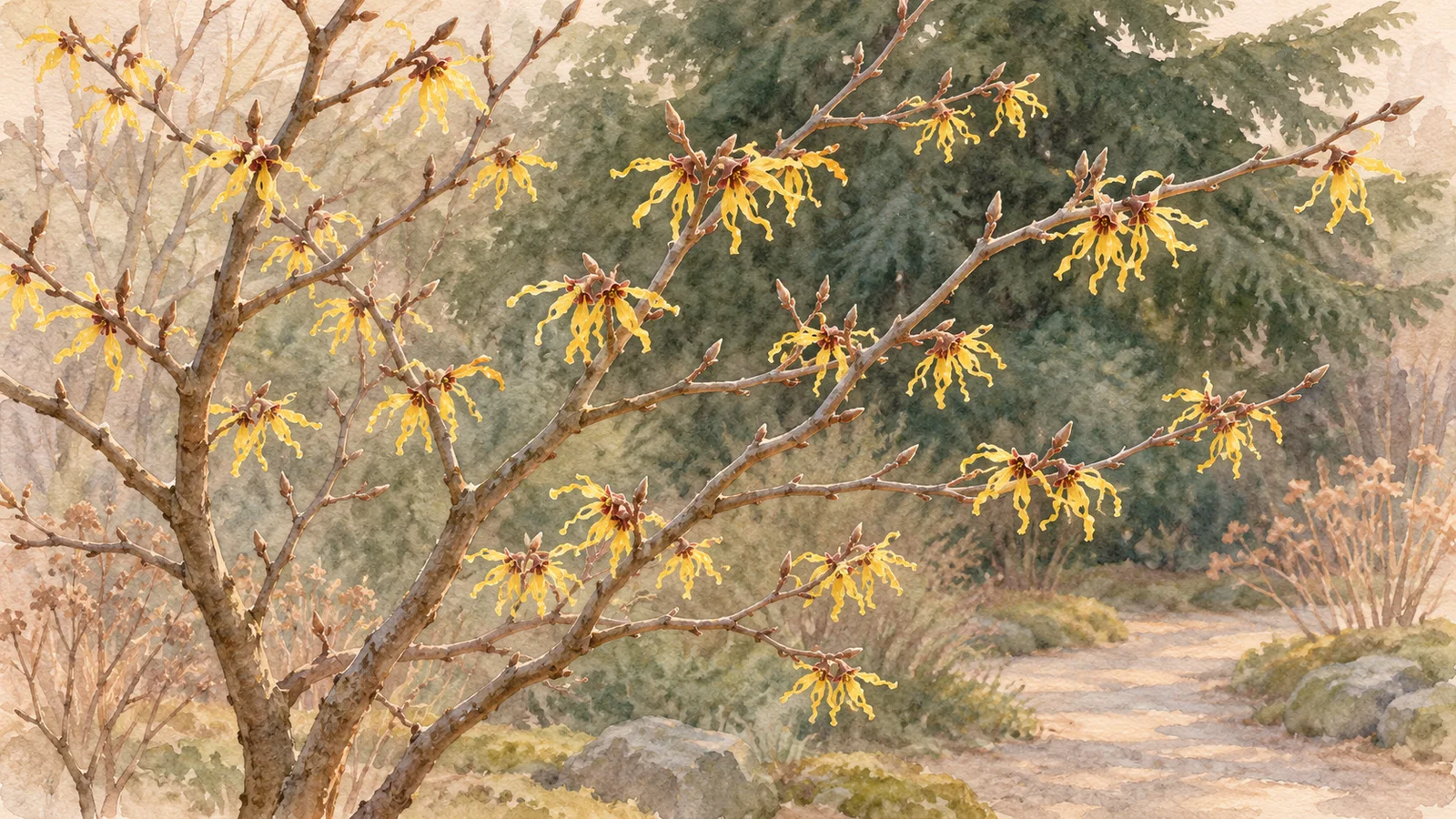
Witch hazel flowers reward a close look. Their narrow petals hang from bare twigs like little curled ribbons, bringing color to a garden that may otherwise be mostly stems and evergreen leaves. But a label that says only “witch hazel” does not promise flowers in February. The species and cultivar matter, as does the weather where you live.
For a winter or early-spring display, start with hybrid witch hazel, Hamamelis × intermedia, or the North American vernal witch hazel, Hamamelis vernalis. Common witchhazel, Hamamelis virginiana, usually flowers in autumn. It is a good garden plant with a different place in the calendar.
Iowa State Extension’s species guide lists hybrids for USDA zones 5–8 and vernal witch hazel for zones 4–8. Hybrid shrubs commonly reach roughly 8–15 feet or more; vernal forms can become dense, suckering shrubs. Check the individual plant’s expected height and spread, rather than treating those ranges as the dimensions of every cultivar. Flowering dates in an Iowa guide are useful regional examples, not appointments that a plant will keep in every state.
Give the branches somewhere to spread
Hybrid witch hazels come from crosses between Japanese and Chinese species. NC State Extension describes an open, often wide-spreading shrub that needs room. A small nursery pot can make it look suitable for a narrow strip beside a door, but a mature canopy needs much more space.
Mark the expected spread on the ground before buying. Leave room for the path, neighboring shrubs and access to the base. A spot where you must shear it every year to reach the gate is a poor fit. Yellow flowers can be easier to see against a dark evergreen backdrop, while a place near a regularly used path brings the small blooms within view.
Choose full sun to partial shade, with moist soil that drains freely. Deep shade reduces the display. Hybrid witch hazels generally suit acidic soil; if yours is strongly alkaline, get a soil test and local advice before committing to the site. Do not assume that a bag of amended soil in the planting hole changes the surrounding garden. The soil-testing guide explains how to begin with a useful sample.
Plant when the soil is workable
The RHS growing guide gives an autumn-to-spring planting window for its UK audience, while Iowa State favors early-season planting. Use your local conditions to choose the date. Frozen soil, waterlogged ground and a hot, dry spell are reasons to wait, even if a calendar says it is planting time.
Before digging, water a dry nursery root ball and inspect the roots as the container comes off. Minnesota Extension’s planting guidance recommends correcting circling roots and avoiding a planting hole filled entirely with a different amended medium. Roots need to move into the soil beyond the original pot.
Set the plant so the upper roots are just covered, rather than burying the base beneath a deep layer of soil. On a grafted witch hazel, keep the swollen graft union above ground. Backfill carefully, water to settle the soil, and check that the plant has not sunk as the hole fills. For a detailed container-removal and planting sequence, use the container-grown tree guide, keeping the witch hazel’s graft position in view.
Keep checking the root ball after planting day
A newly planted shrub has a much smaller working root system than an established one. Rain that dampens the surrounding bed does not necessarily soak the original root ball. Feel the soil in and beside that root zone, and water slowly enough for moisture to enter it instead of running off down the path.
Minnesota Extension’s watering guide emphasizes consistent moisture during establishment and watering the backfilled area as roots expand. This is a commitment across growing seasons, not just the first weekend. Adjust to rainfall, drainage and heat; do not keep adding water to soil that is already saturated.
A roughly 2–3-inch layer of wood-chip or bark mulch helps conserve moisture and keeps competing weeds down. Spread it over the root area, leaving a clear gap around the stems. Recheck the depth before adding more next year. A mound of mulch against the base hides the planting level and gives you another damp layer to mistake for soil.
Preserve flowering wood and watch the graft
These shrubs rarely need a regular haircut. Remove damaged or crossing branches where needed, and make planned shaping cuts after flowering. Flowers form on older growth, so trimming all the branch tips before the display can remove the buds you were waiting for.
Watch for vigorous shoots emerging below the graft or from the rootstock. Trace each one back to its origin and remove it cleanly there. Simply clipping its top leaves the source of the shoot in place. A sucker from the rootstock is not a spare copy of the named cultivar, and allowing it to grow unchecked can crowd out the plant you chose.
Look again on a milder day
A cold morning can make the flowers seem to disappear. The Brooklyn Botanic Garden documents witch hazel petals rolling inward in cold weather and opening as temperatures rise. Revisit the same branch on a milder day before deciding the display has failed.
Fragrance varies among cultivars, and some retain brown leaves that partly hide the flowers. When possible, see a mature specimen in bloom before choosing. If your priority is a locally appropriate native woodland shrub with autumn flowers, consider common witchhazel instead. Maryland Extension describes its late-season flowers, large spreading habit and foliage that can overlap the bloom. Choose that autumn show deliberately rather than buying it in expectation of the hybrid’s winter one.
Sources
- All About Witch Hazels (Iowa State University Extension and Outreach). Accessed November 10, 2026.
- Hamamelis x intermedia (NC State Extension). Accessed November 10, 2026.
- How to grow witch hazel (Royal Horticultural Society). Accessed November 10, 2026.
- Planting and transplanting trees and shrubs (University of Minnesota Extension). Accessed November 10, 2026.
- Watering newly planted trees and shrubs (University of Minnesota Extension). Accessed November 10, 2026.
- Witch-Hazels: Winter Flowers, Fall Foliage, and Lovely Form (Brooklyn Botanic Garden). Accessed November 10, 2026.
- Common Witchhazel (University of Maryland Extension). Accessed November 10, 2026.