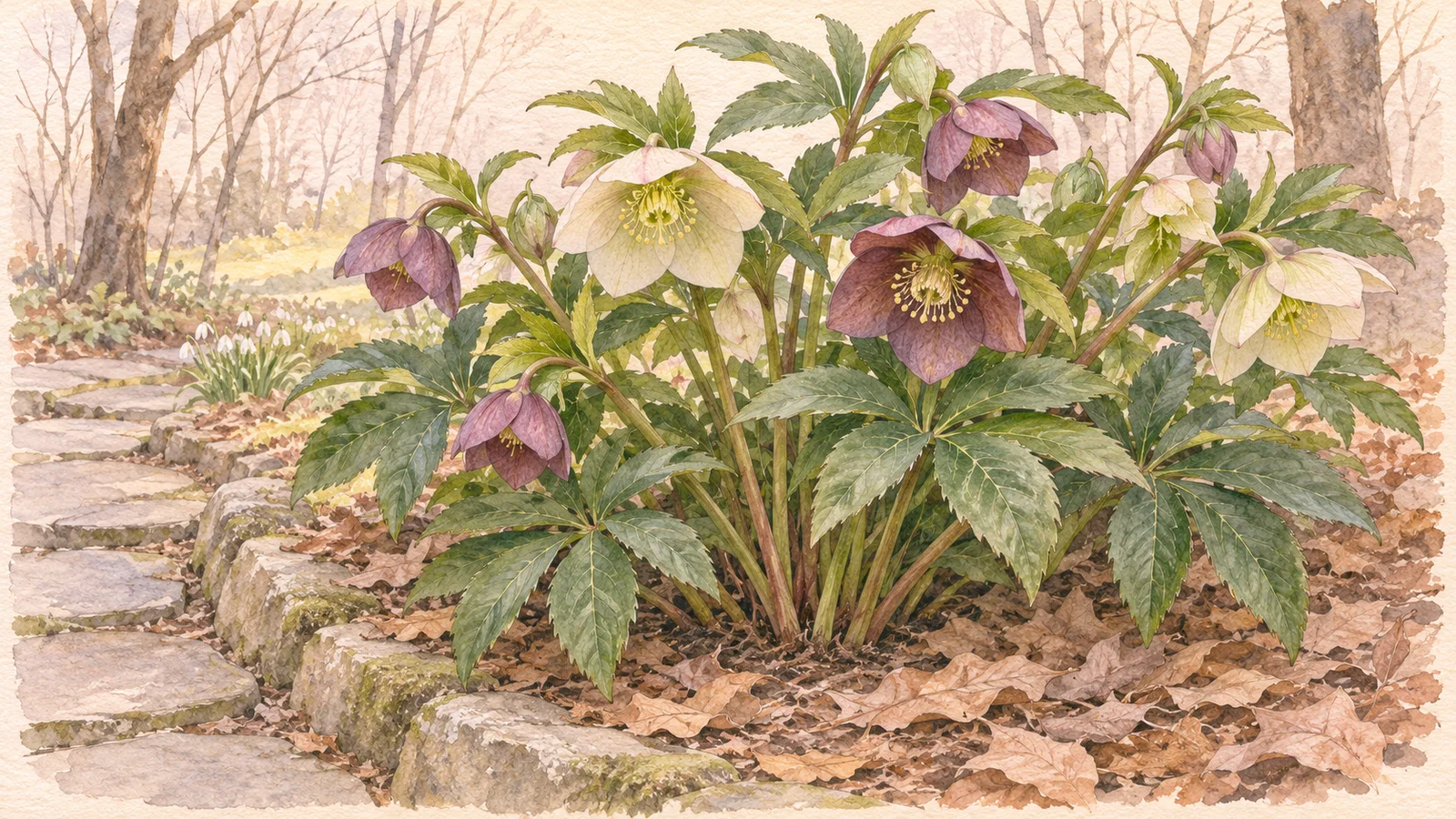
The first hellebore flowers often hang low enough that you have to crouch to see their faces. Give them a place beside a path or just above it, and those cream, pink or plum-colored cups become much easier to enjoy. The more consequential choice, though, is below your feet: roots need moisture without sitting in sodden ground.
This guide is for hybrid Lenten roses, Helleborus × hybridus, planted in a garden bed. They are long-lived perennials with leathery, divided leaves, not roses. Christmas rose, H. niger, and other hellebore species have their own requirements. Keep the plant label; it matters when choosing a site and deciding which leaves to cut.
Find the right patch of shade
Start with light or dappled shade and protection from harsh afternoon sun. A spot near deciduous trees can offer spring light and summer shelter, but inspect the actual bed rather than assuming every place under a tree is suitable. Dense roots and a rain-shadow can leave it much drier than the surrounding garden.
NC State Extension recommends consistent moisture, good drainage and shelter from winter wind. Sun tolerance varies with climate: Wisconsin’s guidance allows more sun in the Midwest while calling for shade farther south. A plant that handles a cool northern exposure may struggle in a hot, exposed southern bed.
Check the cultivar’s hardiness rating against your local winter conditions. Published ranges differ: Wisconsin Extension gives zones 5–9 for this group, with protection extending its range, while other regional guidance includes zone 4. Do not treat extra mulch as a promise that any hellebore will survive beyond its label rating.
Allow for the mature plant, too. Some hybrids spread roughly 2½ feet wide. Leave room to reach the crown for leaf cleanup without stepping into neighboring plants. A slight rise beside a path can also put downward-facing flowers closer to eye level.
Plant when the soil is workable
Spring and fall are useful planting seasons. In a mild climate, winter planting may also work; University of Missouri’s hellebore guidance ties planting to cool weather. A flowering plant at the shop is not a reason to dig frozen or waterlogged soil. If your bed is already closed for winter, plan a spring planting instead.
Look at the site after rain before making the hole. Avoid a hollow where water pools, and choose higher, freely draining ground. Missouri recommends humus-rich soil and a higher position in clay gardens. Compost can improve a planting area’s organic matter, but it does not make a persistently flooded hollow a suitable home.
Set the plant at the same depth it grew in its container, as the RHS growing guide advises. Keep the crown, the base from which shoots emerge, at its previous level. Fill around the roots and water the planting in. Spread organic mulch over the surrounding soil, leaving a gap at the plant’s base rather than burying it beneath a mound.
During the first growing season, check moisture in the root area and water when needed. An established clump’s tolerance of dry spells is not a useful watering schedule for a recent transplant. Conversely, a wet bed needs drainage attention, not another watering because the leaves look unhappy.
Keep soil care modest
Hellebores generally suit soil near neutral to slightly alkaline, but do not add lime just because a plant label says they like it. University of Vermont Extension recommends testing before amendments. Use the soil-testing guide to prepare a sample, telling the laboratory that this is an ornamental perennial bed.
The RHS notes that border-grown hellebores seldom need additional feeding. Before treating weak growth with fertilizer, check whether the roots have been drying out or staying wet. Those problems will not be corrected by a bloom booster.
In cold, windy gardens, foliage can look battered by the end of winter. Chicago Botanic Garden recommends winter mulching for protection from drying winds and summer mulching to help retain moisture. Keep the protective layer loose around the planting and keep checking that it has not accumulated over the crown.
Cut old leaves, not new flower stems
As buds begin to emerge in late winter or early spring, examine the plant at ground level. Hybrid Lenten roses carry their flowers separately from the old leaves. You can remove tired old foliage carefully, working one stalk at a time and preserving the new buds.
Do not apply that whole-plant haircut to an unidentified hellebore. The RHS leaf-spot guidance distinguishes types whose leaves and flowers share stems; cutting those stems before flowering can remove the display you were waiting for.
Round brown lesions, damaged stems or dark flower blotches deserve closer attention than ordinary winter wear. Remove leaves affected by leaf spot promptly and clear infected debris from around the plant. If blackening is extensive or the cause is unclear, seek a diagnosis from your local Extension service before treating it. Use clean pruning tools and avoid reaching blindly into a dense clump with shears.
Wear gloves and long sleeves for this work. Hellebores are poisonous if eaten, and their sap can irritate skin. Keep plants and any cut stems away from children and pets that may chew them; never use the flowers as an edible garnish.
Once the clump is settled, leave it room to mature. Division is not an annual chore, and seed-grown offspring may differ from the parent. Check local guidance before allowing seedlings to spread: NC State flags potential invasiveness, though it describes the threat as low. Remove unwanted seedlings and manage seed heads where necessary. A few well-placed plants are easier to enjoy and keep track of than a patch spreading beyond its bed.
Sources
- Lenten Rose, Helleborus × hybridus (University of Wisconsin–Madison Extension). Accessed November 8, 2026.
- Helleborus x hybridus (NC State Extension). Accessed November 8, 2026.
- Growing Hellebores (University of Vermont Extension). Accessed November 8, 2026.
- How to grow hellebores (Royal Horticultural Society). Accessed November 8, 2026.
- Hellebore leaf spot (Royal Horticultural Society). Accessed November 8, 2026.
- Heavenly Hellebores (University of Missouri). Accessed November 8, 2026.
- Hellebores (Chicago Botanic Garden). Accessed November 8, 2026.