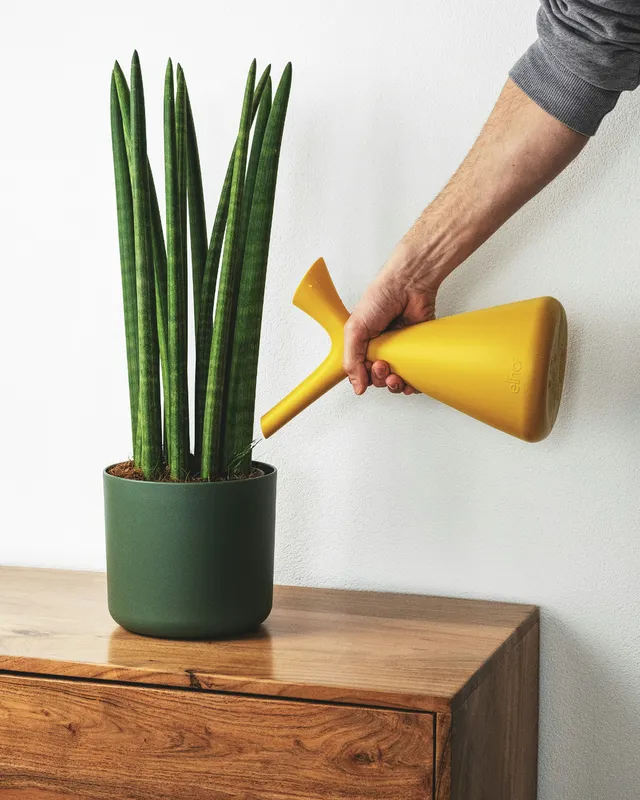
Most houseplants do not need special water. If the water from your tap is suitable for drinking, it is usually a reasonable starting point for common indoor plants. Water quality becomes worth investigating when there is evidence of salt accumulation, a known sensitive species, softened water, or a local report showing an unusual constituent.
That order matters. A brown tip by itself does not prove that tap water is the cause. The same symptom can follow dry roots, damaged roots, excess fertilizer, low humidity, heat, cold, or physical injury. Treat source water as one part of a diagnosis, not as a shortcut around checking the plant and its root zone.
Start with a three-question screen
Before buying filters or switching every plant to distilled water, answer three questions:
- Is there physical evidence of buildup? Look for a white or pale crust on the pot rim, soil surface, drainage saucer, or leaf surfaces repeatedly splashed by water.
- Does the water source add avoidable salts? Water from a household sodium-based softener deserves special attention. Fertilizer also adds soluble salts, so source water is not the only input.
- Does the pattern continue after the basics are corrected? Confirm adequate light, a drainage hole, an appropriate watering interval, and a complete wetting-and-draining cycle first.
Virginia Cooperative Extension notes that tap water is generally suitable for most houseplants. It also emphasizes that container type, potting mix, light, temperature, and watering frequency all change how long the root zone stays wet. Those factors usually deserve attention before a water upgrade.
What your local water report can tell you
If you use a public water system in the United States, find its Consumer Confidence Report. The EPA’s CCR directory is a practical starting point. Reports vary, but they can identify the source, disinfectant, detected contaminants, and other reported measurements for the system.
Use the report to replace guesses with local facts. Do not assume that advice written for another city applies to your tap. A report may help you identify:
- whether the system uses chlorine or chloramine as its disinfectant;
- reported mineral or ion levels that affect hardness or salinity;
- whether fluoride is reported;
- violations, treatment changes, or contact information for questions.
A CCR is written for drinking-water compliance, not as a houseplant prescription. It will not tell you exactly how a particular cultivar will respond in a particular pot. It does help you decide whether source water is a plausible contributor and what, if anything, a treatment device would need to address.
Private well users do not receive a municipal CCR. If well water leaves heavy scale, has known salinity, or is otherwise suspect, use an accredited laboratory and local guidance rather than a countertop gadget as the basis for a decision.
Separate hardness from softened water
Hard water contains dissolved minerals. It can leave visible scale, but hardness alone does not mean every houseplant will be damaged. The problem in a container is cumulative: water evaporates or is used by the plant while some dissolved material remains behind.
Household water softeners can create a different concern. Many exchange calcium and magnesium for sodium. Washington State University Extension advises against using softened water for houseplants because salts can accumulate in the potting medium. If only part of the home is softened, an unsoftened tap may be the simplest alternative.
Do not confuse a drinking-water filter with a guaranteed plant-water solution. Filter technologies remove different constituents. A product’s certification and performance sheet must match the specific issue you found. Its shape, price, or marketing name does not establish that match.
Read the pot, not just the leaf
Visible mineral or fertilizer deposits are stronger evidence than an isolated brown edge. University of Maryland Extension describes deposits as white crystalline coatings on foliage, growing media, or containers. Hard water and soluble fertilizer can both contribute.
Check five places:
- the upper surface of the potting mix;
- the inside and outside rim of the pot;
- the drainage saucer or decorative outer pot;
- drainage holes;
- leaves that are routinely splashed or misted.
Then check your routine. Frequent light watering can wet only part of the root ball and leave dissolved material behind. Fertilizing dry mix, exceeding label directions, or allowing drainage water to remain under the pot can add stress without any problem in the municipal supply.
For a broader symptom check, use the brown leaf-tip diagnosis guide before assigning one cause.
Manage buildup without chasing perfect water
The first response is usually better drainage and better irrigation technique, rather than an expensive new water system.
1. Confirm a complete drainage path
The growing container needs an open drainage hole. Remove it from a tight decorative sleeve before watering if the sleeve traps runoff. Let the container drain completely, then empty the saucer or outer pot.
2. Rewet the whole root ball
Very dry peat- or bark-based mixes can repel water. Water may race down the wall of the pot while the center remains dry. Virginia Cooperative Extension recommends repeated slow applications or temporary bottom soaking to rehydrate a dry root ball, followed by complete drainage.
Bottom watering is useful for rewetting, but it does not wash accumulated salts down and out. The bottom-watering guide explains when to use that method and when top watering is the better tool.
3. Leach from the top when deposits accumulate
Top watering with a suitable source can move dissolved salts through the potting mix and out the drainage holes. University of Missouri Extension recommends applying enough water to wet the entire root ball and allow drainage rather than repeatedly giving small sips.
Protect the sink or tub, use room-temperature water, and let runoff drain freely. Do not leach a pot with blocked drainage, a plant already sitting in saturated mix, or a container that is unsafe to move. If the root ball smells rotten or has collapsing roots, use the root-rot guide instead of adding more water.
4. Reduce the input you can identify
Pause fertilizer until you have checked the label, recent applications, and plant growth. Avoid softened water when sodium is the concern. If the local report or a reliable test identifies a constituent relevant to a sensitive plant, choose an alternate source or a treatment certified for that constituent.
Change one variable at a time. A dated photo and a few weeks of consistent care are more useful than rotating among tap, bottled, filtered, and distilled water every few days.
5. Repot when the medium is no longer serviceable
Heavy crusting, a collapsed mix, blocked drainage, or persistent salt damage may justify replacing the medium. Repotting is not a substitute for correcting the water, fertilizer, or drainage practice that caused the buildup. The low-stress repotting guide covers container sizing and root handling.
Rainwater is an option, not an automatic upgrade
Collected rainwater can reduce reliance on municipal water, but it is not automatically clean. Roof surfaces, gutters, animals, and storage containers can introduce debris, microbes, or chemicals. University of Minnesota Extension classifies rain-barrel water as non-potable and recommends maintaining the barrel and using the water carefully.
For ornamental houseplants, screened and maintained rainwater may be useful. Keep it away from edible plant parts unless applicable food-safety guidance supports the collection and use method. Do not store stagnant water in an open indoor container.
A practical decision table
| What you observe | Best next check | Avoid assuming |
|---|---|---|
| Plant is healthy; no deposits | Continue the current source and monitor | Every plant needs filtered water |
| White crust on soil or pot | Review fertilizer, hardness, softened water, and drainage | The leaf symptom identifies one chemical |
| Water runs straight through a light pot | Check for a hydrophobic, partly dry root ball | Fast runoff means thorough watering |
| Pot stays wet for many days | Check light, mix, pot size, and drainage | Changing water source will fix saturation |
| One sensitive plant repeatedly declines | Verify species needs, local water data, and all cultural factors | A single product or water type guarantees recovery |
The concise rule
Use ordinary tap water unless the plant, pot, or local data gives you a reason to investigate. When there is evidence, identify the input, restore complete wetting and drainage, manage accumulated salts, and evaluate one controlled change at a time. Water quality matters, but it works through the whole container system, not through the faucet alone.
Sources
- Properly Watering Container Houseplants (Virginia Cooperative Extension). Accessed August 25, 2026.
- Chapter 14: Houseplants (Washington State University Extension). Accessed August 25, 2026.
- Safe Drinking Water Act: Consumer Confidence Reports (United States Environmental Protection Agency). Accessed August 25, 2026.
- Rain Barrels in the Home Landscape (University of Minnesota Extension). Accessed August 25, 2026.
- Mineral and Fertilizer Salt Deposits on Indoor Plants (University of Maryland Extension). Accessed August 25, 2026.
- Caring for Houseplants (University of Missouri Extension). Accessed August 25, 2026.