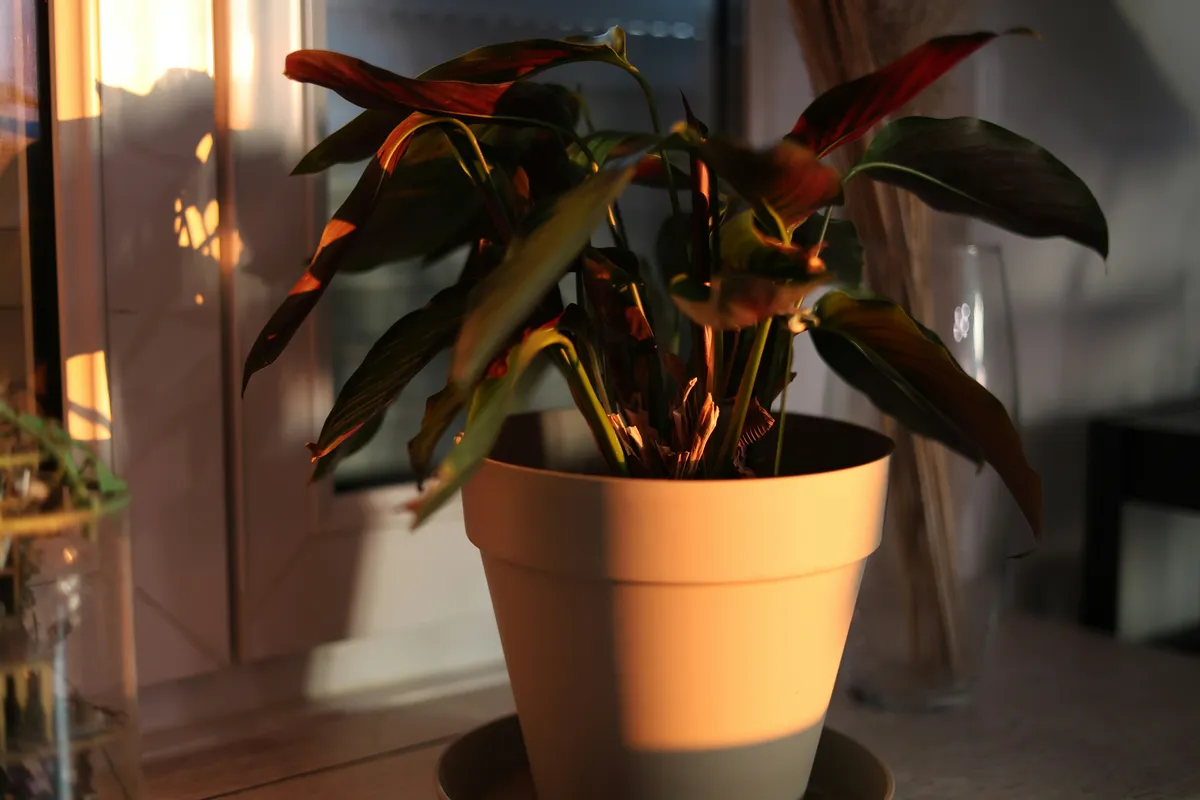
Brown leaf tips are a symptom, not a diagnosis. The dead tissue will not turn green again, and several unrelated problems can create a similar dry edge. Low humidity may be involved, but so can a root ball that became too dry, a root ball that stayed wet, excess fertilizer salts, sensitive water chemistry, heat, drafts, chemical spray, or physical damage.
A useful diagnosis combines the pattern on the plant with recent care and root-zone conditions. Change one likely factor at a time when the plant is otherwise stable. Repeatedly watering, repotting, fertilizing, and relocating a plant together can obscure the cause and add stress.
Read the pattern before treating it
Start with the whole plant, not only the brown point. UC Integrated Pest Management lists dry or wet soil, excess fertilizer or soluble salts, specific toxicities, low humidity, pesticide injury, and mechanical injury among possible causes of brown or scorched tips. Its diagnostic guidance also distinguishes leaf-tip injury from spots, generalized yellowing, wilting, and pest stippling.
Ask these questions:
- Are only the oldest tips affected, or is new growth browning as it opens?
- Is the damage uniform on many leaves or concentrated on the window, vent, walkway, or spray-facing side?
- Is the tissue crisp and dry, soft and spreading, water-soaked, bleached, or marked by a yellow halo?
- Is the mix dry throughout, wet for an unusually long time, compacted, or pulling away from the pot?
- Are roots firm and pale, or dark, soft, and sparse?
- Did the pattern begin after a missed watering, fertilizer application, pesticide, water-source change, repot, cold exposure, or move into stronger light?
- Are there insects, sticky residue, fine stippling, webbing, cottony material, or raised scales?
Uniform, slowly developing tip burn across a sensitive species points toward a shared root-zone or air condition. Damage confined to exposed leaves points more strongly toward light, heat, drafts, rubbing, or spray. Soft lesions that expand into healthy tissue are not typical cosmetic tip burn and deserve disease or root investigation.
Check watering and roots first
Both drought and chronically wet mix can limit water delivery to leaf tissue. A severely dry root ball has no water available; damaged roots in oxygen-poor, saturated mix may also fail to supply the canopy. Watering a wilted plant without checking the mix can therefore worsen the wrong condition.
Iowa State University Extension and Outreach recommends checking moisture rather than watering on a fixed calendar. Light, temperature, humidity, species, plant size, container, and season alter drying time. When the plant is due, wet the full root ball and allow excess water to drain; then empty the saucer or outer pot.
If water immediately runs down the pot wall, the center may still be dry. Rewet a resistant mix gradually and verify moisture below the surface. If the pot remains heavy and wet, confirm that drainage holes are open and that the nursery pot is not standing in water inside a cachepot.
Wilt, yellowing, leaf drop, or continued browning while the mix is wet warrants a root check. University of Maryland Extension describes healthy roots as firm and light-colored and root-rotted tissue as dark and soft. Remove the plant gently, inspect rather than guessing, and replace compacted or poorly draining mix if it is contributing to root decline. A crowded root ball alone is not proof that brown tips require a larger pot; repot only when the roots and mix show a reason.
Investigate fertilizer and soluble salts
Fertilizer salts and minerals from water can accumulate in a container because roots have access to only a limited volume of mix. Clues include a pale crust on the soil or pot, recent heavy fertilization, repeated small sips of water with little drainage, or damage beginning after feeding. Salt injury is more plausible when several leaves develop marginal scorch while pests are absent.
Stop fertilizing while diagnosing. If roots are reasonably healthy, the container drains freely, and the water source is suitable, leach the mix by applying water from the top and letting it drain completely. University of Maryland Extension recommends leaching excessive fertilizer from potting mix or repotting into fresh media when high soluble salts cause leaf scorch. Do not leach a pot whose drainage is blocked or whose roots are already sitting in saturated mix; correct drainage first.
Resume fertilizer only during active growth and at the product’s labeled concentration. More fertilizer does not repair brown tissue. Plants growing slowly in low light generally use fewer nutrients than actively growing plants in adequate light.
Consider water chemistry for sensitive plants
Tap water is acceptable for many houseplants, so brown tips do not automatically justify buying distilled water. Water chemistry becomes a stronger suspect when good moisture and fertilizer practices have not stopped new damage, the local water is softened or high in dissolved minerals, or a known sensitive plant is affected.
Missouri Botanical Garden’s indoor watering guide notes that fluoride can injure sensitive plants such as spider plants and dracaenas and cannot be removed by letting tap water stand. It also advises against sodium-softened water because salts can accumulate in the mix. Letting water stand does not remove fluoride or dissolved minerals.
For a suspected sensitive plant, verify its botanical identity and check the utility’s current water-quality report. Trial rainwater collected safely, distilled water, or another low-mineral source on new growth while keeping other care stable. Do not use rainwater from a contaminated catchment, and do not assume water collected by a dehumidifier is potable or free of metals and microbes.
Evaluate humidity without over-humidifying the home
Indoor humidity can become low in winter and affect humidity-demanding plants. Low humidity is more convincing when thin-leaved species decline during heated winter conditions and root-zone care is appropriate.
Measure relative humidity near the plant with a hygrometer before changing the room. Keep the plant away from forced-air vents and abrupt hot or cold drafts. A humidifier can raise room humidity, but it must be maintained safely. The U.S. Environmental Protection Agency’s humidifier guidance says not to exceed 50 percent indoor relative humidity, to reduce output if nearby materials become damp, and to clean and maintain the unit according to its instructions. Keep steam units away from children because of burn risk.
Misting produces only a brief local change and does not correct dry potting mix. Wet foliage can also favor some diseases. Pebble trays should keep the pot above the water line; they should not turn an ordinary pot into a standing-water reservoir.
Rule out light, temperature, injury, and pests
Direct sun or heat through glass can scorch the most exposed tissue, especially after a sudden move. Cold glass, exterior-door drafts, and heating vents can create localized injury. Move a plant to a more suitable exposure gradually and compare affected with shaded leaves. Already-browned areas will remain brown, so judge the change by new growth.
Look for a physical pattern: tips that rub a wall, brush a doorway, or contact cleaning products may brown on only one side. Keep leaf-shine products, household cleaners, and unlabeled sprays off foliage. If a pesticide is needed for an identified pest, choose a product labeled for that plant and indoor site, follow the label, and test a small area when directed.
Fine pale stippling and webbing suggest spider mites rather than simple tip burn; sticky residue, cottony masses, or raised bumps suggest other sap-feeding pests. Inspect both sides of leaves and stem joints with good light. A local Extension office or plant diagnostic clinic can help when symptoms spread, roots decline, or the cause remains unclear.
Trim only after the plant is stable
Brown tissue is dead and trimming is cosmetic. Clean scissors before and after use, especially if disease is possible. Follow the natural leaf outline and leave a narrow brown margin rather than cutting deeply into healthy green tissue. Remove an entire leaf only when it is mostly damaged or a diagnosed disease calls for sanitation.
Track the date and photograph new leaves. If new growth remains healthy after one targeted correction, the likely stress has been reduced. If browning continues, reconsider the diagnosis instead of escalating every treatment. The durable fix is the right root-zone, air, light, and water conditions for the identified species, not a universal watering or humidity schedule.
Sources
- Houseplant Problems (University of California Statewide Integrated Pest Management Program). Accessed August 25, 2026.
- How to Water Indoor Plants (Missouri Botanical Garden). Accessed August 25, 2026.
- How to Care for Houseplants (Iowa State University Extension and Outreach). Accessed August 25, 2026.
- Diagnose Indoor Plant Problems (University of Maryland Extension). Accessed August 25, 2026.
- Use and Care of Home Humidifiers (U.S. Environmental Protection Agency). Accessed August 25, 2026.