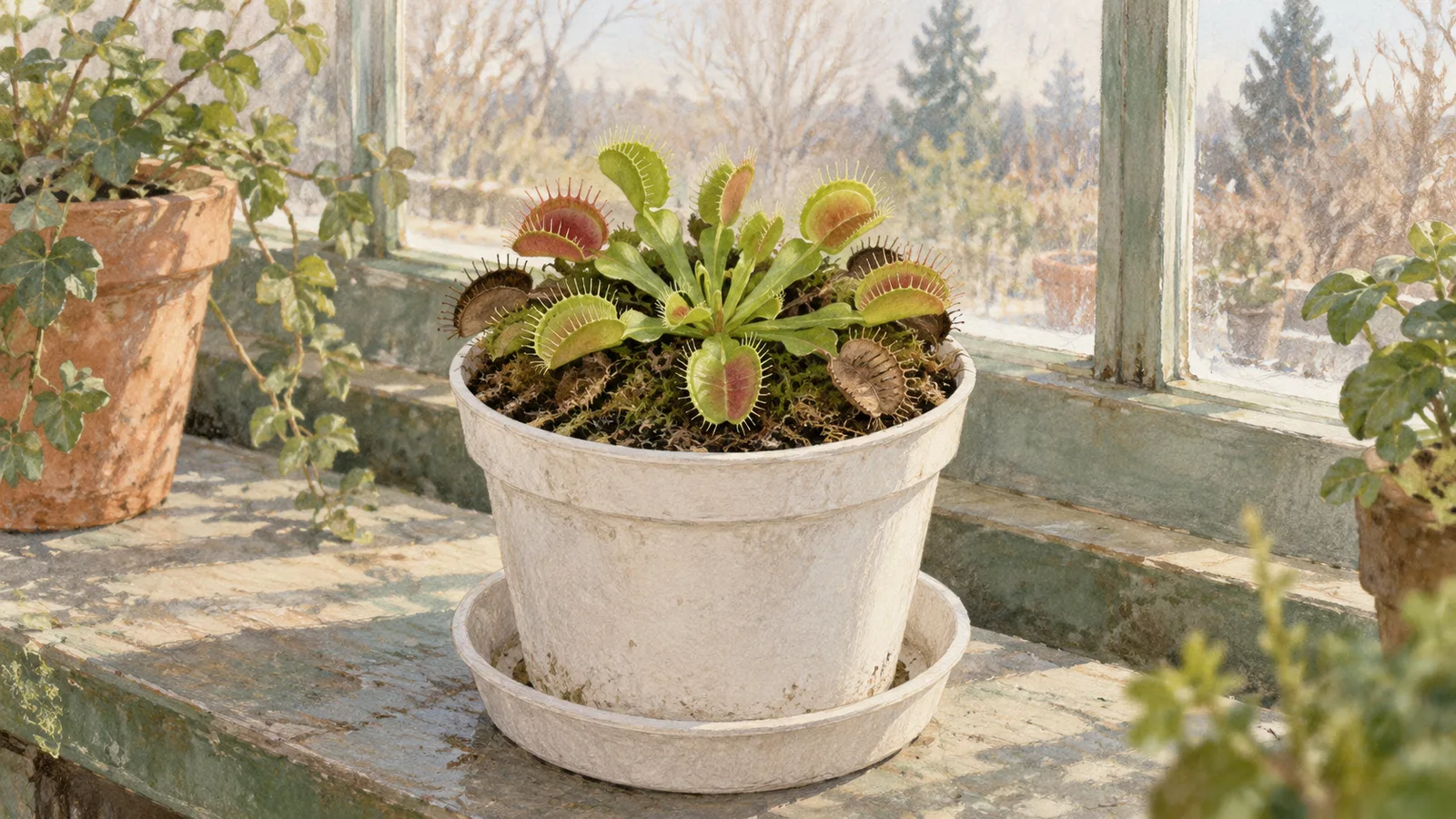
A Venus flytrap can look smaller in November than it did in July. Tall leaves give way to a low rosette, some old traps blacken, and new growth slows. For a plant that has spent the growing season outdoors, that change can be part of its winter rest. It is a cue to change its care, not to fill its traps with food or move it beside a heater.
Start by checking the label: Dionaea muscipula. Tropical pitcher plants have different winter needs, even when the shop displays them beside flytraps. The Venus flytrap comes from the coastal Carolinas, where it experiences seasons. A little nursery pot, however, needs more protection than a plant rooted in a suitable outdoor habitat.
Keep the winter plan consistent with how it grew
If your flytrap has been outdoors under natural daylight, let the shorter days and cooler autumn weather ease it into slower growth. Choose its protected winter position before a hard freeze arrives. Do not wait until a forecast forces you to choose between an exposed balcony and a hot, dim living room.
There is another way to grow this plant. In Carnivorous Plant Newsletter, John Brittnacher describes long-term indoor cultivation without winter dormancy, using strong artificial light and regular feeding. That is a deliberately maintained growing setup. A warm windowsill with weak winter light does not provide the same conditions. If you already have a thriving plant under grow lights, do not abruptly chill it just because the calendar says October; follow the cultivation method that supports its active growth.
For an ordinary outdoor pot, the practical winter job is to shelter its seasonal rest. For a newly purchased plant, ask the grower whether it has been growing under lights or already receiving cool nights. This is especially useful for a small plant bought late in the year.
Find a cool place with daylight
A bright, cool porch, greenhouse or window in an unheated room can work, provided its actual temperatures are suitable. The University of Idaho’s winter-care guidance gives 32–55°F (0–13°C) as a dormancy range. For a small pot you are protecting, choose a place that stays above freezing rather than deliberately testing its cold tolerance.
Put a minimum–maximum thermometer beside the pot. A garage that feels chilly at dinner may fall below freezing before dawn; a glass porch may heat sharply in afternoon sun. Check several days and nights, including the cold forecast, before treating a room name as proof that the location works. Keep the plant where you can reach it easily for watering and inspection.
NC State describes outdoor hardiness in zones 7–10, with protection needed in colder zones. Those regional ratings do not guarantee survival for every exposed container. If your only outdoor place is a windy railing or your shed freezes deeply, arrange a brighter, protected location. Our guide to overwintering perennials in pots explains why containers need their own winter plan.
Leave daylight available to the remaining green leaves. A dark cupboard is not a substitute for a cool window. Keep leaves away from icy glass, and avoid repeatedly moving the pot between a warm room and freezing outdoors.
Reduce water without drying the roots
Use rainwater or distilled water. Flytraps are sensitive to mineral-rich water; switching to an ordinary household water supply for a few convenient months can undo otherwise careful care. If water quality has been confusing, the houseplant water guide explains why softened, filtered and distilled water are different things.
Check the growing medium with a fingertip near the pot’s edge. During rest it should remain damp, while needing less frequent watering than it did in hot summer weather. Add water before the root zone dries out. Do not wait for the whole pot to become hard, pale and shrunken away from its sides.
The RHS recommends watering resting carnivorous plants from below and discarding excess water rather than leaving the container standing in it. Let the medium take up water, then empty the saucer. Recheck the pot after a change in weather or location; a bright porch can dry a small container more quickly than a cool greenhouse bench. A weekly reminder can prompt an inspection, but it cannot tell you whether water is needed that day.
Keep the existing suitable carnivorous-plant medium if it is sound. Do not top it up with ordinary fertilized houseplant compost or add plant food to encourage winter traps. If repotting becomes necessary, use a low-nutrient medium specifically suitable for Venus flytraps, with no added fertilizer.
Watch the center, and leave the traps alone
Some dying outer traps are expected during the seasonal change. Green leaves and small traps near the center are more useful signs to watch than the oldest black leaf. The Maryland horticulturists answering an Ask Extension question point out that these low green leaves can still photosynthesize during rest.
Snip off fully dead foliage with clean scissors without cutting living tissue or tugging at the crown. There is no need to strip a plant back to bare soil. Look beneath the remaining leaves for pests as you tidy, using the houseplant inspection guide if you need a closer routine. Avoid snapping traps shut to check whether the plant is alive, and do not feed a resting plant.
A collapsing center, spreading soft decay or no visible living growth deserves closer attention. Check the moisture, water source and temperatures, and send clear photographs to the nursery or a carnivorous-plant grower if the condition is unclear. A black trap alone cannot distinguish normal leaf loss from a problem; neither can the month of the year.
As daylight and warmth return, watch for renewed leaf growth and adjust watering to the plant’s use. Protect fresh growth from a late freeze. If the pot spent winter sheltered from strong sun and wind, return it outdoors gradually. Let the new traps develop before expecting the full summer rosette again.
Sources
- Dionaea muscipula (NC State Extension). Accessed October 11, 2026.
- How to grow carnivorous plants (Royal Horticultural Society). Accessed October 11, 2026.
- What is winter dormancy in carnivorous plants? (Tom Bennet, Tom’s Carnivores). Accessed October 11, 2026.
- Grow Venus flytraps indoors (2019) (John Brittnacher, Carnivorous Plant Newsletter). Accessed October 11, 2026.
- How Not to Kill Your Grocery Store Venus Flytrap (January/February 2026, page 2) (Samuel DeGrey, University of Idaho Extension). Accessed October 11, 2026.
- Venus flytrap dormancy and green winter leaves, answer 228538 (Ask Extension, Maryland Home & Garden Information Center). Accessed October 11, 2026.