A hardy plant still needs protected roots
A perennial can survive winter in a garden bed and fail in a pot beside it. The difference is around the roots: a container exposes a small volume of growing medium to cold that the surrounding ground would otherwise moderate. Illinois Extension explains that roots are often less cold-tolerant than the plant’s above-ground parts.
For hardy potted perennials, the autumn job is to choose a protected winter location, keep the roots from drying out or staying waterlogged, and let the plant remain dormant. Decide where the pots will go while the ground is still workable and the containers are easy to move.
Check what “perennial” means for this plant
These methods suit plants hardy to your climate. “Perennial” means a plant can live for multiple years; it does not promise survival through your winter. Tropical perennials need a different plan. Many hardy herbaceous perennials lose their above-ground growth, then return from surviving roots or the crown, the base near the soil surface. Others retain leaves. Maryland Extension explains these distinctions.
Find the species or cultivar name and its hardiness rating. The USDA map describes average annual extreme minimum temperatures, not a place’s coldest possible night. It also cannot capture every exposed balcony or sheltered garden corner.
Illinois Extension suggests choosing plants hardy about two zones colder when they will overwinter outdoors in pots. Treat that as a useful selection margin, not a guarantee. A plant barely hardy in the ground deserves more protection in a container. If its identity is uncertain, resolve that before choosing cold storage.
Choose among three winter locations
Sink nursery pots into a garden bed
Temporary burial brings the soil’s insulation around the root ball. Choose a bed with suitable drainage, dig a hole for each pot, and settle it with the rim just visible at ground level. Fill around the sides without raising soil over the plant’s crown. The pot stays intact for lifting in spring.
Iowa State Extension recommends doing this after dormancy begins but before the ground freezes. Keep the plant labels visible. A row of similar-looking dormant pots is much easier to identify in April if each still has its name.
Use a cold, sheltered building
An unheated garage or shed can work if its actual temperature suits dormant plants. Move the plants into storage once they are dormant. New Hampshire Extension gives 30–40°F as a useful range. An ordinary warm room is a different environment.
Put a minimum–maximum thermometer beside the pots and check it through cold nights and sunny days. “Unheated” alone does not establish a reliable temperature. If the space swings far outside suitable conditions, choose another location. Plants that keep green leaves also need appropriate light; do not automatically assign them to a dark corner.
Group and insulate pots outdoors
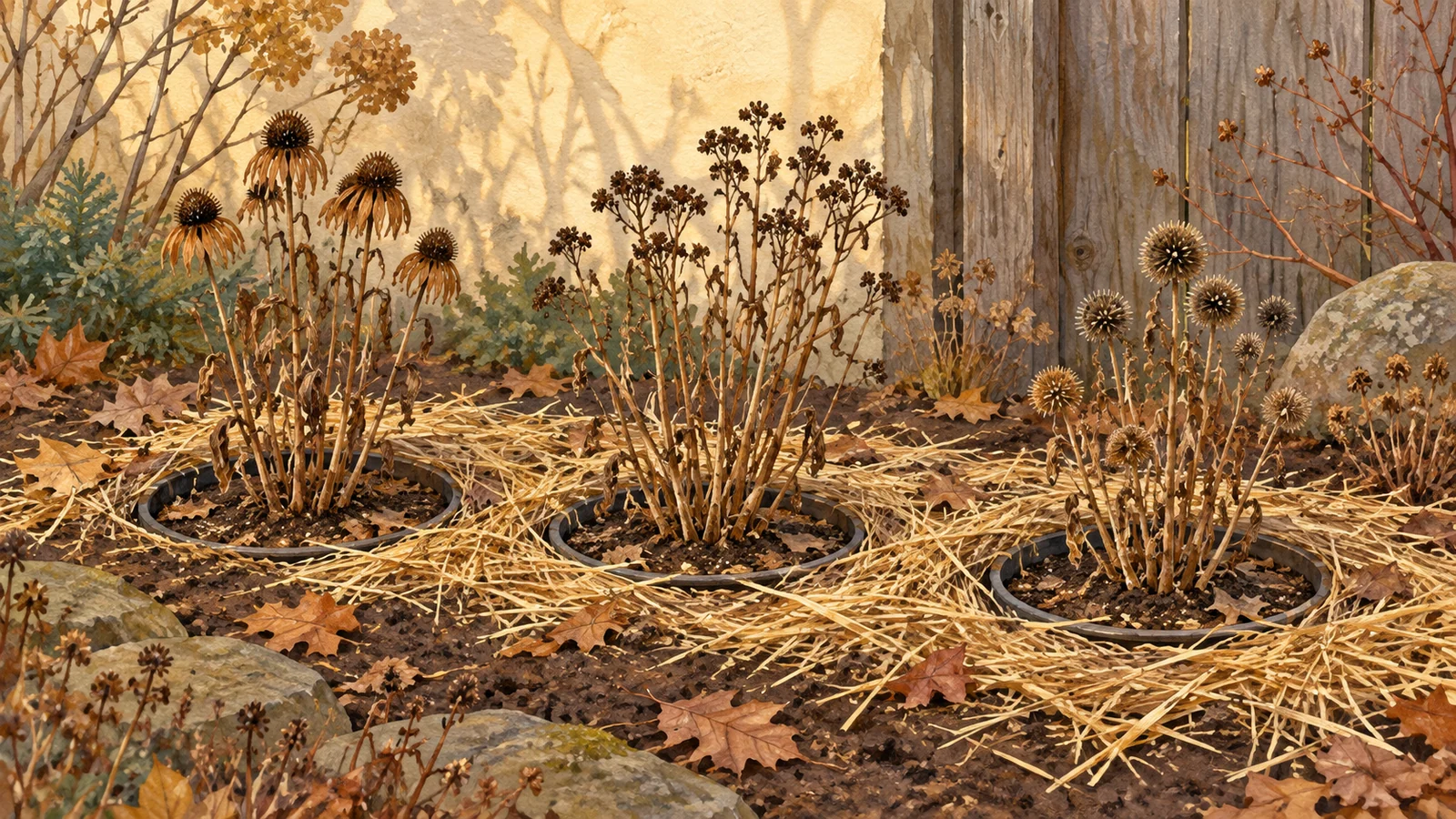
Where burial and cold shelter are unavailable, New Hampshire Extension recommends clustering containers away from strong wind and intense winter sun, with insulating material around them. Use loose straw or another suitable mulch around the pots, concentrating protection around the root zone.
This is a conditional fallback. On an exposed upper-floor balcony or in severe cold, grouping and wrapping may be insufficient. Ask local Extension about your species and location before relying on it. A pot that cannot be moved still needs a realistic winter plan.
Prepare the container as carefully as the plant
Check the container’s frost resistance and drainage holes. The Royal Horticultural Society’s winter-container guidance recommends durable materials and raising freestanding pots on feet or bricks to help drainage. Keep supports stable and the outlets clear. This advice applies to pots remaining above ground, not those being sunk into a bed.
If the plant already grows in a nursery pot inside a decorative outer container, check both layers. Water must be able to leave the growing pot instead of collecting unseen around its base. Winter protection should not turn that arrangement into a reservoir.
Do not give a dormant plant fertilizer to compensate for brown stems or absent leaves. RHS winter-damage guidance warns against late nitrogen-rich feeding that encourages soft growth.
Healthy seedheads and stems can stay where they provide food or shelter for wildlife. Maryland Extension recommends removing disease-affected plant debris while retaining healthy material when practical. Dormancy itself is not a reason to cut every plant flush with the soil. Follow the species’ needs, especially when it keeps living leaves through winter.
Check moisture through the quiet months
Before settling pots into their winter locations, water if the medium needs it and allow excess to drain. Then replace the summer watering schedule with regular moisture checks. A garage roof keeps rain out, while an uncovered pot may receive more winter water than it needs.
For thawed pots, feel the growing medium below the surface and water according to the plant’s needs. Do not repeatedly soak already-wet mix. Iowa State cautions that buried containers drain less readily than freestanding ones, and frozen soil does not need supplemental irrigation.
Make each visit useful: check moisture, drainage, the shelter’s temperature and whether wind has displaced insulation. Leave yourself a route to the pots so these checks remain possible after everything is tucked away.
Bring the pots back as spring develops
Remove winter insulation as severe cold eases and before it obstructs new growth. Buried pots can be lifted once the soil has thawed and the worst winter temperatures have passed. Use local conditions rather than copying another region’s calendar date.
Keep watching the forecast. The USDA notes that plants gradually lose cold hardiness as warmth returns; a warm spell does not mean winter is finished. Avoid a sudden move from sheltered storage into a predicted hard freeze.
For your next planting season, write down which species, container and winter location worked together. When choosing another perennial, decide where its pot will spend January before deciding where its flowers will look best in June.
Sources
- Overwintering Potted Plants (University of Illinois Extension). Accessed September 14, 2026.
- How to Use the Maps (USDA Agricultural Research Service). Accessed September 14, 2026.
- How Can I Overwinter Perennials Still In Containers? (University of New Hampshire Extension). Accessed September 14, 2026.
- Overwintering Unplanted Trees, Shrubs and Perennials (Iowa State University Extension and Outreach). Accessed September 14, 2026.
- Preventing Winter Damage (Royal Horticultural Society). Accessed September 14, 2026.
- Containers: Winter Selection (Royal Horticultural Society). Accessed September 14, 2026.
- Perennials: Selection, Planting, and Care (University of Maryland Extension). Accessed September 14, 2026.