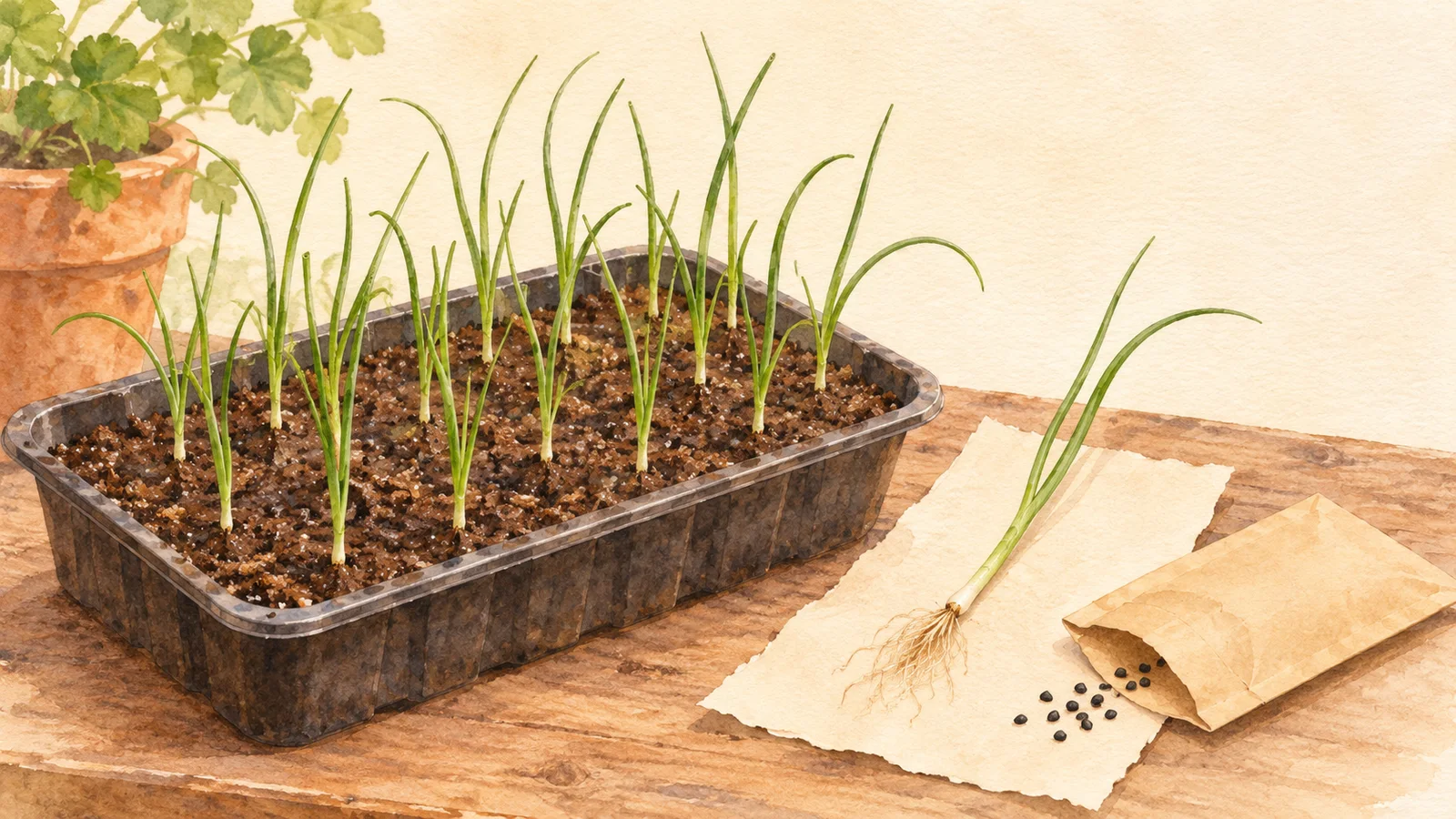
An onion seedling looks more like a blade of grass than dinner. Its first job is to build leaves and roots before the season tells it to swell a bulb. Starting indoors gives that small plant a head start, but only if the variety and sowing date fit the garden it will move into.
This is a project for bulb onions, Allium cepa. For a pot of green tops or grocery-base regrowth, use the green onion guide. Here, the tray is a nursery: the seedlings will need a sunny outdoor bed to finish their crop.
Choose the onion before choosing the tray
The packet’s day-length category matters more than the color of the finished onion. Oregon State University groups bulb onions by the daylight they need to begin bulbing:
| Packet category | Broad fit in the United States |
|---|---|
| Short-day | Southern growing regions, where bulbs begin forming under shorter days |
| Intermediate-day | Central regions; bulb formation generally begins around 12–14 hours of daylight |
| Long-day | Northern regions; typically needs at least 14 hours of daylight |
These are starting points, not a substitute for a local variety recommendation. Look for the cultivar’s regional suitability and planting season, then check whether you want sweet onions for early use or a storage type. A photograph of a large bulb cannot tell you whether that variety will perform at your latitude.
Buy fresh seed for the intended season. Onion seed loses vigor relatively quickly; Iowa State’s onion guide recommends new seed each year. Keep the variety name with the tray. Once several batches are green, their leaves are a poor substitute for labels.
Count back from the outdoor planting window
Find your local onion transplanting window first. This is a cool-season crop, so the correct date may precede the date used for tomatoes. Do not automatically wait for warm summer weather, or assume a northern spring schedule works for a southern winter crop.
Iowa State suggests sowing about 8–10 weeks before transplanting. Minnesota Extension allows 10–12 weeks. Use the recommendation for your region and cultivar rather than combining those into a universal date. For example, an April 15 planting target and a ten-week lead give an early-February sowing date, not a November start.
Write down three dates: sowing, the beginning of hardening off, and the intended move outdoors. The last one remains weather-dependent. A frozen or waterlogged bed is not ready merely because the calendar says so.
Sow a batch you can light properly
Use a clean tray or cells with open drainage holes and fresh seed-starting mix. Moisten the mix before filling; it should feel damp and loose rather than drip water when handled. Garden soil is too dense for these small containers, as Maryland Extension explains. Put a catch tray underneath, but empty drainage water.
For straightforward individual transplants:
- Fill the cells without packing the mix hard.
- Sow one seed per cell, using the packet’s depth; about ½ inch is the RHS indoor-sowing recommendation.
- Cover gently and water without washing the seeds out.
- Label the cultivar and date at once.
- Keep the mix moist through germination, then move emerging seedlings into bright light.
The RHS also describes sowing several seeds in a cell and planting the resulting clump intact. That is a deliberate method likely to produce smaller individual onions. It is different from accidentally overcrowding a flat. Choose one approach before sowing instead of filling every gap with extra seed.
Keep growth compact, not merely green
Set up the light before the seedlings appear. A window can look bright to you yet leave young plants leaning toward the glass. An adjustable grow light lets you illuminate the whole tray; use the fixture’s seedling-distance instructions, since a close fluorescent tube and a powerful LED panel are not interchangeable. The grow-light guide can help you compare light coverage and placement.
After germination, Iowa State recommends cool growing conditions around 55–65°F (13–18°C). Crowding, insufficient light and excessive warmth encourage weak, stretched plants. Thin crowded flats early rather than waiting until the roots become a tangled mat. Keep checking moisture as the leaves grow; neither a dusty root ball nor a permanently flooded tray supports steady growth.
Before adding fertilizer, read the growing-mix label. Some mixes already contain a starter charge. If feeding is needed, use a fertilizer labeled for seedlings at its stated rate. More concentrated feed is not a shortcut to thicker stems.
Make the move outdoors gradual
Allow about 7–10 days to harden the plants, following Iowa State’s advice. Begin in a sheltered, shaded position, then increase their exposure to outdoor sun and air gradually. Check the tray during each outing: its small volume can dry faster outdoors than it did under lights. Bring it indoors if temperatures of 32°F (0°C) or lower are forecast during this transition.
Prepare a sunny, well-drained bed while the seedlings acclimate. Use a soil test to guide fertility rather than pouring garden-strength fertilizer into the nursery tray. Utah State recommends basing amendments on the soil report; its shallow-rooted onion crop also needs steady moisture and careful weed control.
Water the tray before lifting the seedlings. Ease each root ball out instead of pulling on the leaf. For individual bulb onions, Iowa State recommends roughly 4–6 inches between plants, with rows 12–15 inches apart. Set the roots and lower white portion below the surface, keeping green leaves above it, then water to settle the soil. Follow local planting-depth advice for your transplant size and soil.
Watch the roots as well as the leaves
During establishment, check whether water has reached the root zone instead of judging by the surface alone. Remove weeds while they are small, working shallowly so you do not cut onion roots. Utah State’s growing guide emphasizes both moisture and early weed control for bulb development.
If growth stalls, revisit the variety, light, moisture and planting date before adding more fertilizer. Minnesota notes that too much nitrogen can delay maturity and reduce storage quality. Keep the packet and sowing notes until harvest: they will help distinguish a nursery problem from a variety that simply did not suit the season.
Sources
- Types of Onions and Varieties (Oregon State University). Accessed November 16, 2026.
- When should I sow onion seeds indoors? (Iowa State University Extension and Outreach). Accessed November 16, 2026.
- All About Onions (Iowa State University Extension and Outreach). Accessed November 16, 2026.
- Growing onions in home gardens (University of Minnesota Extension). Accessed November 16, 2026.
- How to Grow Onions (Royal Horticultural Society). Accessed November 16, 2026.
- Starting Vegetable Seeds Indoors (University of Maryland Extension). Accessed November 16, 2026.
- How to Grow Onions in Your Garden (Utah State University Extension). Accessed November 16, 2026.