Staghorn fern care becomes much easier once the plant is treated as an epiphyte rather than as an ordinary fern in a soil-filled pot. Platycerium bifurcatum naturally perches on other plants for support without feeding from them. Plants of the World Online accepts the species and places its native range from Java through parts of Australia to New Caledonia.
Indoors, a staghorn can grow on a wooden mount, in a wire basket, or in a small container filled with an airy epiphytic medium. The right setup keeps the root area secure while letting excess water drain and air return. This guide focuses on P. bifurcatum, the common cultivated species; other Platycerium species can differ in size, cold tolerance, growth form, and whether they produce offsets.
Learn the two frond types first
A staghorn fern has two kinds of fronds, and both matter.
- Basal or shield fronds lie against the mount and cover the crown and roots. A new shield may be green, then mature to tan or brown and papery. That color change is normal.
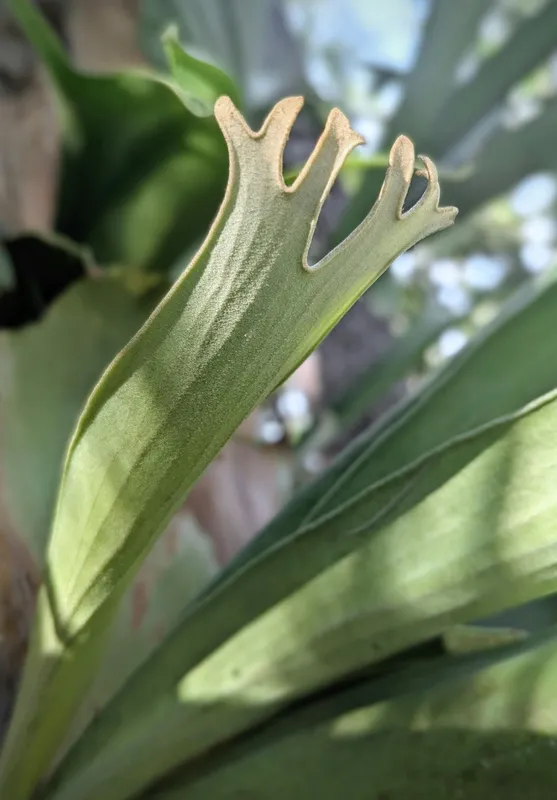
- Fertile or antler fronds project outward, fork repeatedly, and carry spores on parts of their undersides when mature. A soft gray-green coating helps protect these fronds.
North Carolina Extension describes the shield fronds as litter-trapping structures that cover the root crown and the fertile fronds as forked, photosynthetic fronds. Do not peel away a sound brown shield because it looks dead. Do not polish or scrub the pale felt from the green fronds. Wisconsin Extension notes that the older shields anchor and protect the plant and that the fine surface scales slow water loss.
Brown patches also can be normal spore structures when they occur in organized areas on the underside of mature antler fronds. A soft, spreading black area at the crown is a different signal and deserves a moisture and airflow check.
Choose a safe, bright position
Give the fern bright, indirect light or dappled sun. A position near a bright window is more useful than a dim decorative wall far from daylight. Harsh direct sun can scorch a plant that has not been acclimated, while very low light slows drying and can compound moisture problems.
The University of Florida IFAS Extension recommends shaded to partly shaded conditions and warns that very low light can encourage pest and disease problems. If a plant moves outdoors for warm weather, increase light exposure gradually and bring it back inside before conditions fall below the tolerance of that species and specimen.
Normal warm indoor temperatures suit P. bifurcatum. Keep it away from a heating vent, a cold draft, or a spot where a door repeatedly exposes wet fronds to cold air. Moderate humidity can slow drying stress, but humidity does not replace water at the root area. A humid room is useful only if the plant still receives adequate light and air movement.
Check the support, not just the plant
A mounted fern becomes heavier after watering and as shields, roots, medium, and offsets accumulate. Before hanging it:
- inspect the board, basket, fastening material, wall anchor, and hook;
- make sure the support is rated for more than the wet current weight;
- keep wire or line away from soft green tissue;
- leave room for new shield fronds to cover the root zone; and
- choose a location where the mount can be removed for watering without bending fertile fronds.
Small plants can also remain in a draining basket or a compact container with sphagnum or another coarse epiphytic medium. Ordinary dense garden soil is a poor match because it holds water around roots that normally receive abundant air. Missouri Integrated Pest Management describes immersing a mounted plant for watering and allowing it to drip dry before rehanging.
Water from the condition of the medium
There is no universal weekly schedule. Mount size, room temperature, airflow, light, season, and the amount of retained material all change drying time. A small new mount can dry much faster than an old plant with layers of shields and moss.
Use this routine:
- Feel the exposed growing medium and compare the mount’s weight with its weight after watering.
- When the medium has partly dried but the plant has not remained dry for an extended period, remove the mount.
- Wet the root-zone medium thoroughly. A basin soak is practical when the mount material can tolerate immersion; a gentle shower can work for a basket.
- Let all free water drain in a sink, tub, or protected outdoor area.
- Rehang only when the mount is no longer dripping onto the wall or floor.
The goal is a thorough wetting followed by drainage and some drying. Avoid both constant saturation and prolonged neglect. Wisconsin Extension advises consistent moisture, excellent drainage, and some drying between waterings. Growth and evaporation usually slow in cooler, darker months, so the interval often lengthens, but the plant should still be checked rather than placed on a winter calendar.
Misting may briefly wet fronds, but it cannot prove that the enclosed root area received enough water. It also should not leave the crown persistently wet in low light or stagnant air. Dry the plant where air can move around it.
Feed conservatively
Staghorn ferns do not need kitchen scraps tucked behind the shield. Food waste can attract pests, smell, or decay against the crown without delivering a controlled nutrient dose.
If the plant is actively growing and the medium is being flushed adequately, use a complete fertilizer labeled for the plant and application method. Follow the product rate rather than improvising a stronger mix. University of Florida IFAS Extension notes that feeding frequency can decline as a plant matures. Pause and reassess if salts appear on the medium, frond tips worsen after feeding, or the plant is stressed.
Read problems as patterns
One symptom rarely identifies one cause. Start with location, timing, and root-zone evidence.
| What you see | What to check before acting |
|---|---|
| Brown papery shield | Age and texture; an intact mature shield is normal |
| Brown organized patches below antler fronds | Whether they are normal spore-bearing areas |
| Crispy fertile-frond margins | Recent dry-down, hot sun, heat vents, salt buildup, and root condition |
| Soft dark tissue near the crown | Persistent saturation, poor drainage, low light, cold injury, and airflow |
| Pale or slow new growth | Seasonal growth rate, usable light, root condition, and feeding history |
| White cottony clusters or fixed bumps | Mealybugs or scale; isolate and identify before treatment |
The University of Illinois Extension describes mealybugs gathering near frond undersides or the fern base. For any suspected pest, separate the plant from the collection, inspect shields and frond undersides under good light, and use the site’s early pest-inspection checklist. Choose a control only after identifying the pest, and follow a current label that includes the target site and plant. Oils and soaps can mark sensitive fern tissue, so label directions and a small test area matter.
Mount or remount without burying the crown
For a young plant, use a sound untreated board or another durable support, a modest mound of damp long-fiber sphagnum or suitable epiphytic medium, and non-copper fastening that will not slice growing tissue. Place the root area against the medium and secure around the plant without crossing soft green shields or compressing the crown.
Remount when the support has deteriorated, the attachment is unsafe, or growth has clearly exceeded the board. Do not remount merely because the fern looks crowded. University of Florida IFAS Extension notes that established staghorns tolerate crowding and that large plants can be remounted or divided when needed.
Offsets can be separated when they have their own roots and both useful frond types. Use a clean tool, retain as much root structure as practical, and keep the new division warm with an evenly moist, airy medium while it establishes. Spore propagation is possible, but it is a different and much slower project.
A compact care rhythm
- Keep the plant in bright filtered light with airflow.
- Check medium moisture and mount weight instead of following a date.
- Wet thoroughly, drain completely, and protect the wall before rehanging.
- Leave brown shields and the pale frond coating intact.
- Inspect the attachment as the wet plant gains weight.
- Record changes in light, watering, feeding, or placement before diagnosing a symptom.
The central care decision is simple: support the fern securely, give its roots both water and air, and protect the fronds that make the plant look unusual. Most avoidable trouble begins when a decorative wall position is too dark, a mount stays wet too long, or normal shield and spore structures are removed as if they were damage.
Sources
- Platycerium bifurcatum (Cav.) C.Chr. (Royal Botanic Gardens, Kew). Accessed August 28, 2026.
- Common Staghorn Fern: Platycerium bifurcatum (North Carolina Extension Gardener Plant Toolbox). Accessed August 28, 2026.
- Staghorn Fern, Platycerium bifurcatum (University of Wisconsin–Madison Division of Extension). Accessed August 28, 2026.
- Staghorn Ferns (University of Florida IFAS Extension). Accessed August 28, 2026.
- Ferns Make Durable Houseplants (University of Missouri Integrated Pest Management). Accessed August 28, 2026.
- Staghorn Fern: A Growing Work of Art (University of Illinois Extension). Accessed August 28, 2026.