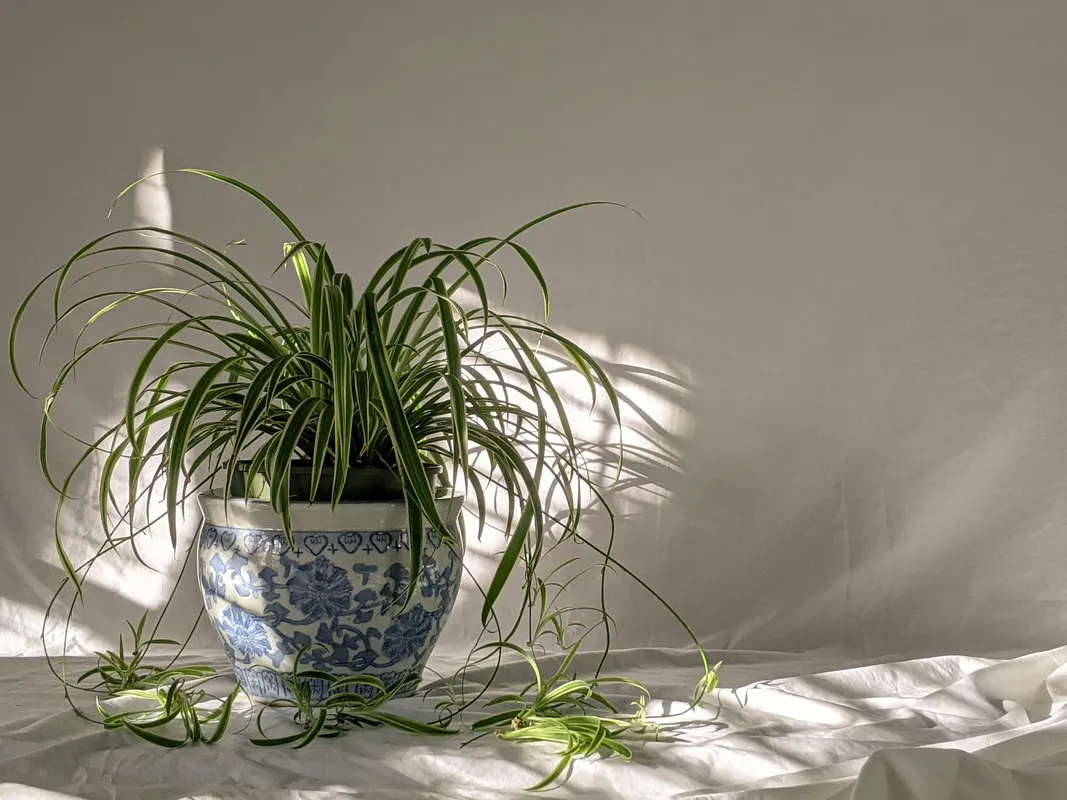
Spider plant (Chlorophytum comosum) is adaptable, but it is not indestructible. A healthy plant still depends on usable light, an aerated root zone, and watering that responds to the pot rather than a fixed day of the week. Treating it as a plant that survives anywhere can hide correctable stress until leaves fade, roots decline, or brown tips accumulate.
The accepted botanical name and native range are documented by Royal Botanic Gardens, Kew. Common indoor forms include green and white-variegated cultivars, but leaf pattern does not change the basic care framework below.
A practical care baseline
| Factor | Useful starting point | What should change the plan |
|---|---|---|
| Light | Bright, indirect light | Move back from bleaching or scorching sun; move closer to useful light if growth weakens |
| Water | Water thoroughly after the root zone has partly dried | Pot size, mix, temperature, root mass, and seasonal light all change drying time |
| Potting mix | Loose houseplant mix in a container with an open drainage hole | A dense mix or oversized pot needs correction if it stays wet too long |
| Fertilizer | Modest applications during active growth, following the product label | Pause when growth is stalled, roots are stressed, or salts are accumulating |
| Temperature | Stable household conditions away from extremes | Cold glass, drafts, and hot vents can injure foliage |
These are observation points, not guarantees. Clemson Cooperative Extension describes spider plants as tolerant of a range of indoor conditions while still favoring bright light, well-drained medium, and careful watering. A plant in dim winter light will not use water at the same rate as a plant under a grow light in active growth.
Give the leaves light they can use
Bright, indirect light supports dense growth and clear variegation without exposing leaves to prolonged heat. An east-facing window, filtered exposure near a brighter window, or a properly positioned grow light can work. Window direction alone is not a complete measurement: trees, overhangs, screens, latitude, season, and distance from the glass all affect the light reaching a leaf.
Spider plants tolerate some shade, but tolerance is not the same as thriving in darkness. University of Illinois Extension recommends medium light and notes that direct sun can scorch foliage. A plant producing narrow, weak growth or losing vigor may need a gradual move toward brighter conditions. Pale patches on the window-facing side after a sudden move, especially when the glass becomes hot, point instead toward excess exposure.
Change light gradually. Moving a shade-grown plant straight into strong afternoon sun can damage leaves before the plant acclimates. Rotate the pot occasionally for balanced growth, but do not use rotation to compensate for a location with almost no usable light.
Water the root zone, not the calendar
Check below the surface before watering. The top can feel dry while the center remains wet, especially in a deep pot or moisture-retentive mix. A finger check at more than one point, a clean wooden skewer, and the changing weight of the pot can provide complementary evidence. None is universal by itself.
When the upper portion of the mix has dried and the pot is noticeably lighter, water slowly across the surface until the entire root ball is moistened and excess leaves the drainage hole. Let the pot drain fully, then empty the saucer or decorative cachepot. A small sip may wet only one channel and leave dry pockets; standing runoff keeps the lower root zone saturated.
The interval may be short during warm, bright growth and much longer in cool, dim conditions. Do not compensate for low humidity by keeping the mix continuously wet. Humidity describes moisture in the air; watering changes moisture around roots. Those are separate variables.
Spider plants develop fleshy roots that store water, but that storage does not protect roots from chronic saturation. Persistent wetness displaces air from the mix and can contribute to root decline. Wilting therefore does not automatically mean thirst: wilted foliage above wet mix needs a drainage and root-zone check before more water is added.
Use a pot and mix that can drain
Choose a container with at least one unobstructed drainage hole. A decorative outer pot is workable only when the inner pot can drain and collected water is discarded. A layer of stones beneath soil does not replace a drainage opening.
A fresh, loose houseplant mix is a reasonable base. If it collapses into a dense mass or stays saturated for an unusually long time, repotting into a more aerated formulation may be more effective than stretching the watering interval indefinitely. Match the mix to the conditions: a very coarse blend can dry too quickly in a hot, bright room, while a fine, water-retentive blend can remain wet in a cool room.
Repot when roots have displaced much of the mix, water runs around a compact root mass without soaking it, or the container no longer supports the plant. Move up only modestly in pot size. A large volume of unused wet mix around a small root system is difficult to manage. Root crowding alone is not a care technique and should not be forced to trigger plantlet production.
Fertilize with restraint
Fertilizer supplies nutrients; it does not replace adequate light or repair damaged roots. During active growth, use a product labeled for indoor foliage plants and follow its rate and frequency. Applying extra fertilizer to force faster growth can raise soluble salts in the potting mix and damage leaf tips or roots.
If growth has slowed because of winter light, recent repotting, root trouble, or another stress, delay feeding until the plant resumes. Periodically watering the entire root ball and allowing free drainage helps move accumulated salts out of the container. Never increase fertilizer merely because the plant has not produced runners.
Diagnose brown tips before changing everything
Brown tips are a symptom, not a single diagnosis. North Carolina Extension Gardener Plant Toolbox lists several possible contributors, including water quality, low humidity, excess fertilizer, and environmental stress. Examine the plant, pot, and recent changes together.
| Evidence to check | Possible contributor | Focused next step |
|---|---|---|
| Mix repeatedly becomes very dry; leaves lose firmness | Incomplete or delayed watering | Rewet the whole root ball and track how quickly it dries |
| Mix remains wet; lower leaves yellow or the crown softens | Poor drainage or root injury | Stop automatic watering and inspect drainage and roots |
| A pale crust appears on mix or pot; feeding was frequent | Soluble-salt buildup | Pause fertilizer and flush only if drainage and roots are sound |
| Tips worsen despite stable moisture and restrained feeding | Mineral-sensitive foliage or water-source issue | Compare a consistent low-mineral water source over several new leaves |
| Damage is limited to the hot window side or follows a cold night | Heat, sun, or cold injury | Move the plant away from the exposure and monitor new growth |
| Tips are torn, bent, or rubbed at a traffic edge | Physical injury | Relocate the pot and protect emerging leaves |
Some Extension guidance identifies fluoride or other dissolved salts as possible causes of tip burn. Letting tap water stand overnight does not reliably remove fluoride, so it should not be presented as a treatment. If water quality remains the leading possibility after moisture and fertilizer are checked, use rainwater that is safely collected or a low-mineral water source consistently for a trial. Judge the result on new leaves; dead brown tissue will not turn green again.
Trim a dry tip only for appearance, using clean scissors and leaving a narrow margin of brown tissue to avoid cutting living leaf. Trimming does not solve the underlying cause. Change one variable at a time and record when damage stops appearing. A broader diagnostic process is available in the brown leaf tips guide.
When your plant produces pups
Mature spider plants can produce flowers and plantlets along arching stems. Plantlets do not prove that every care condition is ideal, and their absence does not automatically call for more fertilizer or a tighter pot. Light, cultivar, maturity, and growing conditions all influence flowering and runner production.
Once a healthy plantlet is present, attached layering or direct potting may be appropriate depending on its roots. Follow the steps for propagating spider plant pups to choose a method and help the young plant establish.
Put pet and air-cleaning claims in context
The ASPCA Animal Poison Control Center classifies spider plant as non-toxic to cats and dogs. That classification does not make the plant food or guarantee that chewing a large amount will cause no digestive upset. Keep plants, potting products, and fertilizers out of reach when an animal repeatedly chews foliage, and contact a veterinarian or animal poison service for concerning symptoms or an uncertain identification.
Claims that a few spider plants meaningfully purify the air in an ordinary room also need context. Iowa State University Extension and Outreach explains that results from sealed laboratory chambers do not translate into a practical houseplant-based air-cleaning system in occupied buildings. Ventilation, source control, and appropriate filtration remain the relevant tools for indoor air quality. Grow a spider plant for its foliage and growth habit, not as a substitute for those measures.
A simple correction sequence
When a spider plant is declining, avoid changing light, water, fertilizer, pot size, and pest treatments all at once.
- Confirm the plant and inspect both leaf surfaces, crowns, and the soil line.
- Check actual moisture through the root zone and verify that drainage is open.
- Review recent light, temperature, repotting, and fertilizer changes.
- Correct the strongest evidence first, then watch new growth over several weeks.
- Escalate to a root inspection or local Extension diagnosis if wet-mix wilting, crown softness, spreading lesions, or unexplained decline continues.
That sequence keeps a manageable plant from becoming a guessing exercise. Spider plant care is forgiving when the root zone can breathe, the leaves receive useful light, and symptoms are treated as clues instead of universal instructions.
Sources
- Chlorophytum comosum (Thunb.) Jacques (Royal Botanic Gardens, Kew). Accessed August 25, 2026.
- Spider Plant (Chlorophytum comosum) (Clemson Cooperative Extension Home & Garden Information Center). Accessed August 25, 2026.
- Spider Plant (University of Illinois Extension). Accessed August 25, 2026.
- Ribbon Plant: Chlorophytum comosum (North Carolina Extension Gardener Plant Toolbox). Accessed August 25, 2026.
- Toxic and Non-Toxic Plants: Spider Plant (ASPCA Animal Poison Control Center). Accessed August 25, 2026.
- Improving Indoor Air Quality with Houseplants (Iowa State University Extension and Outreach). Accessed August 25, 2026.