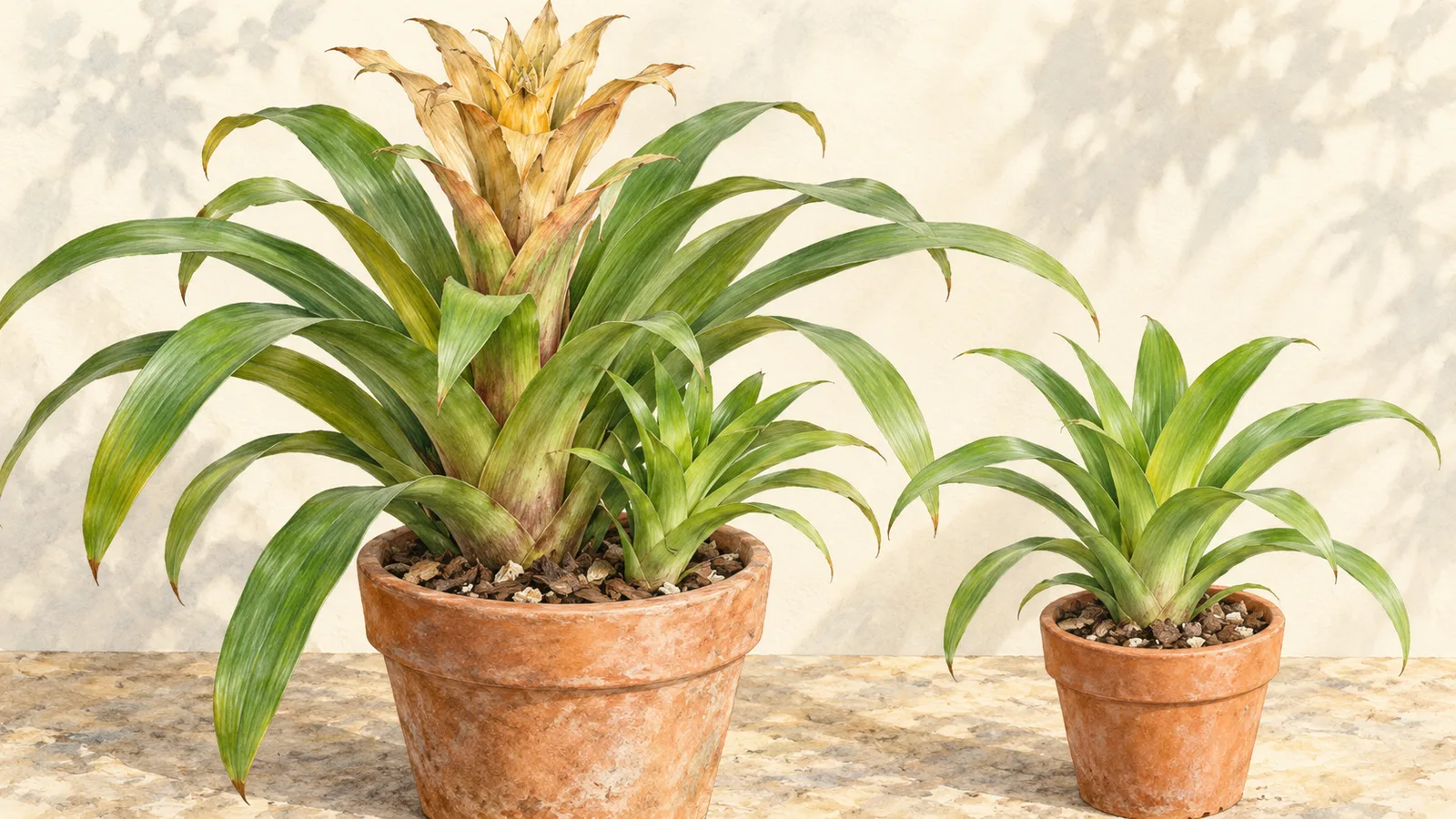
A fading flower spike does not mean you have missed your chance to keep a bromeliad. Look down near the base: a smaller circle of leaves may be growing beside the old rosette. That young plant, called a pup or offset, can become the next plant in the pot, or a separate plant to share.
The first decision is whether to separate it at all. A small pup benefits from time attached to its parent, and a group of rosettes can make a handsome container. You do not need to cut every new shoot away as soon as it appears.
Match the method to the plant
This approach is for potted, rosette-forming bromeliads such as Guzmania, Aechmea and Neoregelia. It is not a pineapple-top method or a reason to put a mounted air plant into potting soil. Keep the plant’s label if you have it; members of the bromeliad family do not all use the same watering routine.
A Guzmania has strap-shaped leaves arranged around a central tank, often beneath a colorful flower display. Its offsets arise at the base. Follow the leaves down to find each young rosette’s own center. A loose leaf from the parent is not an offset, and a piece of flower stalk will not replace one.
Most of these familiar rosette bromeliads bloom once, then the parent gradually declines while new growth continues around it. A drying flower display alone is therefore not a reason to discard the whole pot. Keep caring for the healthy green growth while you assess the pups.
Wait for a substantial rosette
Use the parent as a size reference. The New York Botanical Garden describes separating pups at roughly one-third to one-half the size of the parent. Compare the leafy plants, rather than measuring a pup against a tall flower spike. A few tiny emerging leaves are a reason to wait.
Look for a coherent, firm rosette with several leaves and an intact base. Roots are helpful, but their absence does not automatically make a well-developed pup unusable. UF/IFAS notes that roots can form after separation. Avoid judging readiness by the date you bought the plant: a newly purchased flowering specimen may take time to produce offsets.
If the parent is healthy enough to support the pup, spring is a convenient time to divide. The RHS recommends spring separation, with warm, bright conditions afterward. In a dim winter room, waiting can be the better choice. A fading parent and a firm, substantial pup need a different assessment from a tiny shoot beside a still-healthy rosette.
Expose the join before cutting
Set out a small pot with drainage holes, fresh airy potting mix, a clean sharp knife and a stable work surface. Wear gloves if the leaf edges are spiny. Clean tools before moving between plants; the pruning-tool guide explains cleaning and disinfection without treating them as the same step.
Ease the plant from its container if that gives you a clearer view. Move loose mix away from the connection between parent and pup. Support the base, and keep your fingers out of the blade’s path. Cut the connecting tissue close to the parent so the pup retains its own base; do not slice across the young rosette’s center or tear it off by its leaves.
The UF/IFAS offset guidance describes cutting near the parent’s base and potting the pup separately, whether or not it already has roots. Preserve any roots that come with it. If another pup is still small, leave it attached instead of dividing the whole cluster in one session.
Support it without burying the leaves
Choose a pot for the modest root system, not for the full spread of the leaves. A large volume of wet mix is unnecessary. An airy bromeliad mix or a suitable fine orchid-based mix is preferable to garden soil. For a homemade option, the RHS gives equal parts fine composted bark and peat-free multipurpose potting mix.
Set the pup upright with only its base in the mix. Keep the leaf rosette above the surface. NYBG advises burying the base no more than an inch and using a support until roots anchor it. A small stake beside the base can steady a leaning pup; burying it deeper to stop the wobble puts the wrong part of the plant underground.
Firm the mix lightly around the base without packing it solid. If a small nursery pot tips easily, place it inside a heavier outer container and keep that container drained. You can also leave healthy pups together, remove the dead parent when appropriate, and grow the cluster on in the original pot.
Give roots air as well as moisture
Put the newly potted offset in warm, bright indirect light, protected from strong sun. Wisconsin Extension recommends a shadier, more humid position during rooting and keeping the medium on the dry side to discourage rot. That does not mean putting it in a dark corner or repeatedly soaking the pot because the pup has few roots.
Check the mix before watering. Let excess water escape and empty the saucer. For a tank-forming plant with a developed central cup, follow its normal cup-watering care and refresh that water regularly; water held between the leaves and a saturated pot are different conditions. Do not assume a tiny, undeveloped offset has a useful reservoir yet.
Watch for steady new growth from the center and a base that remains firm. Avoid pulling the plant out every few days to look for roots. A soft, collapsing base or worsening decay calls for inspection, not another automatic watering. If surrounding plants show pests, use the houseplant inspection checklist before placing the new pot among them.
Leave the flower timetable open. UF/IFAS gives a broad range of one to three years for flowering from pups; species and growing conditions matter. The useful early milestone is a stable young rosette making healthy leaves. Once established, return it gradually to the light appropriate for its type and keep its name with the pot you pass along.
Sources
- Bromeliads (University of Wisconsin–Madison Extension). Accessed October 30, 2026.
- How to grow bromeliads (Royal Horticultural Society). Accessed October 30, 2026.
- Bromeliads Grown at Home (New York Botanical Garden). Accessed October 30, 2026.
- Separating bromeliad pups (UF/IFAS Extension Nassau County). Accessed October 30, 2026.
- Guzmania (NC State Extension). Accessed October 30, 2026.