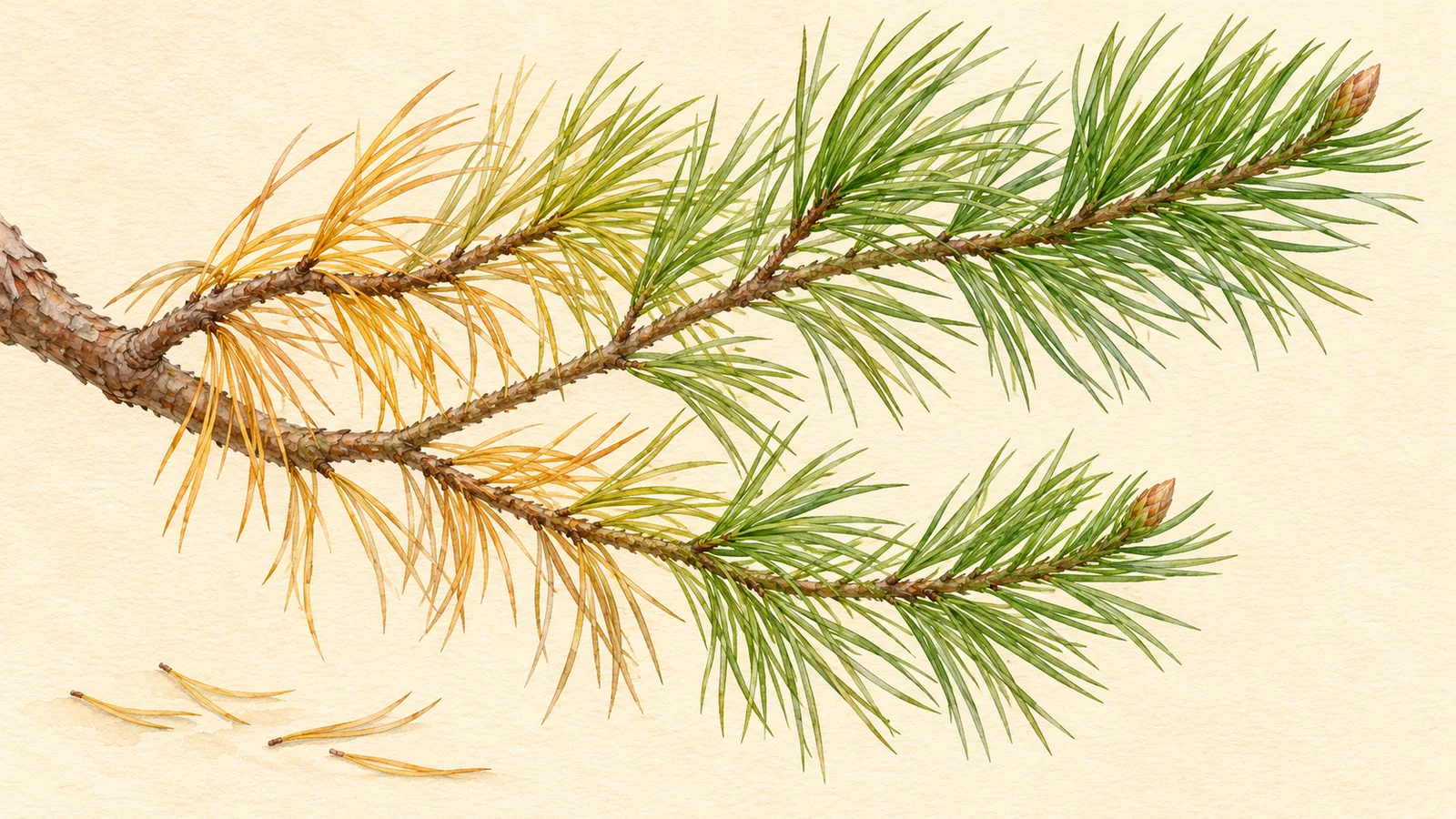
A yellow patch inside a pine can look much worse from the kitchen window than it does beside the tree. Before cutting a branch or buying a spray, follow that branch outward. Older needles may be turning gold near the trunk while the newer growth remains green. In autumn, that arrangement can be ordinary seasonal shedding.
“Evergreen” describes the tree’s year-round foliage, not an unlimited life for each needle. The useful question is which needles are changing, where the change occurs and whether the rest of the plant looks healthy.
Read the branch from the inside out
Start with a reachable branch that has both discolored and green foliage. Look at the needles closest to the trunk, then move your eye toward the outer tip. Are the older inner needles changing together, with a fairly clear boundary before the green outer growth? Wisconsin Extension describes this conspicuous pattern in white pines during fall.
Now step back. Look at several sides of the tree and compare more than one branch. Illinois Extension explains that normal fall needle drop is distributed through the tree’s interior, rather than killing an isolated whole branch or the new needles at its tip. A carpet of needles beneath the tree tells you that foliage has fallen; it does not tell you why.
Take a photograph of the whole tree and another of a branch showing the transition. Keep both green and discolored growth in the close view. A picture filled only with brown needles loses the spatial clue you are trying to inspect. Note the date and whether the change seemed sudden or has been progressing for months.
Different trees make different autumn pictures
White pine often makes this change especially visible because it retains relatively few years of needles. Spruces tend to hold theirs longer, so the older foliage is less conspicuous behind several layers of green. Illinois Extension describes white pine’s open structure as another reason its yellow interior is easy to notice. Do not use the amount of yellow on a neighboring spruce as the standard for your pine.
Arborvitae can shed small older branchlets, giving the interior a brown, twiggy look for a while. Purdue Extension also notes that hot, dry weather can bring needle loss forward. The calendar helps, but neither a particular week nor a fixed percentage of fallen needles proves that a tree is healthy.
Not every cone-bearing tree is evergreen. Deciduous conifers such as larch (including tamarack), dawn redwood and bald cypress normally lose all their needles for winter. Identify the tree before treating a fully yellow canopy as a disaster. Conversely, do not assume a completely brown pine is following the same cycle just because both trees bear cones.
Green tips are reassuring, but not a diagnosis
Some diseases also leave green foliage at the ends of branches. The University of Minnesota’s fir diagnostic guide describes Rhizosphaera needle cast with discolored older needles, green tips and damage that typically begins on lower branches. A hand lens may reveal tiny black fungal structures on affected needles. That example is a reason to look more closely, not a reason to diagnose every shedding conifer with the same disease.
Seek help when whole branches are dying, the newest growth is changing color, the lower canopy keeps thinning, or damage is concentrated on one side. Timing also matters: a problem that started well before autumn or continues to spread deserves more than a seasonal explanation. Species, weather and the history of the site belong in the diagnosis alongside needle color.
Do not use a few spots on a fallen needle as proof of infection. Montana State Extension notes that aging needles may have blemishes. A pile of old debris is less informative than what is happening on the living branches above it.
Leave ordinary shedding alone
Normal seasonal needle drop needs no treatment. Do not prune a living branch merely because its oldest needles are yellow, or apply a fungicide to stop an age-related change. Montana State’s guidance favors maintaining tree health rather than treating this normal cycle.
Check the soil during a dry fall and maintain appropriate watering before the ground freezes. Look beneath the mulch rather than judging moisture from the top of it. Watering should respond to the root area’s condition; more water is not automatically helpful to a tree already standing in wet soil. Our guide to protecting evergreen shrubs from winter drying covers fall moisture and exposed sites in more detail.
Keep that task separate from trying to turn old needles green again. The goal is to support the foliage and roots the tree retains. A recent planting also needs attention to its original root ball; review the container-grown tree planting guide if you are unsure how it was installed.
Bring the pattern to someone who can identify it
If the picture does not fit ordinary shedding, contact your local Extension office, plant diagnostic clinic or a qualified arborist. Send the whole-tree and branch photographs, the species if known, and a short history: planting date, recent drought, changes to drainage or nearby construction, and when the discoloration began. Describe what you can see rather than naming a disease in advance.
Ask the clinic what sample it wants before cutting or mailing branches. Keep a second dated photograph from the same viewpoint for comparison. Whether the answer is normal aging or a specific problem, a clear record of where the change began is more useful than a rushed treatment based on needle color alone.
Sources
- Seasonal Needle Drop Normal on Evergreens (University of Wisconsin–Madison Division of Extension). Accessed November 12, 2026.
- Evergreen Needles Don’t Last Forever (Purdue University Extension). Accessed November 12, 2026.
- Seasonal Needle Drop (Montana State University Extension). Accessed November 12, 2026.
- Evergreens losing needles: Fall needle drop (University of Illinois Extension). Accessed November 12, 2026.
- Fir: Needles drop prematurely (University of Minnesota Extension). Accessed November 12, 2026.