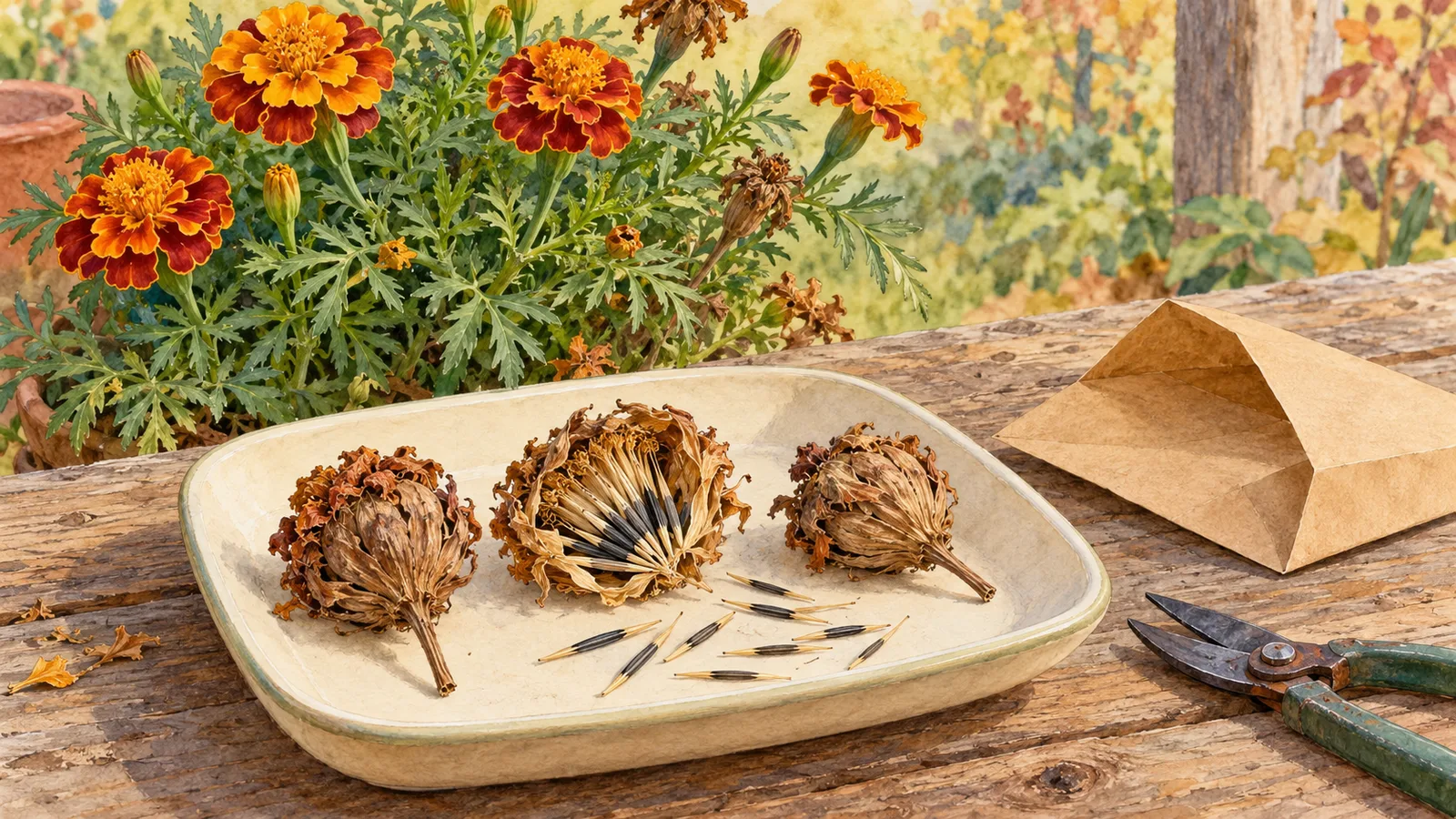
Leave a few marigold flowers on the plant after their color fades, and the job changes. You are no longer keeping the display tidy; you are waiting for seeds to finish developing inside those drying heads. Snipping every spent flower keeps the border neat, but removes the material you hoped to save.
Choose a handful of healthy plants while you can still see their flower colors and growth habits. Keep a paper bag, a pencil and a shallow tray nearby. The useful harvest is a small, dry, clearly labeled batch you can sow next spring, rather than a bag of damp flower heads forgotten in the shed.
Decide what you hope to repeat
This guide concerns garden marigolds in the genus Tagetes, including French marigolds (Tagetes patula) and African marigolds (Tagetes erecta). Minnesota Extension’s marigold guide distinguishes these from each other. Keep the plant’s original tag or seed packet if you have it; a common name alone leaves more uncertainty than a botanical and cultivar name.
A flower you love does not guarantee identical seedlings. Seed saved from an F1 hybrid can produce plants with different colors, heights or flower forms. Open-pollinated varieties offer a better starting point for a repeat, but crossing with another compatible variety can still change the result. Iowa State explains those limits.
Decide whether variation is welcome. A mixed patch for next summer can be a satisfying experiment. For an exact row of matching flowers, buy the named seed again instead of promising that an open garden collection will reproduce it. If the parent’s identity is uncertain, write “unknown marigold” and describe the flower; do not assign a cultivar name from a resemblance.
Reserve some heads, then let them mature
Mark a few stems loosely so they escape the next deadheading round. Continue removing unwanted spent blooms elsewhere if you want more flowers. Minnesota Extension notes that deadheading encourages flowering rather than seed production, so the reserved stems have a different purpose.
Leave the chosen heads until they are brown, shriveled and dry, including the base beneath the petals. A flower that has merely lost its bright color may still be too green. Illinois Extension’s flower-seed guidance emphasizes this maturity check: early collection risks immature seed, while waiting too long can let it scatter.
Visit the marked plants periodically as the heads brown. They will not all be ready together. Collect the dry ones and leave the others; a single autumn cleanup date is less useful than the condition of each head. Avoid saving from plants with obvious disease or from heads that are soft, rotting or covered in mold. Dryness cannot turn decayed material into a sound seed batch.
Collect on a dry day
Wait until rain or morning dew has dried. Hold a paper bag beneath a mature head and snip it off, using clean tools. Put only one known variety or labeled group in each bag. A bag marked before collection is easier to trust than a pile you plan to identify later.
Set the heads in a shallow, open tray in an airy indoor place, away from direct sun and cooking steam. Keep each label with its tray. If using a paper bag, leave space for air movement instead of packing it tightly. The RHS seed-collection guide recommends dry-day collection and further drying to make extraction easier.
Wear gloves if handling marigolds irritates your skin. NC State’s French marigold profile records contact dermatitis as a possible problem. Keep the collection away from food preparation, and supervise children using snips. These envelopes are planting supplies, not snacks.
Open the dry head over a tray
Gently pull apart one head over a light-colored tray. Separate the seeds from the brittle petals, outer head and short stem pieces. Work slowly with the first head so you can see which parts you are removing. Do not grind the whole head into dust; for a small collection, picking out the larger debris by hand is enough.
Let the cleaned seeds lie in a thin layer to finish drying. Turn or stir them gently and keep the label beside them. A dry outer flower does not prove that everything inside is ready for a sealed jar. Humidity and the amount of material affect drying, so avoid treating a fixed number of hours as a guarantee.
Do not wash or ferment this dry flower-seed harvest. Those steps belong to different kinds of seed processing, such as removing the gel from tomato seeds. Skip the oven and food dehydrator as well: Iowa State warns that excess drying heat can damage seed. An ordinary airy room gives you more control than a hot appliance.
Make the envelope useful in spring
Once the seed is thoroughly dry, fold it into a paper envelope and place the envelope inside a tightly sealed container. Store it somewhere cool, dry and dark, with a stable temperature. Illinois Extension’s seed-saving overview explains why moisture and warmth are poor storage partners. A humid greenhouse or a hot windowsill is not a good holding place.
Write the plant name, collection year, flower color and parent location. Add “saved from hybrid” or “open-pollinated; crossing possible” when appropriate. If you share the seed, pass along that uncertainty as well as the attractive flower description. Leave room on the envelope for a later sprouting count.
Before committing a whole seed tray, test a small sample under suitable marigold conditions. Minnesota lists roughly 70–75°F (21–24°C) for germination; keep the sample moist rather than waterlogged. Use the counting approach in the germination-test guide, then return the untouched dry seed to storage. A good sprouting result helps with sowing plans, but it cannot tell you next summer’s flower color or prove that the seed is free of disease.
Sources
- Marigolds (University of Minnesota Extension). Accessed October 16, 2026.
- Cherish favorite flowers and challenge your green thumb with seed-saving (University of Illinois Extension). Accessed October 16, 2026.
- How to Harvest and Store Seeds (Iowa State University Extension and Outreach). Accessed October 16, 2026.
- Seed: collecting and storing (Royal Horticultural Society). Accessed October 16, 2026.
- The ABC of seed saving (University of Illinois Extension). Accessed October 16, 2026.
- Tagetes patula (North Carolina Extension Gardener Plant Toolbox). Accessed October 16, 2026.