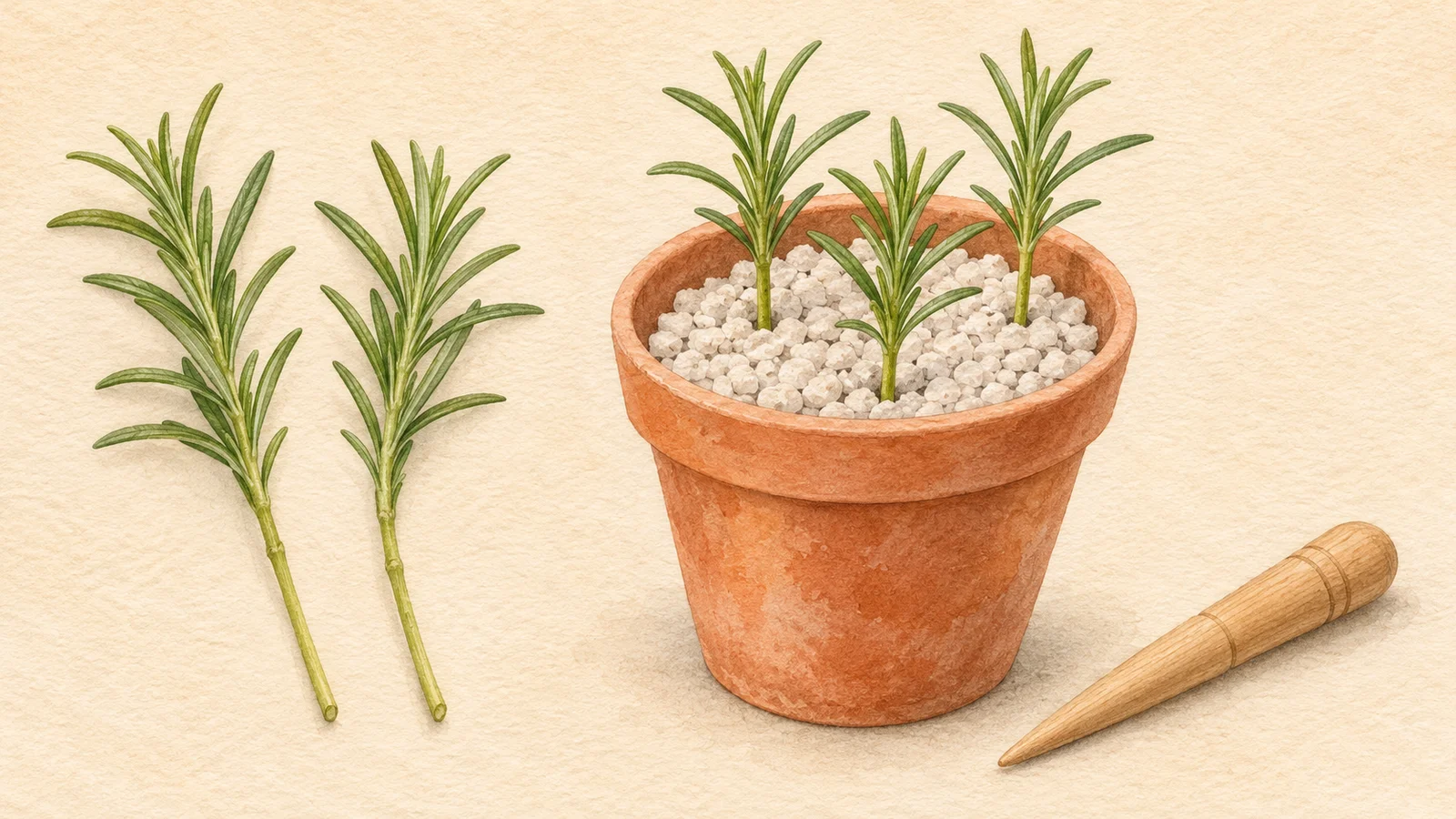
A rosemary cutting starts as a leafy shoot with no roots to replace the water it loses. Treating it like a small established rosemary plant, with strong sun and long dry spells, asks too much of it. Its first home needs gentle light, moisture around the leaves and air around the buried stem.
Choose a healthy parent plant whose scent and growth habit you like. Cuttings preserve those characteristics; seedlings may vary. You do not need to strip a large bush to begin. A small batch gives you room to watch each cutting and keep the leaves from crowding together.
Take the young tips when growth is active
For soft tip cuttings, plan around late spring or early summer. Wisconsin Extension’s rosemary guidance recommends flower-free shoots about 4–6 inches long at that time. The Royal Horticultural Society also lists softwood cuttings from new growth in late spring or summer, with semi-ripe cuttings as a summer option.
Look for a flexible, healthy tip rather than a thick, bare piece of old wood. Leave shoots with flowers, pest damage or deteriorating leaves on the plant while you find better material. If your rosemary is resting through a cold, dim winter, keep it healthy and wait for suitable new growth instead of cutting it back heavily to force this project.
Prepare the pot before taking the shoots. Put clean clippers, a label and the rooting medium within reach, then take only the cuttings you can handle promptly. Keep the cut end downward as you work; a leafy tip should remain above the medium, not be buried upside down.
Give the stem an airy place to root
Use a clean pot with drainage holes and fresh perlite, moistened before planting. Perlite is one of the rooting media recommended for rosemary by Wisconsin Extension. It supports the stems while leaving air spaces; a heavy scoop of garden soil is a different environment.
The general propagation guidance from Illinois Extension emphasizes clean supplies and a medium that provides both water and oxygen. Start with fresh material instead of reusing the contents of a failed pot. Clean the cutting tool before beginning; the pruning-shear cleaning guide explains the difference between removing dirt and disinfecting equipment.
Remove the leaves from the lower half of each cutting, leaving its upper foliage intact. Keep all remaining leaves above the perlite. Make a small planting hole with a clean dibber or pencil, insert the bare lower 1–2 inches of stem and gently firm the perlite around it. Leave enough space that neighboring leaves do not touch. Water lightly to settle the medium and let excess water drain away.
Rooting hormone is optional. Wisconsin notes that it can improve rooting speed, but it is not a substitute for suitable shoots and good conditions. If using it, choose a product labeled for the intended use on an edible herb and follow its directions. Do not guess a stronger dose or use a treated cutting as a kitchen sprig.
Keep the leaves humid without soaking the pot
Place the cuttings in bright, indirect light. A clear bag or propagator cover can help hold humidity around them. Keep the cover off the leaves with supports, and do not put the covered pot in direct sun: Missouri Extension warns that heat can build under plastic and damage foliage.
Check the perlite itself before adding water. It should stay moist while the stems root, but should not sit in a puddle. Illinois Extension advises ventilation as needed for enclosed cuttings. Open or adjust the cover when necessary to keep the enclosure from becoming stagnant, while watching that the small shoots do not wilt.
Iowa State’s stem-cutting guide, which includes rosemary, recommends regular checks and removal of discolored or moldy material. Look closely rather than misting automatically every time you pass. A soft, darkening stem and a dry, shriveled tip are different observations; neither is solved by blindly adding more water.
Label the pot with the date and parent plant. Record a few useful details, such as where it stands and whether the cover is vented. If one batch fails, those notes make the next attempt more informative than simply repeating the same setup.
Check roots, then change the conditions gradually
Iowa State gives four to six weeks as a general rooting range for the plants in its guide, not a promise for every rosemary cutting. A gentle tug may reveal resistance, but repeatedly pulling a stem up to look can disturb delicate new roots. When it seems ready, ease one cutting out carefully with support from below rather than hauling it out by the tip.
Look for actual roots before moving it to an individual pot. Iowa State uses roots at least an inch long as a transplanting guide. Set a rooted cutting into a small container with drainage and free-draining potting mix, keeping its leafy portion above the surface. Settle the mix with water and allow it to drain.
Missouri Extension identifies the move from humid rooting conditions to ordinary air as a particularly vulnerable stage. Reduce the cover gradually and watch the leaves closely during the first weeks. Increase light as the young plant settles in; do not send a newly rooted cutting straight from a humid enclosure to a hot, exposed patio.
Once it is established, rosemary’s longer-term needs take over: good light, drainage and protection from unsuitable winter cold. Illinois Extension’s rosemary page recommends containers for plants that must come indoors for winter, avoiding the disruption of digging them out of the garden. The indoor rosemary guide covers that next stage. Let the new plant build a leafy framework before taking regular kitchen harvests.
Sources
- Rosemary, Salvia rosmarinus (University of Wisconsin-Madison Extension). Accessed November 22, 2026.
- How to Grow Rosemary (Royal Horticultural Society). Accessed November 22, 2026.
- Propagating Herbaceous Plants from Stem Cuttings (Iowa State University Extension and Outreach). Accessed November 22, 2026.
- Propagation (University of Illinois Extension). Accessed November 22, 2026.
- Home Propagation of Houseplants (University of Missouri Extension). Accessed November 22, 2026.
- Rosemary (University of Illinois Extension). Accessed November 22, 2026.