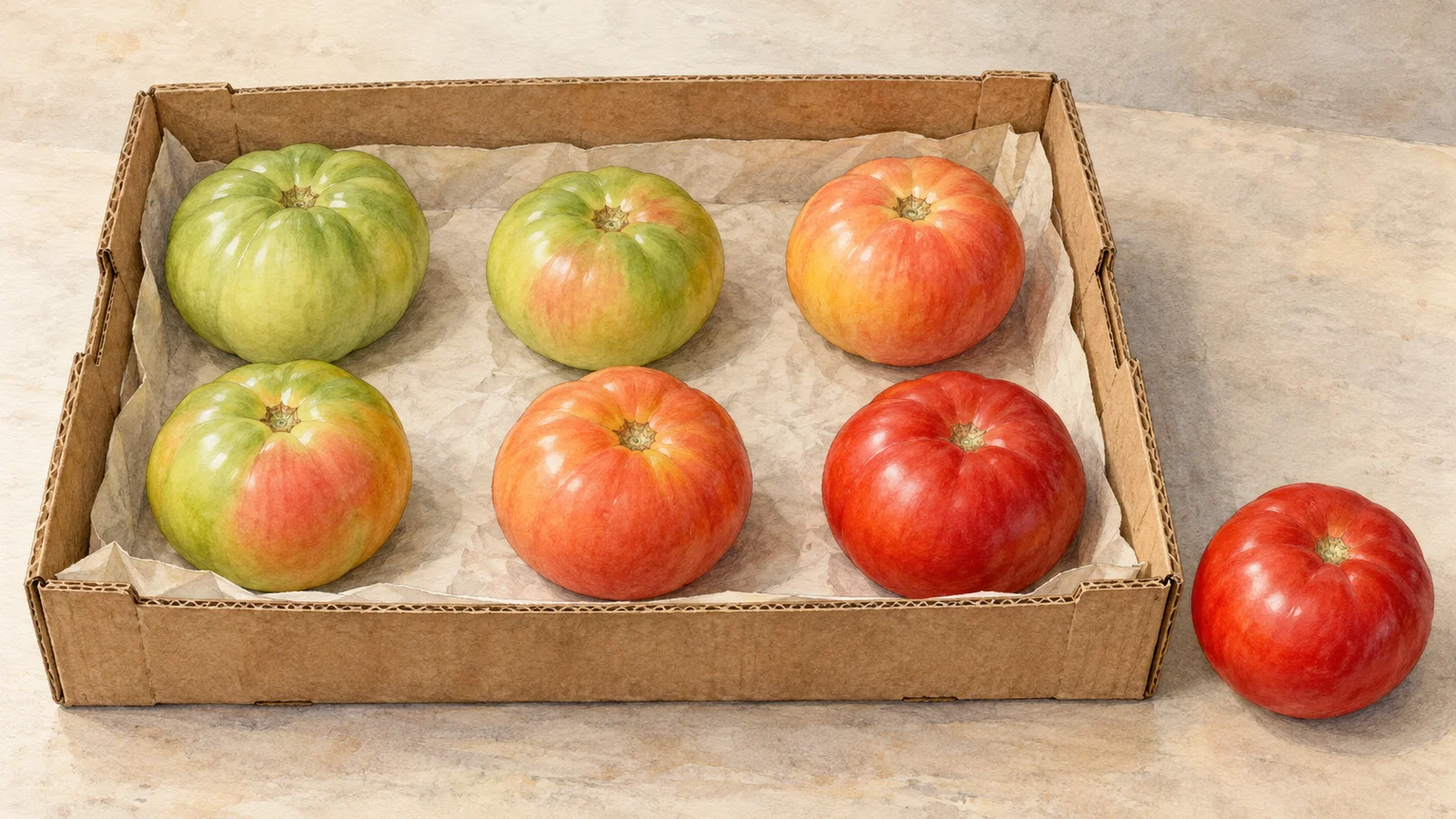
A frost forecast can turn a tomato patch into a last-minute sorting job. Some fruit only needs a warmer place to finish. Other tomatoes are still too immature to develop good flavor after picking. Before bringing every green sphere into the kitchen, clear a table and decide which ones deserve the space.
The useful distinction is mature green, not simply green. Harvesting before frost gives sound, sufficiently developed fruit a chance to ripen indoors. It does not promise that every tomato will become as good as one picked ripe in summer.
Look for development, not a red deadline
Pick before the forecast frost reaches the crop. Do not wait for a damaged vine to tell you the season is over. Take a shallow tray or box outside so the fruit can travel without a deep pile pressing on the bottom layer.
Look for tomatoes that have reached their expected size and are losing their deep green color. A pale or whitish area, especially at the blossom end, or the beginning of a pink blush is encouraging. Minnesota Extension distinguishes these mature fruits from truly immature, uniformly green tomatoes that are unlikely to develop good flavor indoors.
Use the variety as your reference. A cherry tomato and a large slicing tomato are not ready at the same diameter. If you grew more than one kind, keep their labels with their trays. A tomato’s eventual ripe color also depends on its variety, so red is not the only possible finish.
Set already ripe fruit apart for the kitchen. Group the remaining sound tomatoes loosely by maturity: those showing color together, and pale mature-green fruit together. Iowa State’s harvest advice recommends sorting by color so fruit likely to ripen at similar speeds stays together.
Give only sound fruit a place in the box
Remove stems that could puncture neighboring tomatoes. Turn each fruit over and inspect the stem end, blossom end and underside. Keep the ripening batch free of splits, soft decay and suspicious damage; do not bury a questionable tomato beneath sound ones and hope the problem disappears.
Colorado State’s guidance recommends washing the selected fruit under running water and letting it air-dry on a clean towel before storage. Handle it gently. This is a rinse, not a soak in a sink full of garden debris.
Wash your hands before handling the clean batch, and keep dirty harvesting containers away from the drying space. FDA recommends plain running water rather than soap or produce wash. Drying and sorting help with handling; neither turns spoiled fruit into food worth saving. Once a tomato is cut, it belongs in the refrigerator, not back among whole fruit ripening at room temperature.
Set up a place you can check easily
A shallow box with one layer of fruit makes inspection straightforward. Leave a little space between tomatoes rather than wedging them tightly together. Choose a clean, protected indoor surface where you can lift each fruit without moving a stack of boxes first.
Light is not required for ripening. Minnesota Extension recommends room temperature and a single layer with the tomatoes separated. A sunny windowsill is unnecessary, and the cold edge of a window is a poor substitute for a stable indoor location. Use a room thermometer if you are unsure whether a garage or basement is suitable.
For slower handling, Iowa State describes individually wrapping mature green tomatoes in newspaper and keeping them in a dark place at 60–65°F (16–18°C). Remove the wrapping when color develops and move those fruit to room temperature. Wrapping adds an inspection step: you still need to open it and check the fruit, rather than leaving the box untouched for weeks.
Choose the arrangement you can maintain. For a small harvest, an open tray may be easier to watch than individually wrapped fruit. Label each batch with its harvest date and variety; put a reminder near the box if it is outside your usual kitchen routine.
Adjust the pace without hiding the fruit
Ripening tomatoes release ethylene, a gas that encourages other mature fruit to ripen. To hurry a small group, Iowa State’s AnswerLine guidance suggests putting it in a bag or box with a ripe tomato. Keep checking that container and remove deteriorating fruit. A ripe companion helps with timing; it cannot make an immature tomato fully developed.
Temperature also changes the pace. Colorado State gives roughly two weeks at 65–70°F (18–21°C) as an example for green fruit, with a longer wait in cooler conditions. These are planning ranges, not a use-by date or a reason to ignore what the tomato looks like. Avoid using a refrigerator to finish the green batch; cold can impair flavor.
Inspect every few days, looking beneath the fruit as well as at the top. Remove ripe tomatoes for use and discard damaged or decaying ones promptly. If the paper is damp or a fruit has leaked, replace the liner and inspect its neighbors. Do not seal a wet harvest away and assume the box is doing the work for you.
Keep a few notes for next season
Write down which varieties reached useful maturity before the cold and which still carried mostly small green fruit. The answer can help when choosing plants next spring, especially where the growing season is short. A photograph of the labeled trays is enough; you do not need a detailed spreadsheet to remember the difference.
If you want seed for next year, use the separate tomato seed-saving guide and its fruit-selection advice. After the harvest is cleared, clean your pruning tools and plan how to keep the garden soil covered. Leave the ripening boxes somewhere convenient: the last part of this harvest is a series of small checks, not one final picking day.
Sources
- Growing tomatoes in home gardens (University of Minnesota Extension). Accessed October 21, 2026.
- Can I ripen green tomatoes indoors before frost? (Iowa State University Extension and Outreach). Accessed October 21, 2026.
- Growing Tomatoes (Colorado State University Extension). Accessed October 21, 2026.
- Tips for using Green Tomatoes (Iowa State University Extension and Outreach). Accessed October 21, 2026.
- 7 Tips for Cleaning Fruits, Vegetables (U.S. Food and Drug Administration). Accessed October 21, 2026.