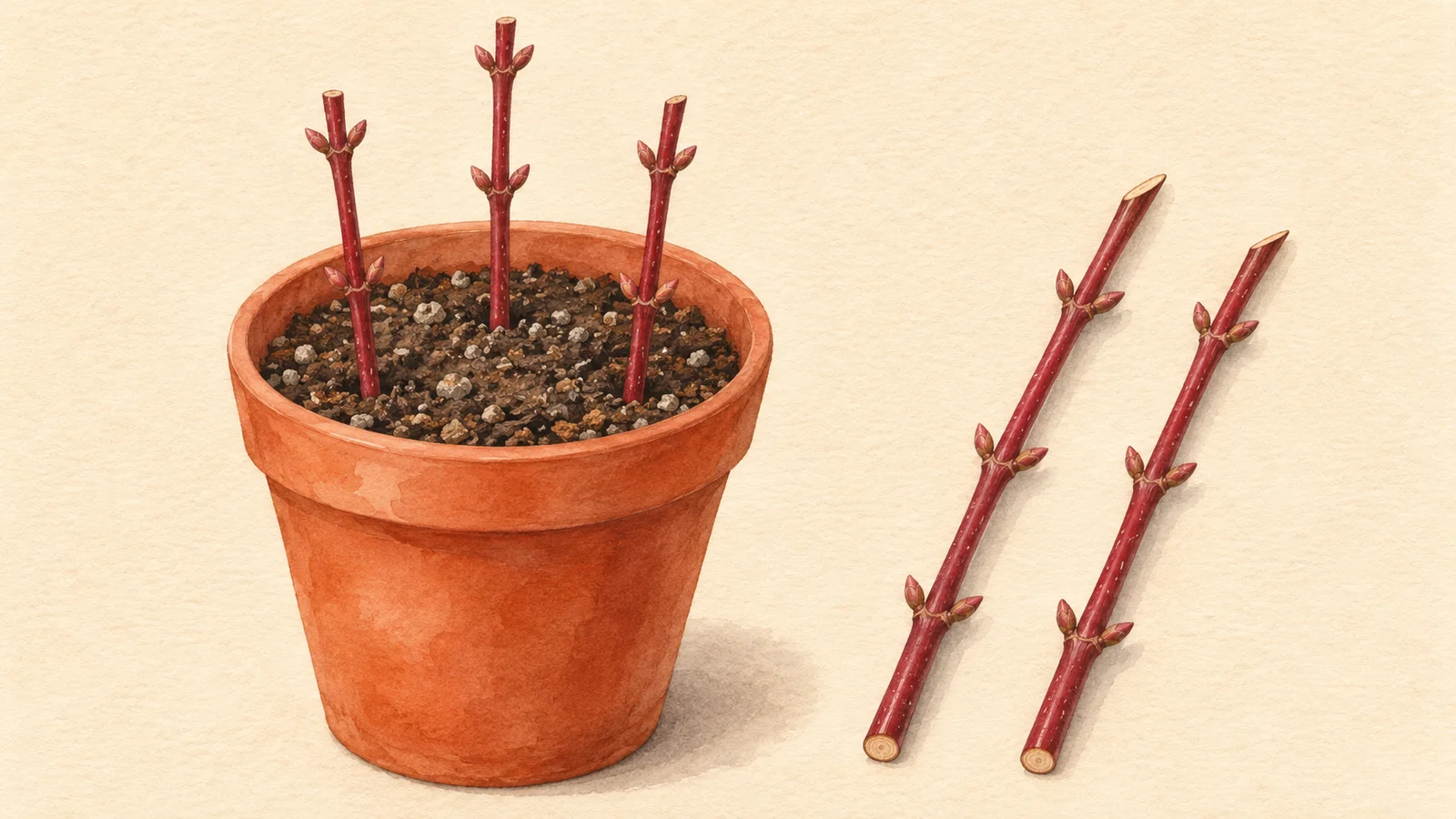
Bare red dogwood stems can look like sticks waiting for the compost pile. A healthy piece of last season’s growth, however, can become a new shrub. The work is small enough for a pot beside a cold frame: select the wood, keep its lower end pointing down and protect it while roots develop. The waiting takes much longer than the cutting.
This project is for red-twig or red-osier dogwood, Cornus sericea, also listed under the older name Cornus stolonifera. Identify your shrub before taking material. A flowering dogwood tree is a different propagation project; a red stem alone is not sufficient identification.
Decide where the new shrubs will go
NC State’s plant profile describes a multi-stemmed shrub that can reach 6–9 feet tall and wide and spread into a colony. It favors consistently moist soil and sun to partial shade. A successful cutting eventually needs that kind of room. One pot of cuttings is plenty when you are filling a gap in a border rather than planting a long hedge.
Take material from a healthy plant you own or have permission to use. Check its name and nursery tag first: some named cultivars have propagation restrictions, as Iowa State’s guidance notes. Keep the identity with the cuttings so that a future recipient knows what they are planting. Write the date and plant name on a durable label before your hands get wet.
Use dormancy as the starting signal
Wait until the leaves have fallen and the season’s shoots have hardened. Hardwood describes mature woody growth, not an old, thick branch. Choose sound shoots from the most recent growing season, avoiding weak growth, damaged bark or obvious pest injury.
The calendar depends on the winter. Iowa State recommends late February or early March for collecting hardwood material in Iowa. The RHS outdoor method allows the dormant period from autumn into late winter, avoiding severe frost. If your garden is already freezing hard and you lack a protected rooting space, leave the stems on the shrub and plan for late winter, before buds open. There is no benefit in making cuttings today if their pot will be stranded outside tomorrow.
Set up the pot, then cut
Have clean pruners, a label, water and a deep pot with drainage holes ready. Piedmont Master Gardeners emphasizes preparing the equipment before removing material so cuttings can be potted promptly. Clean used containers and use fresh rooting mix. The site’s pruning-tool guide can help with tool care.
Use an airy, moisture-holding medium, such as a coir-based mix containing coarse perlite. Wet it thoroughly and let it drain. A deep container gives the buried stem space without pushing its base into the persistently wet bottom of a shallow tray. Do not leave the pot standing in its drainage water.
For this deep-pot method, prepare sections about 6–8 inches long, with several pairs of buds. Remove soft tip growth. Make the lower cut straight across just below a bud pair and the upper cut at a slant above a bud pair. Those different cuts help you keep track of orientation when several pieces are on the bench.
If using rooting hormone, choose one labeled for woody cuttings and follow its directions. Pour a small working portion into a separate container; do not return used material to the original package. Purdue’s propagation guide explains this contamination precaution. More powder is not a substitute for sound wood and suitable moisture.
Make a hole in the mix, insert the flat end downward and settle the medium around it. Bury roughly two-thirds of the cutting while leaving healthy buds exposed. Space the stems so you can inspect each one. Water to settle the mix, drain the pot and put the label in immediately.
Shelter the pot without forgetting it
A sheltered cold frame is useful for this outdoor approach. Keep the pot away from drying wind and heavy rain, and check conditions inside the shelter rather than assuming the cover solves everything. A roof may keep rain out so effectively that the mix dries while the surrounding garden looks wet.
Oregon State’s fall-cutting guidance includes red-twig dogwood and calls for protection when freezing weather arrives. Its Oregon outdoor routine is not a promise that a small pot can survive any northern winter. Use a cool, protected, frost-free space during severe cold, or choose the later collection date suited to your region. Keep the mix moist, with open drainage, and remove fallen debris.
Avoid moving dormant cuttings into a hot living room simply to make something happen. Purdue explains that cool air helps delay leaf growth while roots are developing. Once leaves unfold, they increase the cutting’s water needs; a green shoot is encouraging, but it does not prove a useful root system has formed.
Give roots a growing season
Inspect the pot regularly without repeatedly pulling the stems out. In spring, look for sustained growth and, where visible, roots at drainage holes. A cutting that has collapsed or rotted needs removing; an intact dormant stem does not need discarding merely because its neighbor has opened a bud.
Plan to grow the cuttings on through summer. The RHS container approach leaves them sheltered until the following autumn. Keep checking moisture as leaves enlarge and weather warms. Before separating a plant, gently ease out the mix and confirm that it has roots, supporting them from below. Move rooted cuttings into individual pots and introduce more exposed conditions gradually.
Keep a small record of which stems rooted and where the pot spent winter. Next season, that is more useful than counting the leaves that appeared first. When a young shrub is ready for its permanent place, use the container-grown planting guide and allow for the mature clump, not just the small root ball in your hand.
Sources
- Cornus sericea (NC State Extension Gardener Plant Toolbox). Accessed November 13, 2026.
- Hardwood Cuttings (Royal Horticultural Society). Accessed November 13, 2026.
- Propagation of Trees, Shrubs, and Vines from Hardwood Cuttings (Iowa State University Extension and Outreach). Accessed November 13, 2026.
- Turn fall cuttings into free plants by spring (Oregon State University Extension Service). Accessed November 13, 2026.
- New Plants from Cuttings, HO-37-W (Purdue University Cooperative Extension Service). Accessed November 13, 2026.
- Creating New Plants From Cuttings (Piedmont Master Gardeners). Accessed November 13, 2026.